

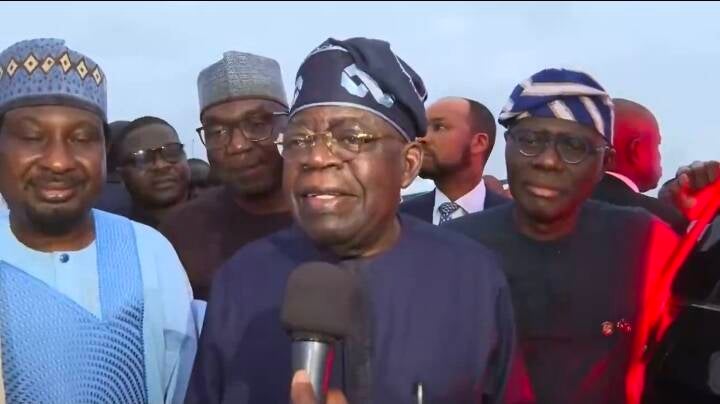
President Bola Tinubu has returned to Nigeria after a four-week working vacation in Europe, declaring himself healthy and ready to resume work as his administration confronts growing public pressure over the cost of living, insecurity and the delivery of promised economic reforms.
The president arrived at the Presidential Wing of the Murtala Muhammed International Airport in Lagos on Tuesday evening aboard the Nigerian Air Force One. His aircraft touched down at about 6:22pm after departing Paris, where he had spent part of his trip following an earlier stay in London.
Speaking briefly to journalists after his arrival, Tinubu said he had enjoyed the break and dismissed questions arising from public speculation about his health. “I enjoyed myself during my vacation,” he said. “I am back, ready to kick, ready to work and there is nothing wrong.”
He added that rumours were common in politics but insisted that the visible facts were clear. “The fact remains that I am here, healthy, sound and ready to go,” he said, signalling an effort by the presidency to draw a line under questions that intensified during his time abroad.
Tinubu left Nigeria on August 30 for what the presidency described as a three-week working vacation in the United Kingdom and France. The trip was subsequently extended by several days, with officials maintaining that the president remained engaged with government business while outside the country. His eventual return on September 29 meant he had spent about four weeks away.
The extension and uncertainty around the precise date of his return prompted widespread discussion on social media and criticism from political opponents, commentators and citizens already frustrated by Nigeria’s difficult economic climate. Some posts and online commentary questioned whether the president was unwell, while others focused on whether a leader should be away from the country for an extended period at a time of persistent security and economic challenges.
No evidence was made public to substantiate claims about illness, and the presidency repeatedly said Tinubu was in good health. On his return, the president directly addressed the issue, choosing to emphasise his fitness and readiness for work rather than give a detailed account of his medical condition or the online speculation.
His arrival comes at a politically sensitive time. Nigeria is approaching the 2027 general election, and Tinubu’s government is being judged not only on its reform agenda but also on whether ordinary households can feel improvements in their daily lives. Since taking office in 2023, his administration has removed the petrol subsidy and liberalised the foreign-exchange market, policies officials say were necessary to stabilise public finances and restore investor confidence.
The reforms have received support from international lenders and some investors, who argue that Nigeria needed to address long-standing distortions in its fuel, currency and fiscal systems. Government officials point to improved public revenues, a more flexible foreign-exchange market, and renewed investor interest as evidence that the policy changes are beginning to take effect.
Official economic data has also shown a faster pace of growth. Nigeria’s economy expanded by 4.43 per cent year-on-year in the second quarter of 2026, compared with 3.89 per cent in the first quarter, according to the National Bureau of Statistics. Higher oil output and stronger non-oil activity helped lift the figure, though the growth rate remains below the administration’s stated ambition of seven per cent annual growth by 2027.
For many Nigerians, however, the main question is whether these headline indicators will translate into lower prices, better-paid jobs and more secure livelihoods. Food, transport, rent and electricity costs remain a central concern for households, while businesses continue to contend with high borrowing costs, unreliable power supply and weak consumer purchasing power.
The government has acknowledged that macroeconomic stability alone is not enough. Finance officials have said they intend to track poverty, real income and inequality more closely in an effort to measure whether reform gains are being shared more widely. That pledge will now be judged against concrete outcomes, especially for workers, traders, young people and families whose incomes have not kept pace with living costs.
Security will also be a major test. Kidnappings, armed attacks and communal violence have continued in several parts of the country, leaving many communities fearful and disrupting farming, travel and local commerce. The government says military and security operations have made progress in some areas, but citizens expect a more sustained reduction in violence and stronger protection for vulnerable communities.
Tinubu’s return also places renewed attention on his cabinet and the speed of government decision-making. The president is expected to spend several days in Lagos before returning to Abuja, where he will resume the full schedule of federal government business. During his trip, he held discussions with French businessman Vincent Bolloré and executives of the Bolloré Group on possible investment in Nigeria’s creative and digital sectors, including film, entertainment and fibre-optic infrastructure.
Supporters of the administration will hope such meetings lead to investment, jobs and improved infrastructure. Critics will demand transparency about any agreements and insist that announcements be followed by projects that Nigerians can see and use.
At the airport, Speaker of the House of Representatives Tajudeen Abbas said he expected the president’s period of rest to result in increased activity by the administration. That expectation captures the mood surrounding Tinubu’s return: Nigerians are likely to measure the president less by the reassurance offered on arrival and more by the decisions, implementation and results that follow.
The president’s message was simple: he is back, healthy and ready to work. The country’s response is likely to be equally direct. Nigerians want tangible relief from hardship, credible security, accountable government and an economy in which the benefits of reform reach beyond official statistics.
📩 Stone Reporters News | 🌍 stonereportersnews.com
✉️ info@stonereportersnews.com | 📘 Facebook: Stone Reporters News | 🐦 X (Twitter): @StoneReportNew | 📸 Instagram: @stonereportersnews
Add comment
Comments