

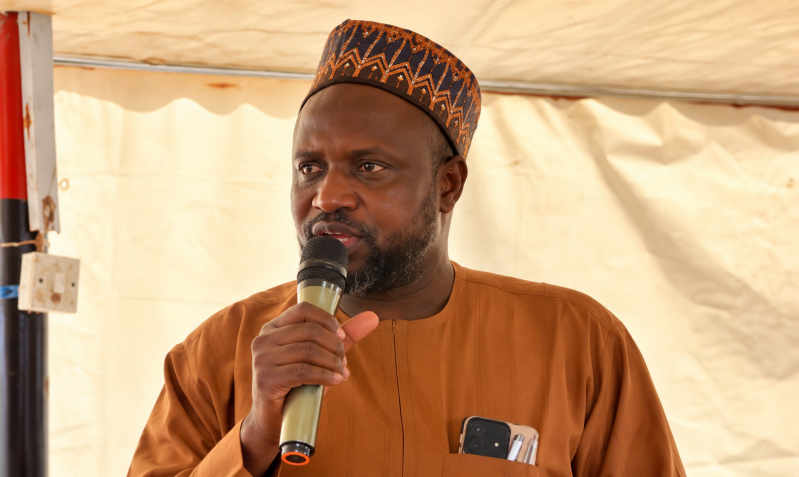
The Chairman of the Miyetti Allah Cattle Breeders Association of Nigeria, MACBAN, Barkin Ladi branch, Idris Saidu Adamu, has identified collective blame, civilian reprisals, identity-based killings and inflammatory social-media narratives as factors he believes are prolonging violence in Plateau State.
Adamu made the remarks during an interaction with journalists in Plateau State, arguing that sustainable peace would remain difficult if crimes committed by individuals continued to be automatically attributed to entire ethnic or religious communities.
“We are having criminals in all parts. Every tribe, every religion has criminals,” Adamu said.
His central argument was that responsibility for killings, kidnapping, cattle rustling, robbery and other crimes should be established through investigation, evidence and prosecution rather than assumptions based on the ethnic or religious identity of victims or suspected perpetrators.
Adamu particularly criticised situations in which civilians take the law into their own hands following an attack.
According to him, reprisals carried out before security agencies identify those responsible can turn individual criminal acts into wider communal conflicts, creating new victims who may have had no connection with the original offence.
He also alleged unequal community reactions when suspects are arrested.
“As far as the Fulani community in Plateau State is concerned, we have never protested the arrest of any criminal that was. In fact, we want the law to take its course on any criminal that is caught,” he said.
“But on the contrary, in the part of the natives and other tribes, when a criminal is caught, they will come out and protest that such a criminal should not be prosecuted.”
That allegation represents Adamu’s account and should not be treated as an established description of the behaviour of Plateau’s indigenous communities generally.
Stone Reporters News has not independently established that communities identified by Adamu routinely protest to prevent criminal suspects from being prosecuted.
His broader position, however, was that communal protection of suspected offenders can weaken accountability and encourage people to view criminal justice through ethnic identity.
Adamu also criticised what he described as the automatic attribution of unresolved crimes to Fulani people.
“If there is any ordinary incident that happens, be it a kidnapping, be it a robbery, anything, any criminality that everyone is capable of doing, if the suspect or the criminal is not caught, the final conclusion to the negative crimes is that it must have been committed by a Fulani,” he said.
He argued that such conclusions could transform what should begin as a criminal investigation into confrontation between communities.
Adamu cited the kidnapping and eventual killing of Defwan Dariye, father of former Plateau State Governor Joshua Dariye, as an example of the dangers of reaching conclusions about perpetrators before investigations are completed.
Defwan Dariye was abducted from his home in Mushere, Bokkos Local Government Area, in June 2020.
Police announced in September 2021 that eight suspects had been arrested over the kidnapping and killing.
Then Force Public Relations Officer Frank Mba said the suspects included people from communities around Mushere and Bokkos. Police identified Jethron Ngusen as the alleged mastermind and said the group included Ya’u Saidu, who was described in reporting as a Fulani accomplice.
The case subsequently became an example used by Plateau officials and community organisations to argue against automatically attaching criminality to an ethnic or religious group.
Former Plateau State Commissioner Yakubu Dati said at the time that the investigation demonstrated why criminal responsibility should be separated from ethnic and religious profiling, noting that the suspects came from different backgrounds.
Adamu’s concerns about inflammatory information also come against documented evidence that social media can worsen tensions in Plateau.
A Premium Times investigation published in August examined violence between February and April 2026 and found that misinformation, graphic material and inflammatory narratives circulated through social media during periods of reprisal violence.
The investigation documented how unverified claims could influence public perceptions of attacks before the identities of perpetrators had been established.
That does not mean social media is the primary cause of Plateau’s conflict.
Violence in the state has developed over decades and involves overlapping disputes concerning land, farming and grazing, political representation, ethnicity, religion, displacement, criminality and failures of security and justice.
Communities on different sides have also accused authorities of failing to protect them or treating victims unequally.
A recent Foundation for Investigative Journalism investigation found deep distrust of government security responses among residents interviewed in Bokkos, Barkin Ladi, Mangu, Riyom and Jos North.
Both Fulani residents and members of indigenous communities interviewed for the report described themselves as victims and accused authorities of failing to adequately protect them.
Adamu also raised concerns about what he described as unequal treatment of displaced communities.
Displacement has become one of the most serious consequences of Plateau’s repeated violence.
People from farming and herding communities have lost homes, farmland, livestock and access to communities following attacks and reprisals.
The competing claims surrounding abandoned land and displaced populations have themselves become politically sensitive, making transparent documentation and safe return arrangements important to any lasting settlement.
Previous peace efforts involving farmers and Fulani communities have recognised the need for cooperation.
In 2024, leaders from affected Plateau communities agreed to establish local peace mechanisms involving farmers and herders, discourage cattle rustling and destruction of crops and expose criminal elements rather than shelter them.
Adamu himself was reported among youth leaders participating in those discussions, where participants pledged cooperation with government and security agencies and support for the return of internally displaced people.
The challenge has been translating such agreements into lasting security.
Only days before Adamu’s latest remarks, three local vigilantes, including a youth leader, were killed during an attack in Kassa community in Barkin Ladi Local Government Area.
Women and youths subsequently blocked the Jos-Barkin Ladi-Mangu highway in protest, demanding stronger security.
The Plateau State Government condemned the killings and said security agencies were working to identify and apprehend those responsible.
The incident illustrates both the importance and complications surrounding civilian security structures in Plateau.
Local vigilantes frequently provide protection in communities where residents believe conventional security forces cannot respond quickly enough.
Some vigilante initiatives in Barkin Ladi have historically included members from different ethnic and religious communities and have worked alongside formal security agencies.
But armed or identity-based civilian groups can also become dangerous if community protection develops into retaliation against people based on ethnicity rather than evidence against individual suspects.
Research on Barkin Ladi has documented both sides of that reality: vigilantes have sometimes helped mediate disputes and provide community security, while the absence of reliable state protection and justice creates conditions in which communities increasingly rely on themselves.
Adamu’s remarks therefore raise a broader question for Plateau: how should communities respond immediately after an attack when perpetrators have not been identified?
Treating every member of an ethnic community as responsible for the actions of unidentified gunmen risks creating a cycle in which one unresolved killing produces retaliatory violence against another community, which then becomes justification for another reprisal.
At the same time, communities that have repeatedly suffered attacks have legitimate demands for protection, investigation, arrests and prosecution.
Calling for an end to collective blame should therefore not mean ignoring credible evidence where investigators establish that particular individuals or armed groups were responsible.
The standard should remain the same regardless of the identity of the suspect or victim: investigate the offence, identify those responsible, preserve evidence and prosecute individuals against whom sufficient evidence exists.
Adamu’s claims about protests against prosecutions, unequal treatment of displaced Fulani communities and particular incidents involving other groups require independent examination rather than automatic acceptance because they come from one party within a deeply contested conflict.
His broader warning about ethnic attribution, however, reflects a principle important to criminal justice: responsibility for a crime belongs to those who committed, assisted or planned it and cannot fairly be transferred to an entire ethnic or religious population without evidence.
For Plateau communities, where decades of violence have produced profound distrust, that distinction may be particularly important.
Peace will require accountability for attacks regardless of who commits them, protection for threatened communities regardless of their identity, safe and lawful solutions for displaced people and restraint from community leaders and social-media users when the perpetrators of an incident have not yet been established.
Adamu’s message is that Plateau cannot break its cycle of violence while criminal responsibility continues to be determined first by identity and only later by evidence.
Whether government and communities can consistently apply the opposite principle — evidence first, identity second — remains one of the central challenges confronting efforts to restore lasting peace in the state.
📩 Stone Reporters News | 🌍 stonereportersnews.com
✉️ info@stonereportersnews.com | 📘 Facebook: Stone Reporters News | 🐦 X (Twitter): @StoneReportNew | 📸 Instagram: @stonereportersnews
Add comment
Comments