

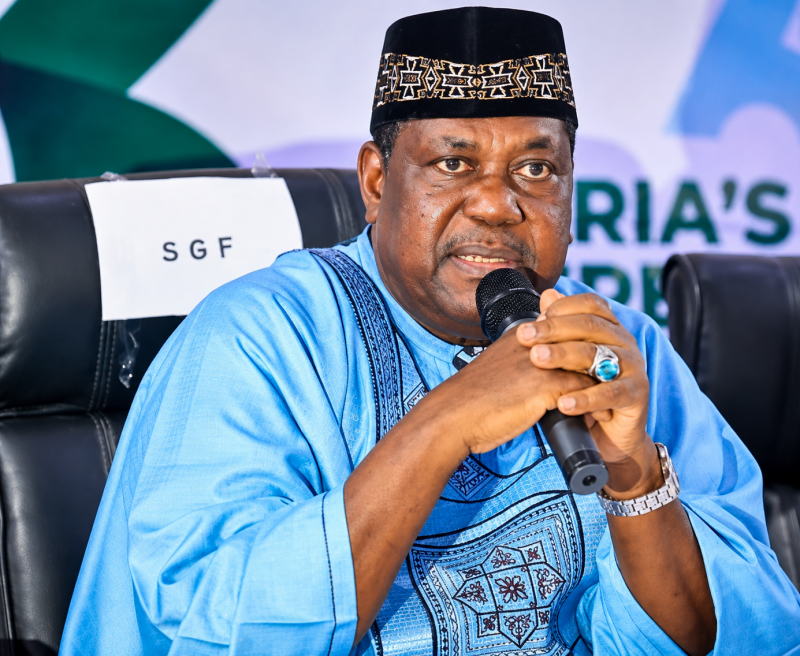
The Federal Government has ruled out returning Nigeria to the petrol subsidy regime, maintaining that the economic reforms introduced by President Bola Tinubu were necessary to prevent the country from sliding towards economic collapse.
Secretary to the Government of the Federation, Senator George Akume, stated this on Wednesday, September 30, 2026, in Abuja while speaking at the 66th Independence Anniversary Lecture organised as part of activities marking Nigeria’s October 1 Independence anniversary.
Akume said the Tinubu administration would continue with its economic reform programme rather than reverse the decision to remove petrol subsidy.
“We will not return to the ruinous petroleum subsidy regime of the past,” the SGF declared.
According to Akume, the administration inherited serious economic challenges when it assumed office in 2023 and consequently introduced major policy changes, including the removal of petrol subsidy, changes to the foreign-exchange market and tax and fiscal reforms.
“This administration took office in 2023 and immediately took bold decisions needed to save the nation from imminent collapse,” Akume said.
He described the measures as difficult but necessary decisions intended to restore economic stability.
“These were difficult decisions, but necessary to rebuild stability and we have started enjoying the results,” he added.
President Tinubu announced the end of the petrol subsidy during his inauguration on May 29, 2023.
The decision was followed by significant increases in petrol prices and transportation costs, making subsidy removal one of the most debated economic policies of the administration.
The government's latest position comes as fuel subsidy has again become an important political issue ahead of the 2027 presidential election.
Former Vice President and African Democratic Congress presidential candidate Atiku Abubakar has said he would restore subsidy if elected, although his campaign has described its proposal as a targeted arrangement rather than simply returning Nigeria to the previous subsidy structure.
The proposal has generated responses from members of the Tinubu administration and the ruling All Progressives Congress, with government officials defending the 2023 removal.
Akume's statement at the Independence lecture makes the Federal Government's current position clear: the Tinubu administration does not intend to return to the previous petrol subsidy regime.
The SGF also presented economic figures which he said showed that some of the government's reforms were producing results.
Citing World Bank figures, Akume said Nigeria's real Gross Domestic Product grew by 4.2 per cent in the first half of 2026, compared with 3.9 per cent during the corresponding period a year earlier.
He acknowledged, however, that economic growth still needed to translate into improved conditions for ordinary Nigerians.
“The task before us now is to ensure that growth translates into jobs and higher incomes for all Nigerians,” Akume said.
Beyond petrol subsidy removal, Akume highlighted the government's promotion of Compressed Natural Gas as an alternative source of fuel for transportation.
According to figures presented by the SGF, more than 120,000 vehicles have been converted to CNG across Nigeria.
He said more than 400 conversion centres and 90 CNG fuelling stations were operating nationwide.
Akume said the government believes increasing the use of natural gas can reduce transportation costs without restoring petrol subsidy.
He also said CNG-powered buses were transporting passengers at fares below those charged by petrol-powered buses.
The government has been promoting CNG following the removal of petrol subsidy as part of measures intended to reduce Nigeria's dependence on petrol for road transportation.
At the Independence lecture, Akume also listed infrastructure development as an area where the administration believes its reforms and investments are producing results.
He cited the Lagos-Calabar Coastal Highway, Abuja-Kano highway, East-West Road, rail modernisation and port reforms among projects expected to improve transportation, connectivity and economic activity.
The SGF said the administration had also taken measures in the power sector through increased investment, improvements in transmission and billing, and efforts to clear legacy debts.
Agriculture and food security also featured in his address.
Akume disclosed that the World Bank had approved a $500 million credit for the Nigeria Sustainable Agricultural Value-Chains for Growth project, known as AGROW.
He said the initiative was intended to increase productivity among smallholder farmers, strengthen agricultural value chains and improve food and nutrition security.
The government is also supporting mechanisation, irrigation, fertiliser, improved seeds, storage facilities and local agricultural processing, according to the SGF.
Akume further addressed education, health, social protection and security as part of the government's wider programme.
He said the Nigerian Education Loan Fund had been expanded to help students finance university and vocational education, while technical and vocational institutions were being strengthened to provide skills required by industries.
On healthcare, he said the administration was equipping primary healthcare centres and expanding social intervention programmes for vulnerable households.
Minister of Information and National Orientation Mohammed Idris, who also spoke at the event, said Nigeria's economy recorded 4.43 per cent growth in the second quarter of 2026.
Idris acknowledged that reforms implemented over the previous three years had required sacrifice and patience from Nigerians.
He said domestic refining capacity was expanding and investment was returning to important sectors of the economy.
The government officials' assessment comes against the continuing impact of economic reforms on households.
The removal of petrol subsidy and changes in the foreign-exchange market significantly altered prices and business costs after 2023, while the government has maintained that the reforms were necessary to address structural economic problems.
Akume's declaration means the Federal Government is choosing to address transportation costs through measures such as CNG expansion rather than restoring the previous petrol subsidy arrangement.
His statement is also significant because of the renewed political debate surrounding subsidy ahead of 2027.
The Tinubu administration's position is that returning to the old arrangement would reverse an important component of its economic reforms.
Opposition figures advocating some form of subsidy restoration have instead focused on the effect of fuel costs on households and questioned how savings resulting from the policy have benefited Nigerians.
Those competing positions are expected to remain part of the economic debate approaching the next general election.
For the Federal Government, however, Wednesday's Independence Anniversary Lecture left little ambiguity about its own policy.
Akume said the administration considers the decisions taken since 2023 difficult but necessary and intends to consolidate rather than reverse them.
The government's immediate challenge, which the SGF himself acknowledged, is ensuring that improvements recorded in headline economic indicators produce jobs, increased incomes and improvements that Nigerians experience directly.
As Nigeria marks 66 years of independence, the administration is therefore presenting continued economic reform, infrastructure investment, CNG expansion, agricultural development and social programmes as its preferred path towards economic stability.
On petrol subsidy specifically, Akume's message was definite: the Federal Government will not return Nigeria to the previous subsidy regime.
📩 Stone Reporters News | 🌍 stonereportersnews.com
✉️ info@stonereportersnews.com | 📘 Facebook: Stone Reporters News | 🐦 X (Twitter): @StoneReportNew | 📸 Instagram: @stonereportersnews
Add comment
Comments