

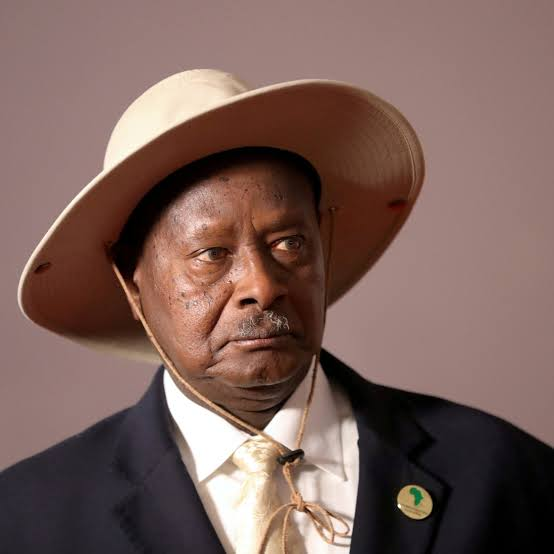
Ugandan President Yoweri Museveni has criticised generations of African leaders for failing to properly study what is required to develop their countries, saying the continent has suffered decades of economic losses from exporting raw materials instead of processing them locally.
Museveni made the remarks on Wednesday, September 30, 2026, in Lamu, Kenya, during the groundbreaking ceremony for the Dangote East Africa Petroleum Refinery, a major industrial project being developed by Nigerian businessman Aliko Dangote.
“I am very happy to be alive to see the betrayal of Africa, which has been going on for the last 70 years, coming to an end,” Museveni said.
“Africa has been betrayed by leaders who refuse to study to know what it requires to develop a country.”
The Ugandan president linked what he described as Africa’s “betrayal” to the continent’s continued dependence on exporting raw commodities while much of the processing, manufacturing and value addition takes place outside Africa.
Museveni said African countries could not continue exporting unprocessed resources while expecting to create enough jobs and wealth for their populations.
“We cannot continue to export unprocessed raw materials; we have to utilise our resources maximally and become the producers,” he said.
His remarks formed part of a broader argument for industrialisation, local production and stronger economic integration among African countries.
Museveni said Africa loses employment opportunities and significant economic value when commodities produced on the continent are exported in raw form and processed elsewhere.
He used commodities including coffee and cotton to illustrate his argument.
Uganda is one of Africa’s major coffee-producing countries, but Museveni has repeatedly argued that coffee-producing nations receive only a fraction of the money generated throughout the global coffee industry because much of the roasting, processing, packaging, branding and retailing takes place outside producing countries.
Under that system, African farmers and exporting countries receive revenue from the raw commodity, while businesses elsewhere capture additional value during processing and sale to consumers.
Museveni said the same problem affects other African commodities and natural resources.
He argued that processing resources locally would allow African economies to create employment at different stages of production rather than exporting those opportunities alongside their raw materials.
For cotton, for example, economic activity can extend beyond farming into ginning, spinning, weaving, textile production and garment manufacturing.
Museveni’s position is that when those processes take place outside Africa, the jobs and additional income associated with them also leave the continent.
The Ugandan leader therefore welcomed the Dangote refinery project in Kenya as part of what he described as a changing approach to African industrial development.
The planned Dangote East Africa Petroleum Refinery is expected to be built in Lamu and designed to process about 700,000 barrels of crude oil per day.
Reports from the groundbreaking ceremony put the investment at approximately $16 billion, with construction expected to take about 40 months.
The project is intended to produce refined petroleum products for Kenya and the wider East African market.
Museveni said projects of that nature could help African countries move away from exporting resources and importing finished products.
He also praised Dangote’s shift over the years from trading and importing products towards large-scale manufacturing and industrial production.
Dangote has developed major industrial investments across Africa, including cement manufacturing and petroleum refining.
His Dangote Petroleum Refinery in Lagos, Nigeria, has a processing capacity of about 650,000 barrels per day and was developed partly to reduce dependence on imported refined petroleum products.
The proposed Lamu refinery represents a further expansion of the group’s petroleum refining operations into East Africa.
Museveni said he supported the Lamu project but clarified that Uganda was not immediately committing investment funds to it.
Uganda is already pursuing separate petroleum projects, including plans connected with its oil resources and regional energy arrangements involving Tanzania.
Museveni said he wanted clarification about existing arrangements before Uganda considered whether to invest in the Lamu project.
“I support this project, but I will not invest here,” he said, explaining that he first wanted to examine Uganda’s existing energy commitments.
His reservation about immediate Ugandan investment did not prevent him from strongly endorsing the industrial principle behind the refinery.
Museveni said Africa needed to become a producer of finished goods rather than remaining primarily a supplier of raw materials to industrialised economies.
He also connected industrial development with employment.
According to Museveni, major African industrial projects should not only attract capital but should create opportunities for citizens across national borders.
He specifically raised the question of whether Ugandans and other East Africans would be able to obtain employment from large regional projects.
Museveni argued that simply allowing East African companies to purchase shares in projects would not fully address the employment issue.
“We need to wake up and maximise our future and allow our citizens to work in any African country,” he said.
His comments also returned attention to his long-standing support for deeper East African integration.
Museveni argued that political and economic integration would create larger markets, allow resources to move more efficiently and provide industries with the scale necessary to compete internationally.
The East African Community currently brings together several countries pursuing greater economic cooperation and movement of people, goods and services.
Museveni has for years advocated deeper political integration among member states.
At the Lamu event, he linked that integration directly to industrialisation and employment, arguing that major investments should benefit people throughout the region rather than being viewed solely through individual national boundaries.
His statement that African leaders had “betrayed” the continent was therefore made within a specific economic argument.
Museveni was not announcing the end of a particular political dispute or accusing a named current African government of betrayal.
He was criticising what he described as a decades-long failure by African leadership to sufficiently understand and pursue industrialisation, value addition and local processing of the continent’s resources.
His argument was that exporting raw materials deprived African countries of jobs and revenue that could have been retained through domestic and regional processing.
Museveni said the development of major African-owned industries showed that this pattern could begin to change.
“I am very happy that Africa is now waking up to be front runners in exporting finished products,” he said.
The Ugandan president’s remarks also reflected an argument he has advanced repeatedly during his decades in office: that Africa’s natural-resource wealth will not automatically translate into prosperity unless governments build industries capable of turning those resources into higher-value products.
His comments in Kenya placed responsibility partly on African political leadership.
According to Museveni, the problem was not simply that Africa lacked resources, but that leaders had failed to adequately study and implement the economic structures necessary to transform those resources into industrial development.
The Lamu refinery groundbreaking consequently became the setting for a wider message from the Ugandan president about Africa’s economic direction.
Museveni presented the refinery not merely as a Kenyan petroleum project but as an example of the type of large-scale African industrial investment he believes the continent requires.
His message centred on three areas: processing African resources within Africa, creating employment through industrialisation and strengthening regional integration so that African industries have larger markets.
For Museveni, the development of industries capable of turning African raw materials into finished products represents a move away from the economic model he criticised.
“I am very happy to be alive to see the betrayal of Africa, which has been going on for the last 70 years, coming to an end,” he said.
The Ugandan leader maintained that African countries must now maximise their resources, build industries and create employment from the commodities and natural wealth already available across the continent.
📩 Stone Reporters News | 🌍 stonereportersnews.com
✉️ info@stonereportersnews.com | 📘 Facebook: Stone Reporters News | 🐦 X (Twitter): @StoneReportNew | 📸 Instagram: @stonereportersnews
Add comment
Comments