

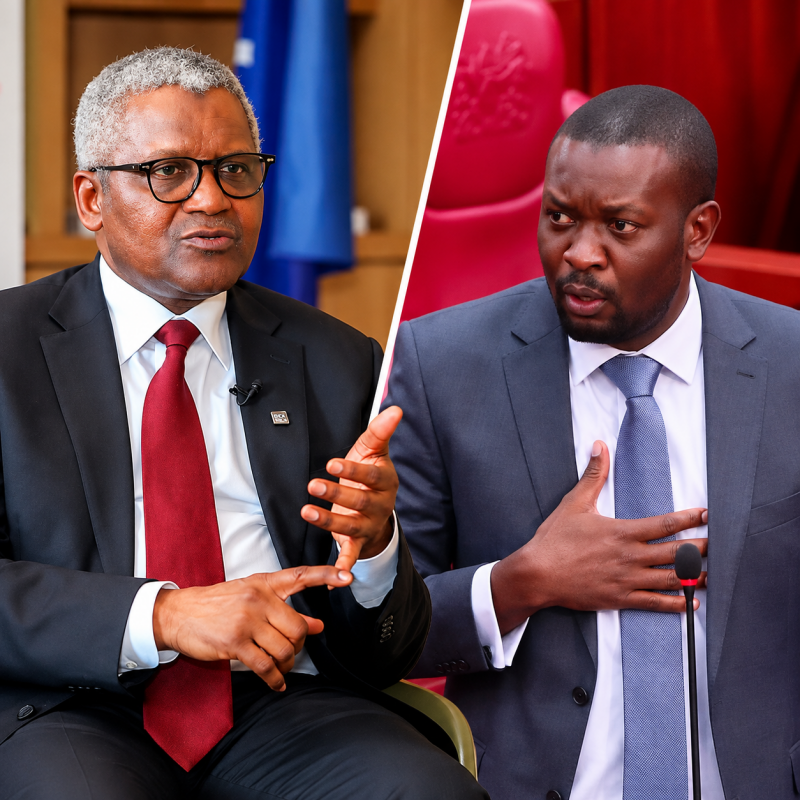
Kenyan Senator Edwin Sifuna has criticised Nigerian billionaire Aliko Dangote over comments directed at opponents of his planned $16 billion oil refinery in Lamu, insisting that investors must respect Kenyans and the constitutional processes governing major projects in the country.
Sifuna, who represents Nairobi and serves as Deputy Minority Leader in the Senate, made the remarks on Wednesday, September 30, 2026, as lawmakers debated issues surrounding the Dangote East Africa Petroleum Refinery being developed in Lamu County.
The senator said he had heard Dangote make comments suggesting that he was prepared to confront people challenging the refinery project.
“The investor himself, I have heard him say that really even if you have problems with the project, he will deal with you. You cannot speak to us like that if you want to invest in our country. We have values,” Sifuna said.
Sifuna’s criticism followed comments Dangote made during the groundbreaking ceremony for the refinery in Lamu.
Addressing legal opposition to the project, Dangote said his company was not frightened by people going to court and indicated that he was prepared for challenges from those opposed to the development.
“We are not really scared about people taking us to court,” Dangote said, before adding that anyone prepared for a struggle would face one from him.
Sifuna objected to the tone of those remarks and argued that concerns raised by Kenyans about a major investment should be answered rather than dismissed.
“There is nothing wrong with explaining things to our people,” the senator said.
He questioned why citizens affected by the project should not receive adequate information about what was being developed and the commitments undertaken by the Kenyan government.
Sifuna’s concerns extended beyond Dangote’s remarks.
The senator told Parliament that lawmakers had not been shown the agreement governing the massive refinery project.
“None of us has seen the agreement on that refinery. None of us knows the commitments that this country has given in order for that refinery to be built,” he said.
He argued that a project of such scale should comply with Kenya’s constitutional requirements, including public participation and appropriate parliamentary oversight.
Sifuna also drew attention to residents of Lamu who have challenged aspects of the project in court.
“Our own people are actually in court and they are crying out for help from their leaders,” he said.
According to the senator, the economic size of the proposed investment should not prevent legitimate questions from being raised about how the project is being implemented.
His comments came as President William Ruto joined several African leaders and Dangote for the groundbreaking ceremony of the proposed refinery.
Ugandan President Yoweri Museveni and Ethiopian Prime Minister Abiy Ahmed were among the African leaders attending the event, alongside other regional dignitaries.
The refinery is planned for Lamu County and is expected to process approximately 700,000 barrels of crude oil per day when completed.
The estimated investment is about $16 billion, making it one of the largest proposed private industrial investments in East Africa.
The facility is intended to produce petrol, diesel and aviation fuel for Kenya and other markets in East and Central Africa.
Dangote has said the project is expected to take approximately 40 months to complete.
The refinery is also expected to form part of a wider industrial development around Lamu, with Dangote saying the project could attract additional businesses and manufacturing investments.
The billionaire has separately said the planned complex could generate as much as 1,000 megawatts of electricity, with about 500 megawatts potentially available for sale to the Kenyan government.
However, the project has already encountered legal challenges.
A Kenyan court ordered the maintenance of the status quo after 133 residents brought a case involving land claims connected with the refinery development.
The petitioners raised concerns over ancestral land, compensation and environmental assessment.
The legal proceedings have not permanently stopped the refinery project, but the court dispute could affect activities at the site while the case proceeds.
Dangote has maintained that the investment will proceed.
The businessman has presented the refinery as part of a broader strategy to expand African-owned industrial capacity and reduce the continent’s dependence on imported refined petroleum products.
The project also has the support of President Ruto’s administration.
Ruto has encouraged Kenyan participation in the refinery and said ordinary citizens could eventually have an opportunity to invest through share ownership.
Kenya has been allocated the possibility of acquiring a stake in the project, while regional governments have also been offered opportunities to participate.
Despite that support, the project has generated debate within Kenya’s Parliament.
Government-allied lawmakers have described the refinery as a major investment capable of creating jobs and strengthening Kenya’s position as an industrial and energy hub.
Opposition lawmakers, including Sifuna, have said they want greater transparency concerning the agreements behind the development, environmental safeguards, public participation and the effect on local communities.
Tetu MP Geoffrey Wandeto also raised questions about whether construction of the refinery would eventually lead to cheaper petroleum products for Kenyan consumers.
He questioned the speed at which the project was progressing and called for lawmakers to be given an opportunity to examine the relevant details.
Other legislators defended the development.
Molo MP Kimani Kuria argued that attention should be placed on implementing the investment, while nominated MP Irene Mayaka described it as an opportunity Kenya should welcome.
The disagreement in Parliament therefore centres not only on whether Kenya should attract major industrial investment, but also on the process through which such investments are approved and implemented.
Sifuna made clear that his criticism was not simply opposition to development.
His position was that investment must be conducted within Kenya’s constitutional framework and that citizens affected by major projects should receive information and explanations.
“If you want to invest in our country, we have values,” Sifuna said.
He maintained that concerns raised by residents should be addressed respectfully rather than treated as an obstacle to the project.
Dangote, meanwhile, has continued to promote the refinery as a major African industrial project.
The businessman has said African countries need to process more of their natural resources on the continent rather than exporting raw materials and importing finished products.
The Lamu refinery is intended to serve that strategy by refining crude oil for the East African market.
The project is also expected to source crude from regional and international suppliers.
Its development has attracted international industrial partners, with Honeywell Technologies agreeing to provide engineering services, technology licensing and equipment for the refinery.
The disagreement between Sifuna and Dangote has now added a political dimension to the questions surrounding the project.
For Sifuna, the size of Dangote’s investment does not remove the obligation to explain the project to Kenyans or address legitimate concerns raised through the courts and political institutions.
For Dangote, the legal challenges have not changed his stated intention to proceed with the refinery, although his company has acknowledged that court proceedings could affect some activities at the site.
The $16 billion refinery has therefore moved beyond its groundbreaking ceremony into a wider Kenyan debate involving investment, land rights, environmental concerns, parliamentary scrutiny and the treatment of communities affected by large-scale development.
Sifuna’s message to Dangote was that foreign investment is welcome, but investors operating in Kenya are expected to respect the country’s laws, institutions and citizens.
“You cannot speak to us like that if you want to invest in our country,” the senator said. “We have values.”
📩 Stone Reporters News | 🌍 stonereportersnews.com
✉️ info@stonereportersnews.com | 📘 Facebook: Stone Reporters News | 🐦 X (Twitter): @StoneReportNew | 📸 Instagram: @stonereportersnews
Add comment
Comments