

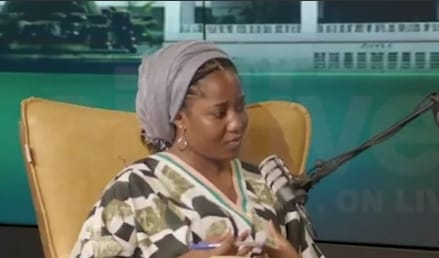
Human rights advocate and founder of the Hassana Maina Foundation, Hassana Maina, has questioned what Nigerians are celebrating on Independence Day, saying insecurity, displacement and other difficulties confronting citizens have left many people feeling like victims of the country's governance failures.
Maina made the remarks on Thursday, October 1, 2026, as Nigeria marked its 66th Independence Anniversary, using the occasion to draw attention to Nigerians affected by insecurity and other challenges across the country.
“We have become the victims of Nigeria bad governance. What are we celebrating independence for?” Maina said in her Independence Day message.
Her statement was a criticism of the condition of the country and the experiences of Nigerians who continue to live with insecurity, poverty and displacement.
Maina, who has been involved in advocacy for victims of violence and insecurity, argued that Independence Day celebrations should also provide an opportunity to examine whether ordinary Nigerians are experiencing the freedom, security and dignity associated with independence.
Her remarks came as political leaders, civil society figures and other Nigerians issued different assessments of the country's progress since independence on October 1, 1960.
Maina's message focused particularly on Nigerians whose lives have been disrupted by insecurity.
She questioned the meaning of independence to families who have lost relatives, people who have been displaced from their communities and citizens who continue to live under the threat of attacks and abductions.
Her comments reflect her assessment of Nigeria's governance and security situation and should not be read as an official finding about the performance of any particular administration.
Nigeria continues to face security challenges in several parts of the country, including terrorism and insurgency in the North-East, banditry and kidnapping in parts of the North-West and North-Central, as well as other forms of violent crime.
Security forces have continued military and police operations against armed groups, with authorities regularly reporting arrests, rescue operations and the killing of terrorists and other armed suspects.
Maina's argument, however, was centred on the human impact of insecurity and the conditions under which victims are expected to participate in national celebrations.
Her question — “What are we celebrating independence for?” — was directed at the gap she believes exists between the symbolic celebration of political independence and the realities confronting many Nigerians.
Nigeria gained independence from British colonial rule on October 1, 1960, becoming a republic three years later in 1963.
The country has since experienced periods of civilian government and military rule before returning to uninterrupted democratic government in 1999.
Independence Day is traditionally marked with presidential addresses, official ceremonies, prayers and messages from political leaders, former officeholders, organisations and citizens.
This year's anniversary has similarly produced contrasting assessments of Nigeria's condition.
President Bola Ahmed Tinubu, in his nationwide Independence Day address on Thursday, acknowledged that millions of Nigerians continue to face economic difficulties but argued that reforms introduced by his administration were beginning to strengthen the country's economy.
Tinubu said Nigeria had gone through difficult adjustments since his administration assumed office in May 2023 and declared that the country was moving from an “age of reform” towards an “age of prosperity.”
“We cannot erase in four years what accumulated over generations. But we can change its course,” Tinubu said.
The President also said his administration's priority was to reduce the cost of living and ensure that improvements in economic indicators translate into better conditions for Nigerians.
Maina's Independence Day message presented a markedly different perspective by focusing on citizens who remain affected by insecurity and governance problems.
Her remarks were not limited to economic indicators or government programmes but raised the broader question of what national independence means to citizens whose fundamental concerns remain personal safety and survival.
For communities affected by terrorism, banditry and kidnapping, insecurity has resulted in deaths, abductions and displacement over the years.
Women and children have also been among those affected by attacks and displacement.
The Federal Government, state governments and security agencies have repeatedly said operations are underway to combat armed groups and restore security to affected communities.
On October 1 itself, the military announced fresh counter-terrorism operations in Adamawa State in which troops killed 16 terrorists during a ground ambush and recovered weapons.
Three Nigerian soldiers were also killed while troops repelled separate attacks against military positions at Garkida and Garaha.
Such operations demonstrate the continuing security confrontation between Nigerian forces and armed groups in parts of the country.
Maina's message, however, focused on the people living with the consequences of those conflicts.
Through the Hassana Maina Foundation, she has been associated with advocacy concerning human rights, insecurity and support for vulnerable people.
Her Independence Day intervention therefore centred on accountability and the responsibility of government to protect citizens.
The Nigerian Constitution places the security and welfare of the people among the primary purposes of government.
Maina's comments effectively measured the meaning of independence against that responsibility, arguing that national celebrations should not overshadow the experiences of people who do not feel adequately protected.
Her use of the phrase “victims of Nigeria bad governance” represents her assessment of the country's leadership and governance record.
It does not mean that every challenge confronting Nigeria can be attributed to a single government or administration.
President Tinubu, for example, used his own October 1 address to argue that many of Nigeria's current economic problems accumulated over decades.
He said his government had chosen difficult reforms rather than continuing policies it considered unsustainable.
Opposition politicians and civil society voices have challenged aspects of that assessment, particularly over the cost of living, insecurity and the impact of government policies on ordinary households.
The different Independence Day messages consequently demonstrate the wider national debate about how Nigeria should measure progress 66 years after independence.
Government officials have pointed to economic reforms, infrastructure, security operations and institutional programmes as evidence of progress.
Critics and advocates have instead drawn attention to poverty, insecurity, unemployment, displacement and the daily experiences of ordinary citizens.
Maina placed herself firmly within the latter conversation.
Her message was that Independence Day should not only commemorate Nigeria's liberation from colonial rule but should also compel leaders and citizens to examine the quality of freedom Nigerians experience today.
For people living peacefully and participating in economic and social life, October 1 may remain a moment of national pride and reflection.
For victims of violence and families waiting for abducted relatives to return, Maina argued that the meaning of the celebration can be very different.
Her statement therefore challenged Nigerian leaders to look beyond ceremonial celebrations and consider the experiences of citizens whose immediate concerns remain security, justice and survival.
As Nigeria enters its 67th year as an independent country, Maina's Independence Day question was direct:
“We have become the victims of Nigeria bad governance. What are we celebrating independence for?”
The statement represents her call for national reflection on whether political independence has translated into the security, accountable governance and quality of life Nigerians expect from their country.
📩 Stone Reporters News | 🌍 stonereportersnews.com
✉️ info@stonereportersnews.com | 📘 Facebook: Stone Reporters News | 🐦 X (Twitter): @StoneReportNew | 📸 Instagram: @stonereportersnews
Add comment
Comments