

Reported by: Ijeoma G | Edited by: Oravbiere Osayomore Promise.
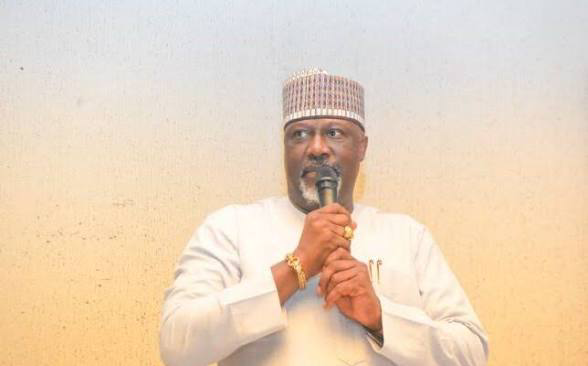
Former Kogi West Senator Dino Melaye has launched a scathing attack on President Bola Tinubu over his 66th Independence Anniversary broadcast, accusing the President of relegating the country's deteriorating security crisis to a footnote while more than 1,000 Nigerians remain in the captivity of terrorists and bandits across the country. Melaye, a chieftain of the African Democratic Congress, made the allegation in a post on his official X handle on Friday, October 2, 2026, describing the President's handling of insecurity in the speech as a "pity" and a "shame". "President Tinubu omitted the most critical issue of insecurity in his Independence Day broadcast, mentioned insecurity only once, when over 1,000 Nigerians are in the hands of their abductors as we speak," Melaye wrote. "Farmers cannot go to farms. Innocent souls being killed on a daily basis. It is a pity. It is a shame".
The former lawmaker's criticism came a day after President Tinubu delivered a nationwide broadcast to mark Nigeria's 66th Independence Anniversary, in which he devoted significant portions of the address to defending his economic reforms and outlining a vision for prosperity. Tinubu framed Nigeria's pre-2023 condition as that of a cancer patient who had been given morphine to dull the pain rather than treated for the disease, saying his administration had chosen to excise the cancer through difficult reforms. "Three and a half years later, the evidence that Nigeria's economic outlook has improved is undeniable," Tinubu said. "Our economy has grown by over 4 per cent this year. Both oil and non-oil sectors have contributed to the renewed period of stable growth. Oil theft is down. Inflation has fallen substantially from its peak". He declared that "the emergency treatment is over" and that the country had reached a turning point where the central economic task had changed from correcting the nation's course to delivering shared and widespread prosperity.
But Melaye's criticism struck at the gap between the President's optimistic framing and the grim reality on the ground. According to security monitoring reports, no fewer than 7,825 Nigerians were kidnapped in 1,713 kidnapping and kidnap-related incidents between July 2025 and June 2026, a 66 per cent increase in victims from the previous cycle. At least 1,142 people were killed during the same period, and total confirmed ransom payments more than tripled to N7.78 billion. The North accounted for 93.7 per cent of all abductions, with Zamfara, Sokoto and Borno states recording the highest numbers of kidnapping victims. As of April 2026, more than 1,000 Nigerians who had been abducted in coordinated attacks in the first quarter of the year remained in captivity, with families facing agonising silence as their abductors ceased contact. Amnesty International reported that at least 1,100 people were kidnapped across northern states between January and April 2026 alone.
The security situation around Independence Day itself underscored the scale of the crisis. On October 1, the day Tinubu delivered his broadcast, bandits attacked the Babban Saura PW community in Chikun Local Government Area of Kaduna State, killing a resident identified as Sikiru and abducting nine people, including his wife and two children. The attackers first stormed the home of an elderly man and abducted two of his children before moving to Sikiru's residence, where they broke through the fence and gained entry into the compound. Sikiru confronted them and was shot dead. His wife and two children were taken away. The bandits also invaded a neighbouring house, abducting a woman identified as Maman Mubarak and her four children. Maman Mubarak was later rescued by soldiers and vigilantes, but her four children remained in captivity. In Sokoto State, bandits opened fire on a vehicle along the Shinkafi–Isa road, killing Jamilu Isah Modawa, who was travelling from Abuja to attend his father's burial. In Plateau State, a 14-year-old herder, Aliyu Ismail, was killed while grazing cattle in Wereng community, Riyom Local Government Area.
Melaye's criticism was not isolated. Other opposition figures and political stakeholders also faulted the President's address. Former Vice President Atiku Abubakar, the presidential candidate of the ADC, said Tinubu's claim of prosperity did not reflect the reality of Nigerians. "Bola, your speech is full of 'we will.' We will make farming cheaper. We will power factories. We will create jobs. We will bring down prices. You have been President for more than three years. Nigerians are entitled to ask what you have done with the time already given to you," Atiku said in a speech delivered at the ADC Headquarters in Abuja on Thursday. He criticised the removal of the fuel subsidy, saying it was done "with one announcement and no credible protection for families," and that petrol, transport and food costs rose as a result.
Dele Momodu, a chieftain of the ADC and Deputy Director-General of the ADC Presidential Campaign Council, said the President's speech had turned Independence Day into a day of lamentation. He specifically objected to Tinubu's analogy of Nigeria as a cancer patient who had survived on painkillers. "At the time you assumed power, Nigeria probably had stage-two cancer at worst. You were expected to stabilise it and not to metastasise it into a stage-four cancer," Momodu said. The Makinde/Daura Presidential Campaign Organisation described the address as "a rhetorical exercise that failed to offer concrete solutions to Nigeria's economic hardship," saying it failed to reassure families and communities affected by killings, maiming and abductions. The Tanimu Turaki-led faction of the Peoples Democratic Party insisted that Nigerians are worse off today than they were in 2023, arguing that "rather than moving from slavery to freedom, Nigerians are travelling through a Red Sea of economic pain caused by insensitive and irresponsible leadership".
Melaye's intervention is consistent with his long-standing criticism of the Tinubu administration. In June 2026, he urged the President to resign over the insecurity crisis, saying Tinubu was "overwhelmed and incapable of leading Nigeria". In September 2026, he mocked Tinubu over his prolonged vacation in Europe, writing sarcastically on X that "President Tinubu is expected to visit Nigeria next week" as the President's return date was repeatedly adjusted. His latest post extends that pattern of criticism, framing the Independence Day speech as a missed opportunity to address the most pressing issue facing the country.
The Presidency has not yet issued a formal response to Melaye's specific criticism of the speech. The President's address did acknowledge insecurity, noting that Nigeria had "endured war, military rule, economic crises, insecurity and political upheaval," and expressing gratitude to the men and women of the Armed Forces and security services who "place themselves in harm's way so that the rest of us may live in peace". But Melaye's central claim—that the President mentioned insecurity only once—suggests that the issue was treated as a passing reference rather than a central theme of the address. Whether the President's speech adequately addressed the security crisis is a matter of political interpretation, but for the thousands of Nigerians whose loved ones remain in captivity, the question is not about the number of mentions in a broadcast. It is about whether the government is doing enough to bring them home. Melaye's answer is clear, and it is not one the Presidency will find comfortable.
📩 Stone Reporters News | 🌍 stonereportersnews.com
✉️ info@stonereportersnews.com | 📘 Facebook: Stone Reporters News | 🐦 X (Twitter): @StoneReportNew | 📸 Instagram: @stonereportersnews
Add comment
Comments