

Reported by Ariajegbe Sylvia Esezobor
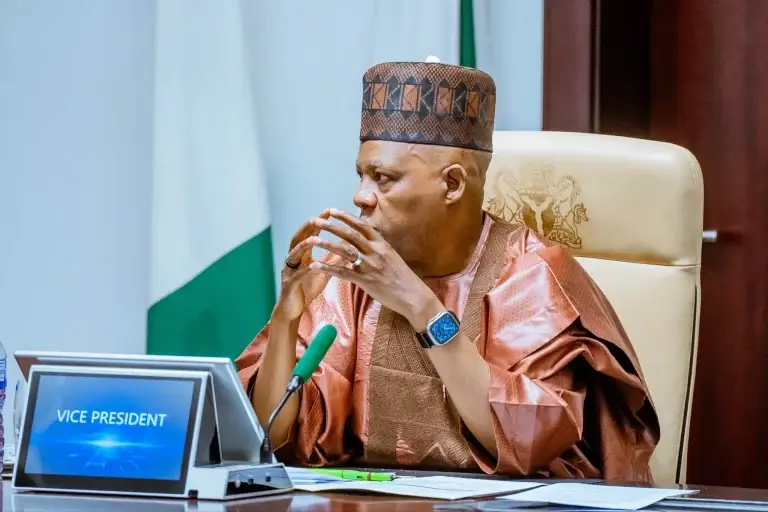
Vice President Kashim Shettima on Sunday flagged off the disbursement of the Community Investment Fund under the Nigeria for Women Programme Scale-Up Project in Katsina State, with more than 40,000 women set to receive business capital after fulfilling prescribed eligibility conditions and demonstrating satisfactory performance in their savings and group activities. The ceremony, held at the Muhammadu Dikko Stadium in Katsina, marked the formal commencement of a programme that state officials say will ultimately reach nearly 800,000 women across all 34 local government areas of the state.
Shettima said the initiative was designed not merely to distribute money but to strengthen women’s economic capacity, improve household incomes and promote financial inclusion at the grassroots. “The Community Investment Fund under the Nigeria for Women Programme Scale-Up Project addresses that question with an investment in capability,” he said. “Over 40,000 women in Katsina State stand to receive business capital, having fulfilled the prescribed eligibility conditions and demonstrated satisfactory performance in their savings and group activities.”
The Vice President stressed that the success of the programme should not be measured only by the number of women who receive funds, but by whether the intervention strengthens businesses, increases household earnings, creates employment and improves women’s ability to withstand economic shocks. He emphasised that the programme’s model of linking finance with savings, training, financial literacy and productive resources was critical to ensuring that beneficiaries could manage and grow their businesses sustainably. “A woman should understand the terms on which she borrows, distinguish revenue from profit, and possess the confidence to question a transaction. Financial participation loses much of its value without informed judgment,” Shettima said. He urged beneficiaries to sustain the discipline that qualified them for the intervention, particularly by keeping proper records, making careful purchases and preserving trust within their groups.
The Vice President also issued a firm warning against political interference in the disbursement process. “Eligibility must remain the basis of access without favouritism or political interference,” he said. “A beneficiary should understand what she receives and how the process works. Each transaction should be properly documented and questions should receive prompt answers.” He commended the Katsina State Government for advancing the programme and acknowledged the support of the World Bank, while urging implementing agencies to sustain monitoring beyond the disbursement ceremony.
Katsina State Governor Dikko Umaru Radda said his administration had committed more than N4 billion to the Nigeria for Women Programme Scale-Up Project and had approved another N4 billion to expand its coverage, bringing the state’s total counterpart funding commitment to over N8 billion. “It is on this note that Katsina State is matching every dollar that is given by the World Bank to support the women in the state,” Radda said. “So far, Katsina State has contributed over four billion Naira for this project and approval last month of another four billion was done by the Executive Council of the state.” He explained that the programme initially commenced in Katsina, Funtua and Daura local government areas, but the state government had expanded it to an additional six local governments, with plans to eventually cover all 34 local government areas. “Today’s flag-off marks the commencement of the disbursement process. It is not the conclusion of the process,” he said. “Access to finance must be accompanied by the knowledge, skills, market opportunities and institutional support required to sustain economic growth.”
The World Bank Senior Social Development Specialist and Task Team Leader for the Nigeria for Women Programme, Michael Ilesanmi, disclosed that the state government had released N8.5 billion in counterpart funding over the past two years, with additional resources budgeted for the 2027 fiscal year. He said the significant investment had paved the way for the programme to move from an initial target of reaching 100,000 women to 800,000 women in the state. “This is why we see Katsina State as a flagship for the Nigerian Women Programme,” Ilesanmi said. He explained that the programme was designed to mobilise poor and vulnerable women into Women Affinity Groups, where they would gain access to financial services, markets, productive assets, skills and other forms of support needed to improve their livelihoods. The programme will equip women with financial literacy, enterprise development skills and improved access to finance, markets and productive opportunities while helping them overcome social barriers that limit economic participation. It will also strengthen the resilience of women to climate change by supporting sustainable livelihood activities capable of generating income and improving household welfare.
The Katsina State Commissioner for Women Affairs, Aisha Aminu Malumfashi, described the initiative as a transformative programme that would deepen women’s participation in economic activities through direct financial assistance and community-based support structures. Under the programme, beneficiaries will be organised into Women Affinity Groups, where they will build savings, access financial and non-financial services, strengthen their businesses and connect to wider markets. Ilesanmi emphasised that the initiative was deliberately inclusive, stressing that every eligible woman aged 18 years and above, including persons with disabilities, could participate. The state government has also decided to provide additional services, including health insurance, for all women beneficiaries, ensuring that the empowerment they receive is comprehensive and wraparound.
The launch forms part of the broader Nigeria for Women Programme Scale-Up, a $540 million initiative financed by the World Bank and the Federal Government, designed to expand economic opportunities for women, strengthen women-led community groups and improve access to finance, particularly for women in rural and underserved communities. The second phase builds on the Nigeria for Women Project, which was implemented between 2018 and 2024, with a focus on expanding its reach and deepening its impact across the country. The initiative is expected to provide women with access to productive resources, financial services, skills and market opportunities, with the broader objective of reducing poverty and strengthening the economic resilience of households and communities.
During his visit to Katsina, Shettima also commissioned three major road projects executed by the Radda administration: the dualised 4.80-kilometre Kofar Sauri–Central Mosque Roundabout Road, the dualised 2.40-kilometre Central Police Station Junction–Kofar Kaura Underpass Road, and the newly constructed four-kilometre Filin Polo–Ring Road. He also launched 30 Compressed Natural Gas hybrid buses and 200 Phase One electric tricycles at the Old Ministry of Works to boost mass transportation in the state. The Vice President was received on arrival at the Umaru Musa Yar’Adua International Airport by Governor Radda and subsequently inspected a quarter guard mounted by men of the Nigeria Air Force. He was accompanied by the Emir of Katsina, Alhaji Abdulmumini Usman, members of the State Executive Council and other top government functionaries. Thereafter, Shettima received defectors into the All Progressives Congress at a political gathering held at the Peoples Square, Government House.
The launch of the Community Investment Fund in Katsina represents a significant milestone in Nigeria’s efforts to advance women’s economic empowerment and financial inclusion. For the 40,000 women receiving business capital, the intervention offers an opportunity to expand their enterprises, improve household incomes and strengthen their economic resilience. For Katsina State, the programme is a demonstration of what can be achieved through sustained partnership between the federal government, state authorities and international development partners. For the broader national agenda, the Katsina model, with its emphasis on savings discipline, financial literacy and community-based support structures, offers a template that other states could adapt as Nigeria pursues its goal of lifting millions of women out of poverty. As Shettima put it, the programme is not merely about distributing money but about investing in capability, and its success will be measured not by the number of beneficiaries but by the strength of the businesses they build and the resilience of the households they sustain.
📩 Stone Reporters News | 🌍 stonereportersnews.com
✉️ info@stonereportersnews.com | 📘 Facebook: Stone Reporters News | 🐦 X (Twitter): @StoneReportNew | 📸 Instagram: @stonereportersnews
Add comment
Comments