

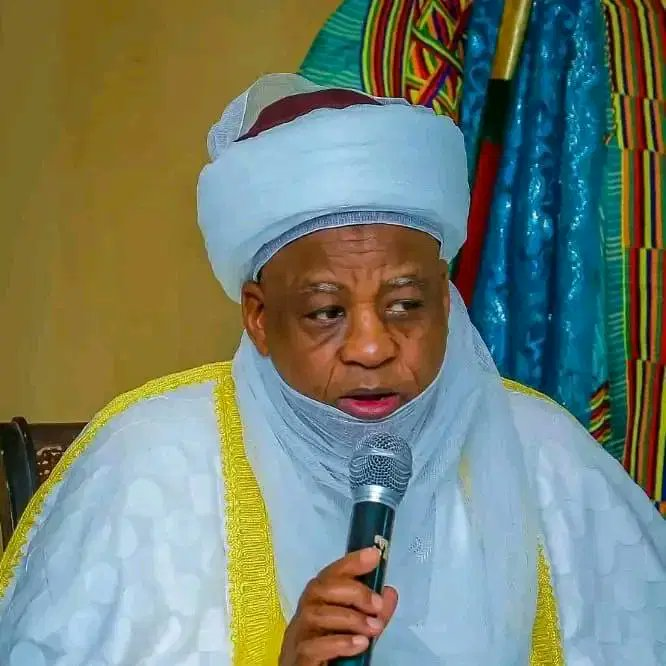
The Sultan of Sokoto, Alhaji Sa’ad Abubakar, has announced plans by the Sultanate Council to establish the Caliphate Islamic Microfinance Bank, an initiative intended to tackle poverty, expand employment opportunities and provide financial support to small-scale entrepreneurs across Nigeria and the West African sub-region.
The Sultan disclosed the development on Sunday, October 18, 2026, in Sokoto, during the opening of a three-day training and capacity-building programme on Baitul Mal wat Tamweel (BMT). The programme was organised by the Islamic Development Bank (IsDB) in collaboration with the Sokoto State Zakat and Endowment Agency, bringing together stakeholders to examine how Islamic financial and social welfare institutions could support economic development.
Represented by the District Head of Kilgori, Alhaji Jabbi Kilgori, the Sultan explained that the proposed financial institution would improve access to Shariah-compliant financing for small businesses and individuals seeking opportunities to expand their economic activities. He said the initiative was designed to help entrepreneurs strengthen their businesses, create employment and improve household livelihoods.
The Sultan disclosed that preparations for establishing the bank had reached an advanced stage, with prospective investors, including those from outside Nigeria, expressing interest in supporting the project. However, he did not announce a commencement date, the amount of investment secured or the regulatory approvals obtained for the proposed institution.
“The aim is to establish a bank that will serve as a model not only for Nigeria but also for the West African sub-region,” the Sultan said.
He described the collaboration between the Islamic Development Bank and the Sokoto State Zakat and Endowment Agency as an important opportunity to strengthen poverty-reduction initiatives through improved management of charitable resources. According to him, effective collection and administration of Zakat, alongside productive investment in vulnerable communities, could help create more sustainable approaches to economic empowerment.
The Sultan urged participants at the training programme to ensure that the knowledge acquired translated into practical improvements in the welfare of disadvantaged households. He emphasised the importance of moving beyond discussions and developing workable measures that would strengthen livelihoods and reduce dependence on temporary assistance.
Speaking at the event, the Chairman of the Sokoto State Zakat and Endowment Agency, Malam Lawal Maidoki, called for a shift from excessive reliance on charitable donations towards programmes capable of helping beneficiaries become economically independent. He explained that while Zakat and other forms of assistance remained essential for vulnerable households, financial relief alone might not provide the resources required to escape poverty permanently.
Maidoki identified Baitul Mal wat Tamweel as an approach that combines social welfare with economic development. Under the model, charitable resources are mobilised to support eligible beneficiaries, while financial services and business development assistance help individuals establish productive activities and generate sustainable income.
He explained that the model incorporates Islamic social finance instruments, including Zakat, Sadaqah and Waqf, alongside Shariah-compliant financial services. These instruments serve different purposes, ranging from obligatory charitable contributions to voluntary donations and endowments, but can be administered within programmes intended to improve the welfare and economic opportunities of vulnerable people.
The agency chairman also highlighted difficulties faced by individuals who cannot satisfy the requirements of conventional microfinance institutions or prefer financing arrangements consistent with Islamic principles. He maintained that an effective BMT framework could help address some of these barriers by connecting social protection with opportunities for entrepreneurship and financial inclusion.
Maidoki argued that poverty-reduction programmes should provide beneficiaries with opportunities to acquire the skills, resources and financial support necessary to become self-reliant. He said the objective should be to help households progress from receiving assistance to establishing productive livelihoods capable of supporting their long-term needs.
Also addressing participants, Indonesian Islamic economics and finance expert Saat Suharto explained that the training was intended to strengthen the capacity of stakeholders to implement BMT principles in ways that were inclusive, accountable and suitable for local conditions.
Suharto said the approach could help vulnerable individuals develop sustainable livelihoods and eventually become financially capable of supporting others through charitable contributions. He identified improved administration of Zakat and Waqf resources, staff development and simpler operational procedures as important areas requiring attention.
The expert also advocated greater use of technology to improve transparency, accountability and operational efficiency in Islamic social finance institutions. He maintained that effective systems for managing funds and monitoring their distribution were essential to ensuring that assistance reached intended beneficiaries and supported meaningful economic activities.
The proposed Caliphate Islamic Microfinance Bank remains at the planning stage, notwithstanding the Sultan's statement that preparations have advanced and attracted investor interest. Details concerning its ownership structure, initial capital, licensing arrangements, branch network and commencement of operations have not yet been publicly announced.
The initiative nevertheless outlines the Sultanate Council's intention to combine financial inclusion, entrepreneurship and Islamic social welfare principles in addressing economic hardship. Its eventual impact will depend on the establishment of the institution, the availability of financing and the implementation of programmes capable of reaching the communities it is intended to serve.
📩 Stone Reporters News | 🌍 stonereportersnews.com
✉️ info@stonereportersnews.com | 📘 Facebook: Stone Reporters News | 🐦 X (Twitter): @StoneReportNew | 📸 Instagram: @stonereportersnews
Add comment
Comments