

Reported by: Oahimire Omone Precious | Edited by: Oravbiere Osayomore Promise.
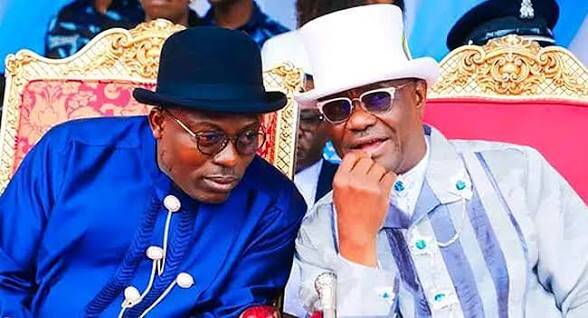
What started as a political alliance built on loyalty and succession in Rivers State has now unraveled into one of Nigeria’s most gripping power struggles, with behind-the-scenes calculations, shifting loyalties, and intense personal tensions shaping what could become a defining political showdown ahead of 2027. At the center of it all are Minister of the Federal Capital Territory, Nyesom Wike, and his political successor turned rival, Governor Siminalayi Fubara.
Insiders describe the situation not just as a disagreement, but as a full-scale battle for control, influence, and political survival. Wike, known for his commanding grip on Rivers politics during his eight-year tenure as governor, is said to be quietly but strategically weighing how to deal with Fubara’s growing independence and, more importantly, his potential ambition to secure a second term in office.
The tension did not erupt overnight. It began subtly, with disagreements over appointments, control of local political structures, and access to the levers of power that traditionally define authority in the state. Observers say Fubara’s early moves to assert himself as governor, rather than operate under the shadow of his predecessor, were the first signs that the relationship was heading for trouble.
Soon, what had been whispered disagreements spilled into the open. The Rivers State House of Assembly became a battlefield, splitting into rival factions. Lawmakers loyal to Wike and those backing Fubara clashed over leadership, legitimacy, and control. At one point, the crisis escalated so sharply that impeachment threats loomed, creating an atmosphere of uncertainty and tension across the state.
Behind closed doors, political meetings reportedly turned heated. Allies on both sides began to draw battle lines, with long-standing relationships strained or broken entirely. The once unified political structure that delivered victory in 2023 fractured into camps, each determined to outmaneuver the other.
President Bola Tinubu was eventually drawn into the crisis, stepping in to prevent a total breakdown of governance in the state. High-level meetings were held in Abuja, where both Wike and Fubara were brought to the table in attempts to broker peace. While these interventions temporarily cooled tensions, they did not resolve the deeper issues driving the conflict.
At the heart of the current intrigue is 2027. For Wike, the possibility of Fubara securing a second term is seen by many analysts as more than just a political outcome, it is a question of influence. Having built an extensive political network over the years, Wike’s standing as a power broker is closely tied to his ability to shape leadership in Rivers State. A Fubara victory without his backing could signal a major shift in that balance.
This is why his recent posture is being closely watched. Political observers say Wike is exploring multiple paths, ranging from reconciliation to outright opposition. Some insiders suggest he may support an alternative candidate entirely, one who would align more closely with his political vision and restore his influence over the state’s structure.
On the other side, Fubara is steadily carving out his own space. His supporters argue that he is simply doing what any elected governor should do, lead independently and make decisions in the interest of governance. They point to his policy direction and administrative actions as evidence that he is focused on delivering results, not engaging in political battles.
But critics see it differently. Within Wike’s camp, there is a growing narrative that Fubara’s moves represent a break from political agreements that facilitated his rise to power. This perception has only deepened mistrust and hardened positions, making reconciliation increasingly difficult.
Meanwhile, the political temperature in Rivers State continues to rise. Grassroots mobilisation has intensified, with both camps working quietly to secure loyalty at the local level. Meetings, consultations, and strategic alignments are reportedly ongoing, all aimed at preparing for what many expect to be a fiercely contested election.
For ordinary residents, the situation is both fascinating and concerning. While some view the unfolding drama as typical of Nigerian politics, others worry about its impact on governance and stability. The repeated cycles of conflict and temporary peace have created uncertainty, with many hoping for a resolution that prioritises development over rivalry.
What makes the situation even more compelling is the broader national context. Rivers State is not just any state, it is a key player in Nigeria’s political and economic landscape. Control of its political structure carries weight far beyond its borders, influencing alliances, elections, and power dynamics at the federal level.
As 2027 approaches, one thing is clear: this is no longer just a disagreement between two politicians. It is a high-stakes contest that will test loyalty, strategy, and political endurance. Whether it ends in reconciliation, realignment, or a full-blown electoral showdown remains uncertain.
For now, Wike’s next move remains the biggest question. Will he attempt to rebuild ties with Fubara, or will he throw his weight behind a new contender? And can Fubara sustain his independence long enough to secure his political future?
In Rivers State, the answers to these questions are already shaping the next chapter of its political story. What began as a succession plan has turned into a gripping power drama, one that is far from over and promises even more twists in the months ahead.
📩 Stone Reporters News | 🌍 stonereportersnews.com
✉️ info@stonereportersnews.com | 📘 Facebook: Stone Reporters News | 🐦 X (Twitter): @StoneReportNew | 📸 Instagram: @stonereportersnews
Add comment
Comments