

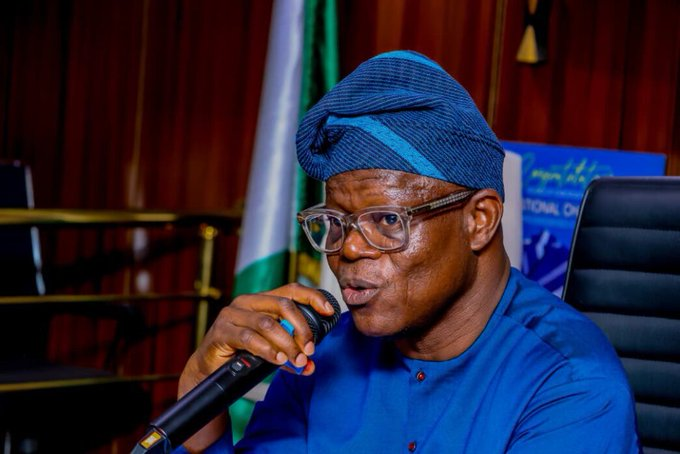
The National Secretary of the All Progressives Congress (APC), Senator Ajibola Basiru, has questioned former Vice-President Atiku Abubakar's economic expertise, accusing him of contributing to the longstanding economic difficulties that President Bola Tinubu's administration is attempting to address.
Basiru made the remarks on Wednesday, October 21, 2026, during an appearance on Channels Television's Politics Today, while discussing Atiku's presidential ambition, Nigeria's economic situation and preparations for the 2027 general elections.
The APC national secretary challenged the assumption that Atiku's experience as vice-president automatically qualified him as an authority on economic management.
Atiku served as Nigeria's vice-president under President Olusegun Obasanjo from 1999 to 2007, a period during which the administration implemented economic reforms, including privatisation and changes to the petroleum sector.
However, Basiru argued that holding high political office did not necessarily establish professional expertise in economics.
“Atiku is not a professional, please, with respect to him,” Basiru said.
He referred to Atiku's educational and professional background, claiming that the former vice-president had trained in hygiene before working in the Nigeria Customs Service.
Basiru subsequently asked: “Where is the expertise? What has he done? Check his profile?”
He maintained that Atiku's political experience should not be confused with specialist economic qualifications.
The APC official went further, directly linking the former vice-president to some of Nigeria's economic problems.
“If there are challenges that is being addressed by President Tinubu, one of the main people that caused it is Atiku Abubakar,” he declared.
Basiru did not, in the reported remarks, provide a detailed economic assessment establishing which specific policies attributable to Atiku were responsible for Nigeria's current difficulties.
His accusation therefore represents the APC official's political assessment rather than an independently established finding.
The comments come amid continuing disagreements between the ruling APC and opposition politicians over inflation, petrol prices, government borrowing and the impact of economic reforms on Nigerian households.
Atiku has repeatedly criticised aspects of the Tinubu administration's economic management, particularly the financial pressure facing ordinary Nigerians.
The former vice-president has also advocated measures intended to reduce the cost of petroleum products, including a proposed production subsidy for locally refined petrol.
The APC has opposed that proposal, arguing that returning to subsidy-related arrangements could create additional fiscal obligations and undermine the government's deregulation policy.
During Wednesday's interview, Basiru criticised politicians who promised substantial reductions in petrol prices without explaining how such measures would be implemented.
He questioned the feasibility of proposals to reduce petrol prices to between ₦200 and ₦300 per litre, describing such promises as unrealistic.
“You must not lie to people because you want to get their votes,” he said.
Basiru argued that political parties seeking public support should present economic proposals that could be implemented within Nigeria's existing financial and regulatory circumstances.
The dispute reflects wider differences over how the country should manage energy prices and address the cost of living.
While the Tinubu administration maintains that removing petrol subsidies and introducing other structural reforms are necessary to improve public finances, opposition figures have questioned the immediate effects of those measures on households and businesses.
Atiku's proposed approach would involve government support for locally refined petroleum products, with the stated objective of reducing consumer prices.
The APC has challenged the former vice-president to explain the funding arrangements, legal basis and mechanisms that would ensure consumers benefit from such support.
Those policy disagreements have become increasingly prominent as political parties prepare for the 2027 presidential election.
Asked whether Atiku could pose a serious challenge to the APC, Basiru also questioned the former vice-president's political prospects.
He referred to Atiku's repeated attempts to become president and suggested that his latest ambition represented another effort to secure the office.
Basiru compared him to the late Kenyan opposition politician Oginga Odinga, using the comparison to criticise his prolonged pursuit of presidential power.
The APC official's assessment was a partisan prediction, not an established indication of how Nigerians will vote in 2027.
Atiku remains an influential figure in Nigeria's opposition politics, having contested previous presidential elections and served in one of the country's highest executive offices.
His political record and economic proposals remain subjects of public debate, particularly as Nigerians assess competing claims about the causes of the country's economic challenges.
Responsibility for Nigeria's present economic conditions cannot be established solely through political statements. The country's economic performance has been shaped by decisions across successive administrations, as well as domestic structural problems and international economic developments.
Basiru's latest remarks add to an increasingly confrontational exchange between the APC and opposition leaders over the country's economic direction.
The APC continues to defend Tinubu's reform programme as an effort to address longstanding problems, while Atiku and other opposition figures have challenged the government's handling of economic hardship.
As of the latest reports, there was no confirmed direct response from Atiku to Basiru's specific comments during Wednesday's interview.
The disagreement is expected to remain part of the wider political debate as parties present their economic policies ahead of the 2027 general elections.
📩 Stone Reporters News | 🌍 stonereportersnews.com
✉️ info@stonereportersnews.com | 📘 Facebook: Stone Reporters News | 🐦 X (Twitter): @StoneReportNew | 📸 Instagram: @stonereportersnews
Add comment
Comments