

Reported by: Oahimire Omone Precious | Edited by: Gabriel Osa
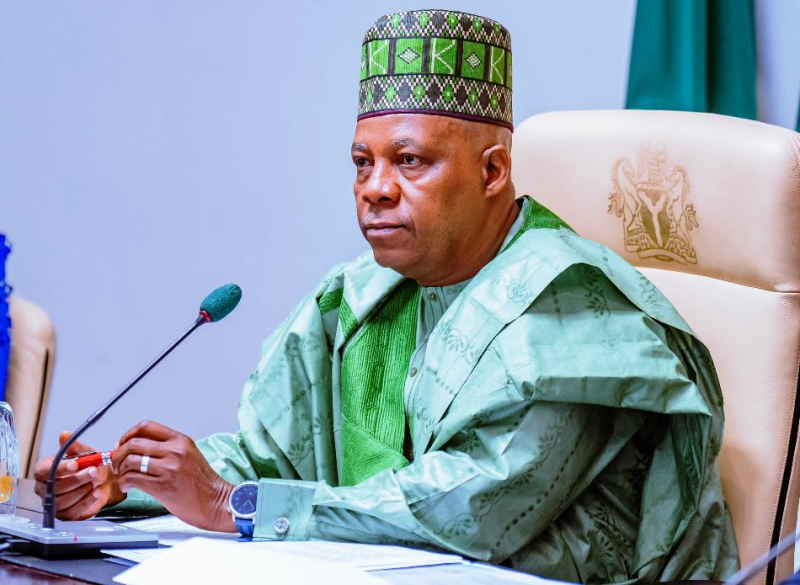
Vice President Kashim Shettima has defended the federal government’s proposed tax reform programme, insisting that its implementation is designed to reduce the financial pressure facing small businesses and low-income households rather than increase economic hardship. Speaking on Wednesday in Abuja while representing President Bola Ahmed Tinubu at an interfaith Ramadan and Lent breaking-of-fast ceremony, the Vice President said the reform agenda was carefully structured to simplify Nigeria’s multiple taxation system and support poverty reduction objectives.
The event, which took place within the State House, brought together senior government officials, religious leaders, and top policymakers. Participants included members of the Federal Executive Council, the governor of the Central Bank of Nigeria, presidential advisers, and heads of various federal agencies and parastatals. The gathering was framed as both a spiritual and policy-oriented engagement reflecting Nigeria’s multicultural religious composition during the overlapping observance of Ramadan and Lent.
Shettima devoted much of his address to defending the administration’s economic direction, arguing that critics who claim the tax reform package is intended to burden the poor are spreading misinformation. According to him, the policy framework seeks to eliminate the complex network of overlapping levies that small enterprises and informal traders currently face across multiple tiers of government. He explained that many Nigerian small business operators are often subjected to local government charges, state taxes, and other administrative fees that accumulate into what he described as a “multiple taxation trap.”
The Vice President argued that streamlining tax collection would simplify compliance procedures and reduce operational costs for micro, small, and medium-scale enterprises. He maintained that economic inclusion remains a core objective of the reform strategy, particularly because small businesses constitute a significant portion of Nigeria’s private sector employment structure. By reducing administrative friction and removing redundant charges, the government hopes to create a more favourable environment for entrepreneurial activity and grassroots economic participation.
Addressing broader economic policy outcomes, Shettima highlighted improvements in Nigeria’s foreign exchange position, noting that recent fiscal and monetary adjustments had contributed to the strengthening of external reserves. He also pointed to efforts to rationalise multiple exchange rate mechanisms, describing the previous structure as economically inefficient and susceptible to speculative pressures.
The Vice President reiterated the administration’s justification for removing fuel subsidy payments, stating that the policy was necessary to halt what he described as an unsustainable financial drain on national resources. He explained that although subsidy removal was not explicitly stated in President Tinubu’s 2023 inauguration address, the decision was later taken after policy evaluation showed that continued subsidy spending was consuming funds that could otherwise support infrastructure and social investment programmes.
Shettima acknowledged that subsidy removal initially generated public anxiety due to rising transportation and commodity prices. However, he argued that three years into the reform process, the national economy has shown signs of recovery through improved fiscal discipline, currency management, and market-oriented energy pricing. Economic analysts have produced mixed assessments of this claim, with some pointing to macroeconomic stabilisation indicators while others highlight persistent inflationary pressures affecting household purchasing power.
The Vice President urged government officials and political communicators to actively engage the public in explaining the administration’s economic programmes. He suggested that information dissemination should extend beyond formal policy announcements to include community engagement, religious forums, and public education platforms.
Shettima used the metaphor of public outreach to encourage what he described as “taking government to the people.” He urged ministers, advisers, and agency heads to serve as ambassadors of the administration’s reform agenda by correcting what he called false narratives circulating through opposition political channels and social media commentary.
The Vice President’s statement reflects the administration’s growing emphasis on communication strategy as a component of economic governance. Officials believe that policy resistance often arises from information gaps rather than deliberate opposition to reform initiatives. Consequently, the government is promoting what it calls fact-based public education regarding fiscal and economic changes.
During the interfaith ceremony, Shettima also emphasised the importance of national unity and cooperation among religious communities. The Ramadan and Lent joint observance was presented as a symbolic gesture of Nigeria’s pluralistic society, where Muslims and Christians often share social and public spaces despite occasional episodes of sectarian tension in some regions.
He commended religious leaders for supporting peacebuilding initiatives and urged them to continue promoting messages of tolerance and mutual respect across communities. According to him, social harmony remains essential for sustainable economic development, particularly in a country confronting security, poverty, and youth unemployment challenges.
The Vice President also praised President Tinubu’s leadership approach, describing him as courageous for pursuing reforms that previous administrations allegedly avoided due to political sensitivity. Shettima argued that decisive economic restructuring is necessary to reposition the Nigerian economy for long-term growth, even if such reforms generate short-term discomfort.
Policy analysts have observed that the administration’s reform programme has focused on subsidy removal, exchange rate liberalisation, and fiscal consolidation. Government officials argue that these measures are intended to improve investment confidence, expand domestic production incentives, and reduce structural distortions in the economy.
Opposition groups and some civil society organisations, however, continue to criticise aspects of the reforms, particularly the impact of rising living costs on vulnerable populations. Critics contend that while macroeconomic indicators may show improvement, ordinary Nigerians are experiencing reduced real income due to inflation and transportation cost escalation.
Shettima responded indirectly to such criticism by urging public officials to become more proactive in communicating policy achievements. He said the administration must confront what he described as deliberate misinformation campaigns aimed at undermining public trust in government programmes.
The Vice President concluded his remarks by thanking participants at the interfaith gathering for their support and cooperation with the administration. He expressed appreciation for what he called comradeship and partnership among religious, political, and administrative stakeholders in advancing national development goals.
Stone Reporters note that the government’s push to promote its tax reform and economic restructuring agenda is likely to remain a central topic of national debate in the coming months. While officials maintain that the reforms are designed to expand economic opportunity and reduce poverty, policy critics argue that effective implementation will be critical to ensuring that the promised benefits reach low-income households and small business operators across the country.
📩 Stone Reporters News | 🌍 stonereportersnews.com
✉️ info@stonereportersnews.com | 📘 Facebook: Stone Reporters | 🐦 X (Twitter): @StoneReportNew | 📸 Instagram: @StoneReportNew
Add comment
Comments