

Reported By Mary Udezue | Edited by: Gabriel Osa
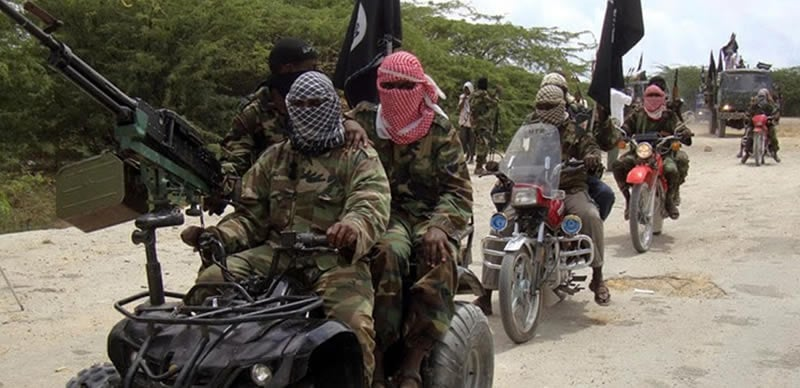
A large-scale attack by suspected Boko Haram militants on the Ngoshe community in Gwoza Local Government Area of Borno State has triggered a major humanitarian crisis after hundreds of residents were abducted and thousands of civilians forced to flee their homes. The assault, which occurred during the night in late February 2026, represents one of the most significant insurgent operations reported in southern Borno in recent months.
Local authorities and security sources reported that the attackers arrived heavily armed and launched a coordinated assault that began with an attack on a nearby military formation before moving into the civilian settlement. Militants reportedly overran parts of the area, firing indiscriminately and setting buildings on fire. Homes, shops, and vehicles were burned as residents attempted to escape the violence.
According to reports from community leaders and security officials, more than 300 residents were abducted during the raid. Many of the victims are believed to be women and children who were rounded up by the insurgents and taken into nearby forest and mountainous terrain believed to be used as insurgent hideouts.
The attack caused widespread panic across Ngoshe and surrounding settlements, prompting a mass exodus of civilians. Thousands of survivors fled toward Pulka, a nearby town that hosts a significant military presence and an internally displaced persons camp. Many of the displaced reportedly spent nights outdoors or in overcrowded public buildings such as schools due to fear of further attacks.
Residents who escaped described the attack as sudden and overwhelming. According to local accounts, insurgents stormed the town in large numbers and moved systematically through neighborhoods while firing weapons and forcing residents out of their homes. In several instances, civilians attempting to flee were reportedly chased or captured by the militants.
Community leaders also confirmed that several civilians and members of local security groups were killed during the assault. Among those reportedly killed was the chief imam of the town, along with other community elders who were unable to escape the attack.
Security sources further indicated that the militants initially targeted a military position located near the town. The attack on the base reportedly involved heavy gunfire and the destruction of equipment before the insurgents advanced into the community. This sequence suggested that the operation had been carefully planned to weaken security resistance before the civilian assault began.
Senator Mohammed Ali Ndume, who represents Borno South Senatorial District, confirmed that both civilians and security personnel were killed during the attack. He warned that the number of missing residents remained unclear but could exceed one hundred or more, as many families reported relatives who had not been accounted for after the raid.
Ndume described the attack as another example of the continuing security threat posed by Boko Haram and the Islamic State West Africa Province (ISWAP), which both operate in the northeastern region of Nigeria. He called for intensified military operations in insurgent strongholds such as the Sambisa Forest and Mandara Mountains, which are believed to serve as operational bases for extremist fighters.
Ngoshe is located close to the Mandara mountain range along the Nigeria-Cameroon border, an area that has historically been used by insurgents as a refuge due to its difficult terrain and limited state presence. Security analysts note that the geography of the region makes it difficult for conventional military forces to track and pursue militant groups effectively.
The attack highlights the continuing threat posed by the long-running Boko Haram insurgency in northeastern Nigeria. Since launching its armed campaign in 2009, the extremist movement and its splinter factions have carried out mass killings, kidnappings, and village raids across Borno, Yobe, and Adamawa states, displacing millions of civilians and destabilizing large parts of the region.
Although Nigerian security forces have conducted multiple counter-insurgency operations in recent years, attacks on rural communities continue to occur, particularly in areas where military presence is limited. Analysts say insurgent groups often target remote villages to abduct civilians, seize supplies, and demonstrate their continued operational capability.
The abduction of large numbers of civilians has been a recurring tactic used by Boko Haram and ISWAP. In previous attacks across northeastern Nigeria, militants have kidnapped villagers and forced them into labor, demanded ransom payments, or attempted to indoctrinate captives into their ranks.
Humanitarian organizations monitoring the crisis warn that the latest attack could significantly increase the number of internally displaced people in southern Borno. Many communities in the region were only recently resettled after years of earlier insurgent violence, meaning the renewed attacks could reverse fragile recovery efforts.
Local leaders and security experts have urged the Nigerian government to strengthen military operations and improve intelligence gathering in border areas to prevent further large-scale attacks. Residents of Gwoza and neighboring communities have also called for increased troop deployment and aerial surveillance to protect villages vulnerable to insurgent raids.
For survivors of the Ngoshe attack, the immediate challenge remains the search for missing relatives and the struggle to rebuild their lives after losing homes and livelihoods. Many displaced families are now relying on humanitarian assistance while hoping that security forces will rescue those still held by the militants.
📩 Stone Reporters News | 🌍 stonereportersnews.com
✉️ info@stonereportersnews.com | 📘 Facebook: Stone Reporters | 🐦 X (Twitter): @StoneReportNew | 📸 Instagram: @stonereportersnews
Add comment
Comments