

Reported By Mary Udezue | Edited by: Gabriel Osa
The Israeli Ambassador to Nigeria, Michael Freeman, has alleged that the Iranian government is actively sponsoring terrorism and destabilisation activities in Nigeria and across West Africa, a claim that has intensified debate about the international dimensions of Nigeria’s long-running security crisis.
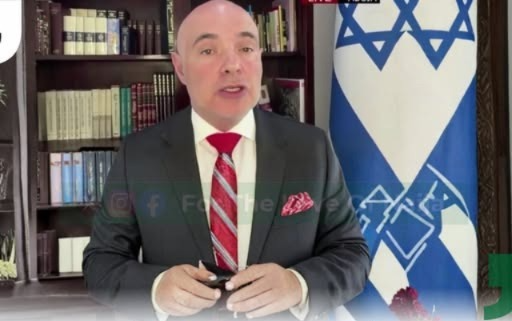
Freeman made the allegation during an interview on ARISE News on March 6, 2026, where he discussed Iran’s global activities and their potential impact on Africa. According to the envoy, Iran has been expanding its influence beyond the Middle East and is involved in backing movements that could undermine stability in several countries, including Nigeria.
During the interview, Freeman specifically pointed to the Islamic Movement of Nigeria (IMN), a Shiite religious organisation founded by Sheikh Ibrahim El-Zakzaky, alleging that the group receives ideological and political backing from Iran. He stated that Iran’s leadership has openly shown support for the movement, arguing that the relationship between Tehran and the group has been publicly acknowledged by Iranian officials.
Freeman claimed that Iran’s activities form part of a broader global strategy in which the Iranian government funds, trains, and supports militant organisations around the world. According to him, Tehran has been involved in supporting groups such as Hamas, Hezbollah, and the Houthi movement, which Israel and several Western governments classify as terrorist organisations.
The ambassador argued that Iran’s strategy involves building alliances with ideological movements abroad as a way of expanding its geopolitical influence and weakening governments that oppose it. He said this approach has been used in multiple regions, including the Middle East, Europe, and Africa.
Freeman further claimed that Iran has been attempting to spread instability across West Africa and the Sahel region, with Nigeria emerging as one of the key areas where Tehran’s influence is allegedly increasing. According to him, intelligence and historical records suggest that Iran has been working through proxy networks and ideological allies to expand its reach in the region.
He also framed Iran as a major global sponsor of terrorism, asserting that the country’s leadership has pursued a long-standing policy hostile to Israel and its allies. According to Freeman, Iran has invested heavily in ballistic missile programmes and nuclear research while simultaneously supporting armed groups in different parts of the world.
During the interview, Freeman said Iran has maintained a hostile policy toward Israel for decades, frequently repeating slogans such as “death to Israel” and “death to America,” which he argued reflects the ideological posture of the Iranian state. He described Iran as the only country within the United Nations system that openly calls for the destruction of another sovereign state.
Freeman linked the current geopolitical tensions in the Middle East to Iran’s regional influence, arguing that the conflicts involving Israel and militant groups such as Hamas and Hezbollah cannot be separated from Iran’s support for those organisations.
The ambassador’s comments come at a time when Nigeria continues to face complex security challenges, including insurgency in the northeast, banditry in the northwest, kidnapping in several states, and communal conflicts in parts of the country.
Nigeria’s insurgency crisis began in 2009 with the rise of Boko Haram, a jihadist group that later split into factions including the Islamic State West Africa Province (ISWAP). The conflict has resulted in tens of thousands of deaths and displaced millions of people across northeastern Nigeria and neighbouring countries.
Although the groups responsible for most attacks in Nigeria are largely locally rooted, analysts have long debated the extent to which external ideological or financial support influences militant networks operating within the country.
Freeman also used the interview to highlight Israel’s willingness to cooperate with Nigeria on counter-terrorism efforts. He stated that Israel is prepared to share intelligence, technology, and expertise to help Nigeria address security threats affecting both Christians and Muslims.
He emphasised that any cooperation between Israel and Nigeria would occur strictly with the consent and participation of the Nigerian government, noting that security collaboration must respect Nigeria’s sovereignty.
The Israeli envoy said that global terrorism has become an interconnected phenomenon and that countries affected by extremist violence must work together to share intelligence and disrupt militant networks before they grow stronger.
Freeman’s remarks are likely to generate diplomatic attention because accusations involving foreign state sponsorship of terrorism are highly sensitive and often require extensive intelligence verification.
Iranian authorities have historically rejected accusations that they sponsor terrorism, arguing instead that their foreign policy supports what they describe as “resistance movements” against Western influence and Israeli policies in the Middle East.
Analysts note that geopolitical rivalry between Israel and Iran has intensified in recent years, particularly over Iran’s nuclear programme, regional alliances, and the ongoing conflicts involving militant groups allied with Tehran.
Within Nigeria, the Islamic Movement of Nigeria has previously been involved in confrontations with security forces. The Nigerian government banned the organisation in 2019 after deadly clashes between its members and the military in several cities.
Despite the ban, the group continues to have followers across parts of northern Nigeria, and its leader, Sheikh Ibrahim El-Zakzaky, remains a controversial figure in the country’s religious and political landscape.
Security experts say the debate surrounding foreign influence in Nigeria’s internal security challenges highlights the increasingly global nature of modern conflicts, where ideological networks, financial flows, and geopolitical rivalries can intersect with local grievances and militant movements.
As Nigeria continues to battle multiple security threats, the allegations made by the Israeli ambassador have added a new dimension to discussions about the role of international actors in the country’s security landscape and the broader stability of West Africa.
📩 Stone Reporters News | 🌍 stonereportersnews.com
✉️ info@stonereportersnews.com | 📘 Facebook: Stone Reporters | 🐦 X (Twitter): @StoneReportNew | 📸 Instagram: @stonereportersnews
Add comment
Comments