

Reported by: Oahimire Omone Precious | Edited by: Gabriel Osa
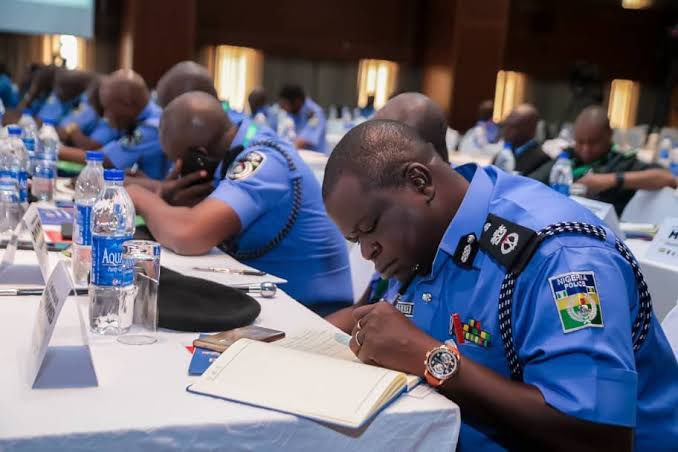
Nigeria’s Police Service Commission has approved the promotion of seven Assistant Inspectors-General of Police to the rank of Deputy Inspectors-General, a significant leadership restructuring that comes amid wider changes within the country’s top law-enforcement hierarchy. The promotions were announced following a formal assessment exercise conducted at the commission’s headquarters in Abuja and are intended to strengthen the senior command structure of the Nigeria Police Force as it responds to evolving security challenges across the country.
The elevation of the seven officers follows a selection process described by officials as rigorous and merit-based. Candidates were evaluated through written examinations and oral interviews organized by the Police Service Commission, the constitutional body responsible for the recruitment, promotion and disciplinary oversight of officers in the Nigeria Police Force. According to the commission, the assessment considered several factors including seniority, service records, professional conduct and overall performance during the evaluation process.
Officials explained that the promotions were partly necessitated by recent retirements within the police high command. Eight Deputy Inspectors-General had vacated their positions, creating vacancies in strategic leadership roles within the force. These vacancies emerged after a series of institutional transitions within the police leadership structure, including changes connected to the appointment of a new Inspector-General of Police.
The newly promoted Deputy Inspectors-General are Zachariah Fera Achinyan, who previously served as Assistant Inspector-General in charge of Zone 4 in Makurdi; Zango Ibrahim Baba, formerly the Assistant Inspector-General overseeing the Department of Logistics and Supply; Isyaku Mohammed, who had responsibility for the Armament Department at the Force Headquarters in Abuja; and Margaret Agebe Ochalla, formerly the Assistant Inspector-General at the Force Criminal Investigation Department Annex in Lagos.
Also elevated are Mohammed Abdul Sulaiman, previously in charge of Police Accounts and Budget at the Force Headquarters in Abuja; Kenechukwu Onwuemelie, who served as Assistant Inspector-General overseeing Zone 15 in Maiduguri; and Umar Shehu Nadada, formerly the Assistant Inspector-General in charge of Zone 14 headquartered in Katsina.
With their promotion, the officers are expected to assume strategic roles within the police force’s management structure, commonly referred to as the Force Management Team. This body serves as the highest administrative and operational decision-making group within the Nigeria Police Force and plays a central role in shaping policy direction, coordinating national security operations and overseeing regional policing commands.
The promotions come at a time when Nigeria continues to confront complex security threats across several regions. Armed insurgency linked to extremist groups remains active in the northeastern part of the country, while banditry and kidnapping networks have destabilized communities in the northwest. Separatist tensions and organized crime activities also pose security challenges in parts of the southeast and south-south regions. Strengthening the leadership cadre of the police force has therefore become a priority for the federal government as it seeks to improve coordination among security agencies and enhance operational effectiveness.
Officials from the Police Service Commission stated that the promotions were intended to reinforce the leadership capacity of the force and ensure continuity in command at the highest level. The commission emphasized that the promotion process adhered to established institutional procedures designed to ensure fairness and professionalism. According to the statement issued by the commission’s public affairs department, the evaluation of candidates was conducted under strict oversight by members of the PSC board.
Among those who participated as examiners during the promotion exercise were retired Supreme Court Justice Paul Adamu Galumje, retired Deputy Inspector-General Taiwo Lakanu, who chairs the PSC Standing Committee on Police Matters, and the commission’s secretary, Onyemuche Nnamani. Their involvement was intended to provide transparency and credibility to the process while ensuring that candidates were assessed according to established professional standards.
The Chairman of the Police Service Commission, retired Deputy Inspector-General Hashimu Salihu Argungu, congratulated the newly promoted officers and urged them to uphold the values and responsibilities associated with their new rank. In his remarks, Argungu emphasized the importance of professionalism, discipline and integrity within the leadership of the Nigeria Police Force. He also encouraged the officers to maintain a strong working relationship with the commission as they carry out their new duties.
Argungu stressed that the new leadership appointments carry significant expectations given the security pressures currently facing the country. He called on the newly promoted Deputy Inspectors-General to prioritize national security objectives and support reforms aimed at improving the efficiency and credibility of the police force.
Security analysts say the restructuring reflects a broader effort by the Nigerian authorities to maintain continuity within the police command structure following recent retirements and leadership transitions. The Nigeria Police Force operates a hierarchical command system in which Deputy Inspectors-General serve directly under the Inspector-General of Police and oversee major operational departments, regional zones or specialized units within the organization.
The appointment of new Deputy Inspectors-General also plays a role in succession planning within the police leadership hierarchy. Officers who reach the rank of DIG often become eligible for appointment to the position of Inspector-General, the highest rank in the force, depending on future administrative decisions by the federal government.
In recent years the Nigeria Police Force has undergone several reforms aimed at improving accountability, operational efficiency and public trust. These reforms have included changes to recruitment procedures, expanded training programs and the restructuring of operational commands to better address emerging security threats. Leadership promotions such as the latest elevation of seven senior officers are viewed as part of this ongoing institutional transformation.
The newly promoted officers now face the challenge of translating their experience and leadership into practical results as the police force continues its efforts to tackle organized crime, terrorism and other security threats affecting Nigeria’s diverse regions. Their performance within the Force Management Team will likely shape the direction of policing strategy in the country in the years ahead.
📩 Stone Reporters News | 🌍 stonereportersnews.com
✉️ info@stonereportersnews.com | 📘 Facebook: Stone Reporters | 🐦 X (Twitter): @StoneReportNew | 📸 Instagram: @stonereportersnews
Add comment
Comments