

Reported by: Oahimire Omone Precious | Edited by: Gabriel Osa
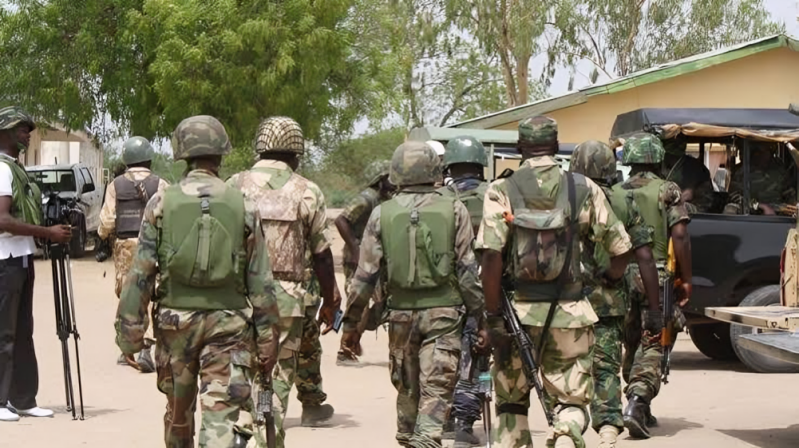
Nigeria’s military says a coordinated security operation spanning the South-South and South-East has led to the arrest of 20 suspected drug peddlers in Yenagoa, Bayelsa State, and the safe defusal of six improvised explosive devices in Imo State, in what appears to be part of a wider campaign to disrupt criminal finance, protect transport corridors, and degrade militant capabilities in two strategically sensitive regions. The operations were publicly outlined by the Director of Defence Media Operations, Major General Michael Onoja, and were carried out through joint efforts involving troops of Operation Delta Safe, the Department of State Services, and the National Drug Law Enforcement Agency in the Bayelsa operation, alongside Operation Udo Ka in the South-East.
The Yenagoa arrests are significant not merely because of the number of suspects taken into custody, but because of what they suggest about the military’s current understanding of the security environment in the Niger Delta. The official account describes the operation as intelligence-led and specifically targeted at criminal networks, indicating that the military and partner agencies are increasingly treating drug trafficking as part of a wider ecosystem that also includes kidnapping, illicit arms movement, illegal oil activity, and organized violence. The operation reportedly resulted in the recovery of illicit substances, though the military has not yet publicly released a detailed inventory of the drugs seized, nor the identities of those arrested. That omission leaves some evidentiary gaps, but the broad thrust of the operation is clear: drug interdiction is being framed as a national security issue, not simply a conventional law enforcement matter.
That framing is consistent with the broader pattern of recent military activity in the Niger Delta. In January, Defence Headquarters said Operation Delta Safe had destroyed 53 illegal refining sites and arrested 81 suspected oil thieves and other criminals across the region. In another January briefing tied to the same operational theatre, officials said 20 illegal refining sites had been destroyed and 31 suspects arrested across Bayelsa, Delta, Imo, and Rivers states. Those earlier operations focused heavily on crude theft and petroleum crime, but they revealed the same underlying logic now visible in Yenagoa: security agencies appear to be working on the assumption that criminal enterprises in the region are interconnected, with different illicit markets reinforcing each other financially and operationally.
The latest account strengthens that interpretation because the Yenagoa arrests were announced alongside a series of other enforcement actions across the South-South. According to the military briefing, troops also uncovered an illegal bunkering site in Warri South Local Government Area of Delta State, where tankers, barges, and large volumes of suspected illegally refined petroleum products were recovered. In Rivers State, an illegal refining site was dismantled in Tai Local Government Area, with about 1,500 litres of refined products confiscated. In Ughelli North, troops working with Tantita operatives intercepted a vehicle carrying 22 jerrycans containing roughly 660 litres of illegally refined Automotive Gas Oil, and two suspects were arrested. Additional anti-drug follow-up raids were also reported in Bayelsa and Akwa Ibom on 17 March. Taken together, those actions indicate that the military was not conducting an isolated narcotics raid in Yenagoa, but a broader regional pressure campaign against criminal supply chains and revenue streams.
The South-East side of the same briefing points to a different, though related, security challenge. In Imo State, troops of Operation Udo Ka were said to have repelled an attack on their position at Orsu-Ihiteukwa, recovered ammunition, and then discovered and safely defused six IEDs along key routes. The military also said two suspected IED experts were neutralised while allegedly attempting to emplace explosive devices. If that account is accurate, the implication is serious: the devices were not dormant remnants left behind from earlier fighting, but components of an active route-denial or ambush strategy designed either to target troops, limit mobility, or terrorise civilians moving through contested areas.
This latest explosives recovery did not emerge in a vacuum. On 13 March, the Nigerian Army said troops under 34 Artillery Brigade, working with other security services, reopened the Lilu–Eketutu Road between Anambra and Imo after years of disruption blamed on IPOB and its armed affiliate, the Eastern Security Network. In that operation, the army said troops discovered IEDs planted at various points, disconnected explosive devices, and destroyed what it described as a bomb-making facility in the Orsu–Eketutu Mother Valley and Orsu–Ihiteukwa general areas. The road had reportedly been effectively shut for more than three years due to persistent attacks and insecurity. That earlier operation matters because it establishes that the six IEDs now reported in Imo fit into a wider pattern of explosive threats along movement corridors in the area.
The Imo operation has also been wrapped in a credibility battle. After the army released images from its March clearance operations, IPOB disputed the authenticity of the material and accused the military of fabricating or manipulating evidence. In response, the army insisted that the images came from operations conducted in Orsu and invited journalists and civil society actors to verify the operational areas. The dispute is more than rhetorical. It shows that the fight in the South-East now includes a heavy information component, where public belief, visual proof, and control of narrative are almost as fiercely contested as the terrain itself. In that context, the report of six newly defused IEDs reinforces the military’s claim that explosive threats in the area remain real and current.
What links Yenagoa and Imo is not geography but doctrine. In both theatres, the military appears to be applying a network-disruption model. In the Niger Delta, that means pursuing oil theft, illegal refining, narcotics distribution, kidnapping, and weapons movement as overlapping elements of organized criminality. In the South-East, it means combining route clearance, explosive ordnance disposal, and counter-militant operations to degrade hostile infrastructure and restore mobility. The use of multiple agencies in the Bayelsa operation, and the multi-service character of the Imo operations, suggest that the armed forces are trying to move beyond reactive patrols toward integrated operations based on intelligence fusion and persistent pressure.
There are, however, still hard factual limits to what can be concluded from the public record. The military has not released the names of the 20 Yenagoa suspects, the exact types and quantities of narcotics recovered, the forensic profile of the six IEDs, or court documentation showing what charges have followed. Without those details, the public can assess the scale and direction of the operation, but not yet the full legal strength of the cases or the technical sophistication of the explosive devices. That matters because durable security outcomes depend not just on arrests and recoveries, but on prosecutions, intelligence exploitation, and the ability to prevent networks from rapidly regenerating.
Even so, the broader significance of the operation is unmistakable. The Yenagoa arrests and the Imo bomb disposals point to a military campaign that is increasingly trying to attack insecurity at its logistical base, whether that base is drug money in the creeks or explosive cells in contested inland corridors. The immediate operational gains are clear enough. The larger test will be whether they translate into sustained reductions in criminal financing, safer movement for civilians, and credible follow-through in the justice system. Until then, the latest announcement stands as evidence of tactical momentum, but not yet proof of strategic resolution.
📩 Stone Reporters News | 🌍 stonereportersnews.com
✉️ info@stonereportersnews.com | 📘 Facebook: Stone Reporters | 🐦 X (Twitter): @StoneReportNew | 📸 Instagram: @stonereportersnews
Add comment
Comments