

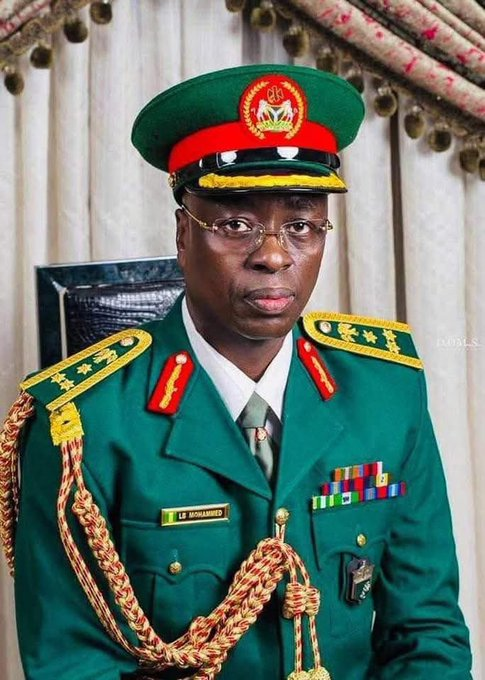
Former Zamfara CPG Commander Lawal Bature Mohammed Dies Months After Bandit Ambush
Brigadier General Lawal Bature Mohammed (rtd), the former commander of the Zamfara Community Protection Guards, has died from complications arising from gunshot injuries he sustained in a bandit attack last year, in a development that has reopened scrutiny of the risks faced by local security formations in one of Nigeria’s worst conflict zones. Reports published on March 27 and March 28, 2026, said the retired general had been receiving treatment after the attack but did not recover.
Multiple reports identify the late officer as widely known by the nickname “Dan Gusau.” The core facts are consistent across outlets: he was shot by bandits during an ambush in Zamfara in 2025, he was later flown to Egypt for advanced treatment, and he eventually died after months of medical care. Those details appear in Sundiata Post and other republications that attribute the report to Daily Trust.
The funeral prayer for Mohammed was reportedly held on Thursday evening in Sabon Gari, Gusau, the Zamfara State capital, after which he was buried according to Islamic rites. That places the burial on March 26, 2026, given the publication dates of the reports that followed.
What remains less clear, however, is the exact operational circumstance of the ambush. The most widely repeated reports confirm that he suffered bullet wounds in a bandit attack in Zamfara, but the accessible public reporting does not provide a precise official date, exact location, convoy composition, or the identity of the armed group involved. Some secondary summaries state he was attacked “during an operation,” but that detail is not yet well documented in an accessible primary official statement.
That uncertainty matters because Mohammed was not an ordinary retiree. He had remained at the center of Zamfara’s effort to build a local security response to persistent rural violence. Official Zamfara State government material from June 2024 identifies Brigadier General Lawal Bature Mohammed as the commandant of the Community Protection Guards and shows him leading decorated personnel who had been recognized for bravery in anti-bandit frontline operations.
The Zamfara Community Protection Guards, also known as Askarawa Zamfara, were formally unveiled by Governor Dauda Lawal in January 2024 as a complementary structure to support regular security forces. At the launch, the state said it had approved the engagement of 5,200 guards across the 14 local government areas, with 2,645 graduating in the first batch after training. The stated purpose was to partner with formal agencies and help defend vulnerable communities.
That broader background is essential to understanding Mohammed’s significance. As commandant, he was a key symbol of the state’s attempt to create an organized local defense structure at a time when Zamfara remained under repeated pressure from bandit groups involved in killings, kidnappings, village raids and attacks on security operatives. His death, months after surviving the initial shooting, underlines the long tail of such violence: victims do not always die at the scene, but from complications that persist long after headlines move on.
The state government had publicly celebrated the CPG’s role before Mohammed’s death. In June 2024, Governor Lawal decorated 20 Community Protection Guards for what his office described as exceptional performance, and he pledged support for the families of personnel killed in the line of duty. In that same event, Mohammed was quoted as saying the awardees were selected from different local government areas based on performance.
That pledge now reads differently in light of Mohammed’s death. Reports published after his passing note that while he was recovering from his injuries, retired Assistant Inspector-General of Police Muhammad Shehu Daligent was appointed to replace him as commander of the CPG, suggesting that the severity of the injuries had already forced a change in operational leadership before his death was eventually announced.
The available reporting does not establish whether Mohammed ever returned fully to public duties after the ambush. But the sequence is clear enough: active command role, attack and severe gunshot wounds, medical evacuation to Egypt, leadership replacement during recovery, then death months later.
His death also lands in a state where attacks on security-linked formations have remained frequent. In October 2025, for example, gunmen ambushed a security patrol in Tsafe area of Zamfara, killing eight people, including police officers and members of a local paramilitary support group, according to the Associated Press. That incident was separate from Mohammed’s case, but it illustrates the operational environment in which community-based guards and supporting forces have been working.
The CPG model itself has always been both practical and controversial. Practically, it reflects the reality that communities under repeated attack often demand a local force familiar with the terrain, language, and threat patterns. But it also raises strategic questions about training, rules of engagement, command-and-control discipline, resourcing, intelligence quality, and exposure to retaliation by heavily armed bandit networks. Mohammed’s career in that structure made him one of the most visible faces of that experiment in Zamfara.
Stone Reporters note that this is one of the most important dimensions of the story. Mohammed’s death is not only about the passing of a retired brigadier general. It is also about the long-term vulnerability of state-backed local protection systems operating in a theatre where armed groups can strike, disperse, and regroup across forested and lightly governed terrain. The loss of a former commander underlines how even senior security figures remain exposed beyond the battlefield and beyond the first wave of treatment. That is an inference drawn from the pattern in the reporting and the documented security context in Zamfara.
At this stage, the facts most solidly established are these: Mohammed is dead; he was the former Zamfara CPG commander; he had sustained severe gunshot wounds in a 2025 bandit ambush; he was flown to Egypt for treatment; Muhammad Shehu Daligent later replaced him in command; and he was buried in Gusau after funeral prayers on Thursday evening. The precise tactical details of the ambush remain less fully documented in publicly accessible official material.
His death is likely to resonate strongly in Zamfara’s security circles because it compresses several realities into one case: the persistence of bandit violence, the burden carried by local auxiliary formations, the limits of medical rescue after battlefield trauma, and the political pressure on authorities to show that community protection structures are more than symbolic. Whether the state issues a fuller official account of the original attack may determine how much more of this story becomes clear in the coming days.
📩 Stone Reporters News | 🌍 stonereportersnews.com
✉️ info@stonereportersnews.com | 📘 Facebook: Stone Reporters | 🐦 X (Twitter): @StoneReportNew | 📸 Instagram: @stonereportersnews
Reported by: Ijeoma G | Edited by: Jevaun Rhashan
Add comment
Comments