

Manchester Gang Case Deepens as Court Jails 10 Over Revenge Plot After Bonfire Night Killing
A major gang prosecution in northern England has laid bare how the fatal stabbing of teenager Alexander John Soyoye on Bonfire Night in 2020 triggered a second wave of planned retaliatory violence, leading to lengthy prison sentences for 10 young men linked to the Manchester-based M40 group. The sentencing, delivered at Preston Crown Court in July 2022, followed convictions for conspiracy to murder and conspiracy to inflict grievous bodily harm, with the court finding that within days of Soyoye’s killing, members and associates of his group had moved from grief to organised revenge planning.
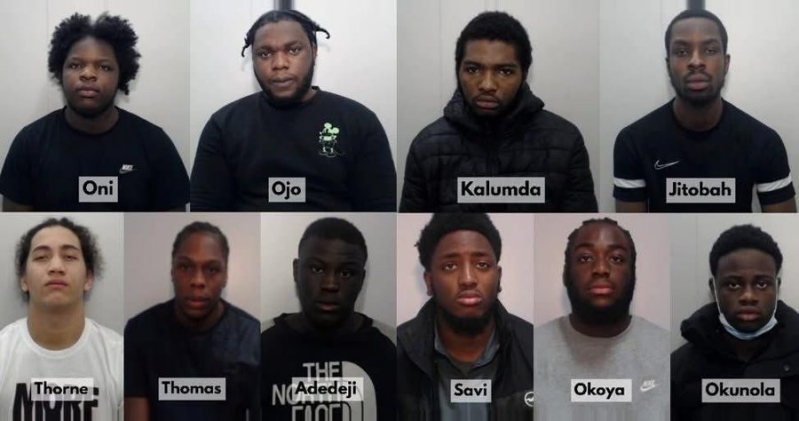
The four defendants convicted of conspiracy to murder were Harry Oni, Jeffery Ojo, Gideon Kalumda and Brooklyn Jitobah, who received prison terms of 21, 21, 21 and 20 years respectively. Six others, Simon Thorne, Martin Thomas, Ademola Adedeji, Raymond Savi, Omolade Okoya and Azim Okunola, were convicted of conspiracy to commit section 18 assault and initially sentenced to eight years each. Greater Manchester Police said the 10 men were jailed for a combined 131 years and identified them as members of the same group, known as “M40” or “40,” with other aliases including “2x2,” “4s,” “Lane Boys” and “Laners.”
The background to the case was an increasingly violent feud in autumn 2020 between M40 and rival groups referred to in court as PMG, RTD or 706, based around Oldham and Rochdale. On the evening of November 5, 2020, Soyoye, who was 16, was attacked in Moston after two groups of young men converged with visible weapons including machetes, poles and a baseball bat. Court records and police accounts show that once the smaller M40-associated group realised it was outnumbered, it fled, but Soyoye was caught, stabbed 15 times and attacked on Birchenall Street, where he died at the scene. The assault was filmed, and later prosecutions over the killing resulted in seven men being convicted of murder and one of manslaughter.
The later conspiracy trial was legally distinct from the murder trial. The court was told that after Soyoye’s death, 10 members or associates of M40 formed a criminal agreement to attack those they believed were responsible. Sentencing remarks show the judge concluded that the conspiracy formed quickly, within days of the killing, and that Telegram messages exchanged on November 8, 2020 showed participants planning revenge, identifying targets, discussing where they could be found, and considering how young women associated with rivals could be pressured into revealing their whereabouts. The court found that four of the defendants intended a killing, while the remaining six intended serious bodily harm.
Three acts of violence followed before police moved in. The first, on November 10, 2020, involved Oni and Ojo confronting a target identified in court as Hellion Santos at Hopwood College. The judge found that Oni had taken a large bladed weapon, likely a sword or machete, while Ojo acted as backup, but the intended victim escaped. The second incident took place on December 16, 2020 in the Freehold Flats area of Rochdale, territory the group associated with RTD. According to the sentencing remarks, Oni and Kalumda travelled there, Oni armed himself again with a machete, and a victim suffered deep slash wounds across his back in an attack captured on CCTV.
The third incident was even more serious. On December 29, 2020, according to the judge’s findings in the sentencing remarks, Oni and Ojo travelled to Gorton, while Jitobah, Thorne, Thomas and others converged in the same area. A 21-year-old man was attacked and stabbed multiple times, and police later argued that this and the earlier incidents were not isolated explosions of anger but the opening moves in a broader revenge campaign that would likely have escalated had officers not intervened. The Court of Appeal later summarised the prosecution case as one in which the Telegram exchanges, the target selection and the subsequent attacks together demonstrated an active conspiracy rather than mere posturing or immature boasting.
The case has remained controversial long after the original sentencing. In January 2025, the Court of Appeal overturned Ademola Adedeji’s conviction after fresh evidence undermined the prosecution’s identification of him in a video said to support the gang case. The court also reduced the sentences of Raymond Savi and Omolade Okoya from eight years to four years and six months each, while upholding the convictions of Harry Oni, Jeffrey Ojo, Brooklyn Jitoboh and Martin Thomas, along with the remaining challenged convictions. The appellate ruling means the original sentencing list cited in early reports is no longer fully accurate in its final legal position.
The appeals also widened debate in Britain over race, gang evidence and the use of drill music or social media material in serious criminal trials. Community groups and defence advocates argued that the prosecution relied too heavily on a “gang” narrative and on messages that they said reflected teenage grief and bravado rather than settled homicidal intent. The Guardian reported that supporters of the defendants described the case as a miscarriage of justice affecting Black teenagers from Manchester, while prosecutors and the courts maintained that, aside from Adedeji’s case, the evidence as a whole supported the convictions.
Far from ending there, the Soyoye case has continued to generate new developments. Greater Manchester Police said on April 9, 2026 that Emerson Teta had been extradited from the Netherlands and charged with murder, manslaughter and violent disorder in connection with Soyoye’s death. Police added that he was the latest person charged after several extraditions earlier this year, indicating that the Moston killing remains an active and expanding case even though the principal murder and conspiracy trials concluded years ago.
Taken together, the proceedings show a chain of violence rather than a single fatal street attack: Soyoye’s murder on November 5, 2020, the retaliatory Telegram planning days later, three subsequent attacks blamed on M40 members, a 2022 sentencing that initially put 10 young men behind bars for up to 21 years, a 2025 appeal that partly unravelled the prosecution case against one defendant, and a 2026 extradition that reopened the original murder file. The case has become one of Manchester’s most consequential recent gang prosecutions, not only because of the brutality involved, but because it continues to test how British courts draw the line between association, online rhetoric, grief-driven revenge talk and criminal conspiracy.
📩 Stone Reporters News | 🌍 stonereportersnews.com
✉️ info@stonereportersnews.com | 📘 Facebook: Stone Reporters News | 🐦 X (Twitter): @StoneReportNew | 📸 Instagram: @stonereportersnews
Add comment
Comments