

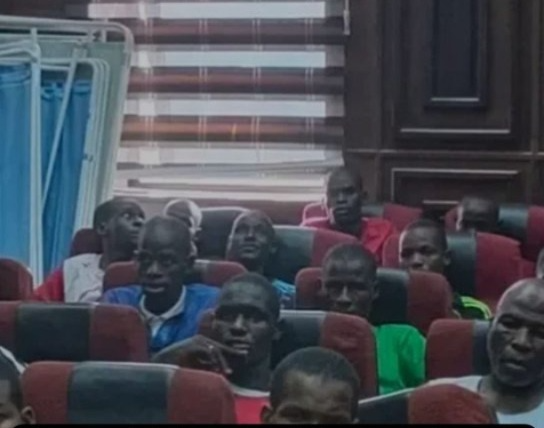
Nigeria Convicts 386 Terrorism Suspects in Four-Day Abuja Mass Trial as Government Pushes Judicial Offensive
Nigeria has convicted 386 terrorism suspects after a four-day mass trial at the Federal High Court in Abuja, in what officials describe as the ninth phase of the country’s long-running effort to clear a backlog of terrorism cases tied largely to the Boko Haram conflict and related extremist violence. According to Attorney-General and Justice Minister Lateef Fagbemi, the government brought 508 terrorism-related cases before the court during the special sitting, which began on Tuesday and ended on Friday, with proceedings handled by 10 Federal High Court judges.
The official breakdown is more precise than the headline figure of “more than 300” suggests. Fagbemi said 386 defendants were convicted, eight were discharged, two were acquitted, and 112 cases were adjourned to the next phase of proceedings. He said the inclusion of discharges and acquittals demonstrated that the process was not purely mechanical and that courts distinguished between cases supported by sufficient evidence and those that were not. The adjourned matters are due to continue in mid-June.
The trial took place at the Abuja Division of the Federal High Court despite the Easter vacation, reflecting the government’s attempt to give urgency to terrorism prosecutions that have often dragged on for years. Nigerian outlets reported that judges including Binta Nyako, Emeka Nwite, Musa Liman and Akpan Ekerete were among those handling the cases. The proceedings were part of a coordinated special sitting rather than a single courtroom trial, which is why hundreds of cases could be processed over four days.
Many of the convictions followed guilty pleas, and sentences ranged widely depending on the offence. Fagbemi and several media reports said some convicts received prison terms of up to 20 years, while other reports indicated that penalties in the broader exercise ranged from five years to life imprisonment, depending on the facts of each case and the count proved against each defendant. The government used the outcome to project toughness, with Fagbemi saying the state had been able to bring the accused to justice and was sending a clear message that there was no place for terrorism in Nigeria.
Several individual cases emerging from the mass trial help explain the kinds of conduct the state is targeting. One of the most prominent was the conviction of Babagana Habeeb, a Maiduguri-based fuel dealer and former Borno senatorial aspirant, who was sentenced to 10 years after pleading guilty to aiding and abetting terrorism through the sale of petroleum products to Boko Haram members. Other defendants reportedly received long terms for supplying cattle, goats, money, or other logistical support to the insurgents. These cases show that the government is not focusing only on gunmen captured in battle, but also on alleged facilitators, financiers and suppliers.
The mass trial unfolded against an exceptionally broad and deteriorating security landscape. Nigeria’s northeastern insurgency, driven first by Boko Haram and later complicated by Islamic State West Africa Province, has lasted more than a decade and remains the country’s most internationally recognised conflict. But the violence has spread and fragmented. AP noted that Nigeria is also contending with Islamic State-linked Lakurawa elements in the northwest, large-scale kidnapping gangs, and deadly farmer-herder violence in north-central areas. Together these overlapping crises have produced mass displacement, thousands of deaths, and repeated warnings from the United Nations over the humanitarian cost.
That wider context is important because the Abuja proceedings were not held in a period of improving calm. They happened as attacks continued elsewhere in the country, including recent killings in Niger, Benue, Kaduna and Borno states. In that sense, the trial was not simply retrospective justice for older offences; it was also a political and judicial response to an active conflict environment in which the state is trying to show it can punish not just violence itself but the networks that sustain it.
The government’s presentation of the trial stressed legality and due process. Fagbemi said the mix of convictions, discharges and acquittals showed adherence to the rule of law. BusinessDay reported before the proceedings began that the government described the phase as open and in line with judicial standards, while some reports also noted the presence of observers from relevant institutions during earlier terrorism-trial phases. Still, the speed and scale of the process inevitably revive longstanding concerns about whether mass terrorism trials can provide consistently robust defence, disclosure, and scrutiny in every case.
Those concerns are not new. The Institute for Security Studies warned in an earlier assessment of Nigeria’s mass terror trials that the country needed to learn from problems in prior rounds, including weak case preparation, the danger of overbroad prosecutions, and the challenge of distinguishing between hardened operatives and people swept into detention under looser suspicion. United Nations special procedure correspondence last year also raised concerns around prolonged detention and the handling of terrorism-related defendants in Nigeria, particularly where cases involve logistical support allegations rather than direct battlefield conduct. Those earlier warnings do not prove wrongdoing in this latest phase, but they are part of the background against which these convictions will be judged.
Even so, from the government’s perspective, the Abuja outcome is significant. It reduces a visible part of the backlog, reinforces the judiciary’s role in the counterterrorism system, and gives Abuja a concrete achievement to point to at a time when the military campaign alone is not delivering a decisive end to insecurity. The choice to deploy 10 judges simultaneously, even during court vacation, indicates that the authorities want these trials to be seen as a national priority rather than an administrative afterthought.
The clearest verified picture, then, is this: Nigeria processed 508 terrorism-related cases in a four-day special sitting in Abuja; 386 defendants were convicted, eight discharged, two acquitted, and 112 cases rolled over; many convictions followed guilty pleas; and sentences reached at least 20 years, with some local reports indicating even stiffer penalties in particular cases. Whether this marks a turning point in accountability or merely a dramatic episode in an overburdened justice system will depend on what follows next: the June continuation of adjourned cases, the transparency of appeal processes, and whether courtroom results are matched by real improvement in the security conditions that produced the prosecutions in the first place.
📩 Stone Reporters News | 🌍 stonereportersnews.com
✉️ info@stonereportersnews.com | 📘 Facebook: Stone Reporters News | 🐦 X (Twitter): @StoneReportNew | 📸 Instagram: @stonereportersnews
Reported by: Oahimire Omone Precious | Edited by: Gabriel Osa
Add comment
Comments