

Reported by: Ijeoma G | Edited by: Oravbiere Osayomore Promise.
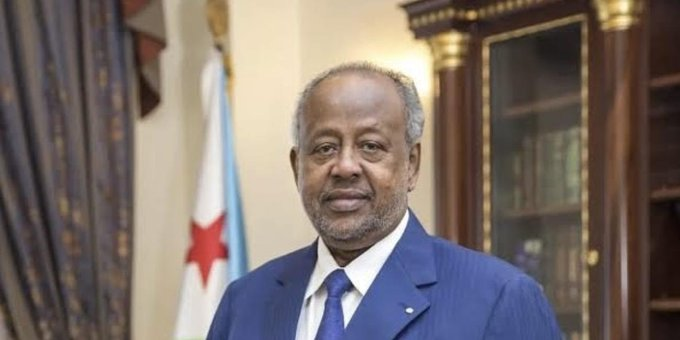
Djibouti’s long-serving President Ismaïl Omar Guelleh has secured re-election for a sixth term, extending his rule over the Horn of Africa nation to 27 years following an election in which he won an overwhelming majority of the vote, according to official results released by the country’s electoral authorities.
The election, held on April 10, 2026, saw Guelleh win approximately 97.8 percent of the vote, cementing his continued dominance in a political system that has been largely controlled by his ruling coalition since he first assumed office in 1999. Turnout was reported at around 80 percent of registered voters, according to state-linked electoral figures, reflecting participation in a contest widely viewed as lacking genuine competition.
Guelleh, aged 77, faced only one challenger in the election, Mohamed Farah Samatar, a former government insider who ran as an independent candidate. Samatar reportedly secured just over 2 percent of the vote, highlighting the limited competitiveness of the race. Several opposition groups either boycotted the election entirely or were excluded from meaningful participation, citing longstanding restrictions on political activity and unequal access to state media and campaign resources.
The election followed a constitutional amendment passed in 2025 that removed the presidential age limit of 75. That change effectively cleared the way for Guelleh to seek another term despite previous constitutional constraints. Critics had warned at the time that the reform was designed to prolong his stay in power, while government supporters argued it was necessary to maintain political stability and continuity.
Guelleh’s presidency, which began in 1999 after he succeeded his uncle Hassan Gouled Aptidon, has been marked by strong centralized control over political institutions. His party, along with allied coalitions, has consistently dominated parliamentary and presidential elections over the past two decades, often amid opposition boycotts or fragmented participation.
Djibouti’s strategic location at the entrance to the Red Sea and the Gulf of Aden has made it one of the most geopolitically significant small states in the world. The country hosts military bases for several global powers, including the United States, China, France, Japan, and Italy. These installations, alongside port operations that serve landlocked Ethiopia, form the backbone of Djibouti’s economy and contribute significantly to state revenue.
State media described the election process as peaceful, with no major incidents reported on voting day. Supporters of the president gathered in the capital to celebrate the result, portraying it as a continuation of stability in a region often affected by conflict and political instability.
Regional bodies such as the African Union and the Intergovernmental Authority on Development acknowledged the election outcome and called for continued cooperation and peace in the region. However, international human rights organizations have repeatedly raised concerns about the political environment in Djibouti, pointing to limitations on opposition activity, press freedom, and political pluralism.
Authorities in Djibouti have consistently rejected these criticisms, maintaining that elections reflect the will of the people and that stability is essential given the country’s sensitive geopolitical environment. Government officials often emphasize that Djibouti’s role as a security and logistics hub requires continuity in leadership to maintain investor confidence and international partnerships.
Economically, Djibouti relies heavily on its ports and logistics services, particularly those linked to Ethiopia’s imports and exports. The country’s economy is also supported by lease payments from foreign military bases, which constitute a significant portion of national revenue. However, analysts have noted that this model makes Djibouti highly dependent on external actors and vulnerable to shifts in regional dynamics and global trade patterns.
Over the years, Guelleh’s leadership has been credited by supporters with maintaining relative stability in a volatile region that includes conflict-affected neighbors such as Somalia and Yemen. At the same time, critics argue that the concentration of political power has limited democratic development and restricted meaningful political competition.
The latest election result effectively ensures that Guelleh will remain in office until at least the early 2030s, depending on constitutional provisions and future reforms. His continued leadership underscores both the entrenched nature of Djibouti’s political system and the broader challenges of governance in strategic but institutionally constrained states.
As Djibouti enters another term under President Guelleh, attention is expected to remain focused on issues of political reform, economic diversification, and the country’s evolving role in regional and global security architecture.
📩 Stone Reporters News | 🌍 stonereportersnews.com
✉️ info@stonereportersnews.com | 📘 Facebook: Stone Reporters News | 🐦 X (Twitter): @StoneReportNew | 📸 Instagram: @stonereportersnews
Add comment
Comments