

Reported by: Ijeoma G | Edited by: Oravbiere Osayomore Promise.
Africa’s richest industrialist, Aliko Dangote, is preparing a landmark move that could reshape capital markets across the continent, with plans to offer shares in his $20 billion oil refinery on multiple African stock exchanges—a first-of-its-kind initiative aimed at deepening regional investment integration and attracting global capital into Africa’s energy sector.
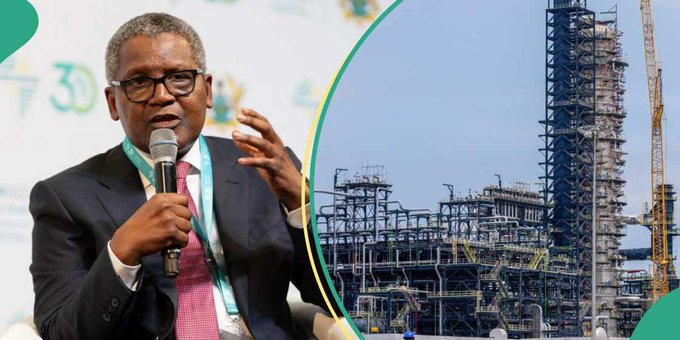
The proposed listing of the Dangote Refinery, located in Nigeria’s Lekki Free Zone, represents one of the most ambitious corporate finance strategies ever undertaken in Africa. The refinery, which began operations in 2024 after nearly a decade of construction, has a processing capacity of 650,000 barrels per day, making it the largest single-train refinery in the world and a central pillar in efforts to transform Africa’s energy independence.
According to multiple industry disclosures, Dangote Group intends to float between 5 percent and 10 percent of the refinery’s equity to investors while retaining majority ownership. The offering is expected to value the refinery between $40 billion and $50 billion, potentially making it the largest initial public offering ever conducted on an African exchange.
What distinguishes this planned offering is its multi-exchange ambition. Discussions are underway involving several major African bourses, including the Nigerian Exchange Group, the Johannesburg Stock Exchange, and the Bourse Régionale des Valeurs Mobilières. The goal is to allow investors across different African markets to participate directly in the ownership of the refinery, marking a significant step toward financial market integration on the continent.
Market analysts say the strategy reflects a broader vision to create a pan-African investment asset, one that mirrors the refinery’s role as a continental energy supplier. The facility already exports refined petroleum products—including gasoline, diesel, and aviation fuel—to countries across West, Central, and East Africa, helping to reduce dependence on imports from Europe and the Middle East.
The IPO is also expected to introduce innovative financial mechanisms tailored to attract both domestic and international investors. One such feature under consideration allows investors to purchase shares in local currency while receiving dividends in U.S. dollars. This hybrid structure is designed to mitigate currency risk, a major concern for foreign investors in African markets, and is backed by the refinery’s strong export revenues, projected at over $6 billion annually.
Dangote has repeatedly emphasized that the listing is part of a broader effort to democratize ownership of the refinery and address concerns about market dominance. By opening up equity participation, the company aims to broaden its investor base while strengthening transparency and corporate governance.
The timing of the planned listing aligns with the refinery’s increasing operational capacity and strategic importance. Since reaching full production levels earlier in 2026, the facility has ramped up exports to African markets, shipping multiple cargoes of gasoline and significantly boosting urea fertilizer distribution. These developments have positioned the refinery as a key player in stabilizing fuel supply across the continent, particularly amid disruptions linked to global geopolitical tensions.
Recent data shows that Nigeria’s petroleum exports have surged as a result of the refinery’s output, with shipments reaching multiple African countries including Ghana, Cameroon, and Tanzania. The refinery’s growing influence has coincided with a sharp decline in fuel imports into Nigeria, marking a shift in the country’s long-standing reliance on foreign refined products.
The planned share sale is also closely tied to Dangote Group’s expansion strategy. The company has outlined ambitions to double the refinery’s capacity to 1.4 million barrels per day within the next few years, a move that would position it among the largest refining complexes globally. Financing for this expansion is expected to come partly from the proceeds of the equity offering, as well as loans from institutions such as the African Export-Import Bank.
Financial advisors, including major investment banks and regional brokerage firms, have already been engaged to structure the offering and navigate regulatory approvals across multiple jurisdictions. The complexity of listing on several exchanges simultaneously presents significant logistical and legal challenges, particularly in harmonizing disclosure requirements, currency frameworks, and investor protections.
Despite these hurdles, market observers view the initiative as a potential catalyst for deeper integration of African capital markets. If successful, the Dangote refinery listing could pave the way for other large-scale African enterprises to pursue cross-border listings, enhancing liquidity, increasing investor participation, and strengthening financial connectivity across the continent.
Economists also note the broader implications for Africa’s industrialization agenda. By mobilizing capital from within the continent, the listing could reduce reliance on external financing and support the development of homegrown industries. It may also encourage pension funds, sovereign wealth funds, and retail investors across Africa to allocate more resources to infrastructure and energy projects.
However, some analysts caution that the success of the offering will depend on market conditions, regulatory approvals, and investor confidence. Currency volatility, political risk, and varying levels of market maturity across African exchanges remain key considerations that could influence the final structure and timing of the IPO.
Dangote Group has not yet announced a definitive date for the multi-exchange listing, but indications suggest it could take place in phases, beginning with the Nigerian Exchange before expanding to other African markets. The process is expected to unfold over the course of 2026, subject to regulatory clearance and market readiness.
For Dangote, the move represents more than a financial milestone; it is a strategic effort to position Africa as a serious player in global energy markets. By opening up ownership of its flagship refinery to investors across the continent, the company is effectively inviting Africa to co-own one of its most significant industrial assets.
As preparations intensify, the planned listing is already being described as a transformative moment for African finance—one that could redefine how major infrastructure projects are funded and owned, and signal a new era of cross-border investment collaboration on the continent.
📩 Stone Reporters News | 🌍 stonereportersnews.com
✉️ info@stonereportersnews.com | 📘 Facebook: Stone Reporters News | 🐦 X (Twitter): @StoneReportNew | 📸 Instagram: @stonereportersnews
Add comment
Comments