

Published by: Oravbiere Osayomore Promise.
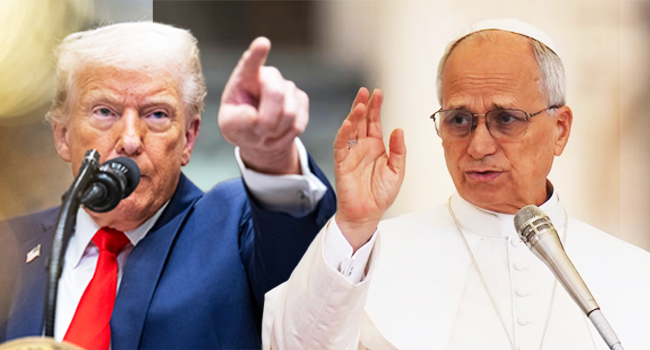
A sharp and highly unusual public confrontation has erupted between U.S. President Donald Trump and Pope Leo XIV following the pontiff’s renewed call for an end to war, exposing deep ideological divisions between political power and religious authority at a time of mounting global tensions.
The dispute intensified after Pope Leo delivered a forceful anti-war message during a vigil at St. Peter’s Basilica, where he condemned what he described as the “idolatry of power” and warned against the growing normalization of violence in international relations. Without naming specific countries, the pope urged world leaders to abandon militarism and pursue dialogue, declaring emphatically that humanity must move away from war. His remarks were widely interpreted as a critique of ongoing global conflicts involving major international powers, including tensions linked to the United States and its allies.
President Donald Trump responded swiftly and directly after returning to Washington, telling reporters he was “not a big fan” of the pope and describing him as “very liberal.” He accused the pontiff of taking positions that weaken global security and suggested that his rhetoric on international conflict was unrealistic in the face of escalating geopolitical threats. Trump also criticized the pope’s approach to issues surrounding Iran, arguing that it failed to adequately address concerns about nuclear development and regional instability.
The president’s remarks were further amplified through subsequent public comments, where he portrayed the pope’s message as incompatible with his administration’s foreign policy priorities. He argued that calls for restraint, particularly in the context of ongoing international tensions, risked emboldening adversaries and undermining deterrence strategies. The tone and directness of the criticism marked a rare and striking public disagreement between a U.S. president and the head of the Catholic Church.
Pope Leo, the first American-born pontiff, has increasingly positioned himself as a global voice for peace amid rising conflicts around the world. In his recent address, he warned against what he described as a moral decline in global leadership, where power and military force are increasingly prioritized over diplomacy and human life. He called on nations to pursue negotiation and reject violence, stressing that war brings irreversible human suffering.
Although the pope did not directly mention Trump or any specific government, his message came at a time of heightened tensions in the Middle East and broader international concerns over the risk of escalation. His repeated appeals for peace have become a defining feature of his early papacy, drawing both praise from humanitarian groups and criticism from political figures who view his stance as overly idealistic.
Following the backlash from the U.S. president, Pope Leo addressed the controversy while speaking to journalists during an overseas trip. He emphasized that his role is spiritual rather than political, insisting that his statements are rooted in religious teaching and moral responsibility rather than alignment with any political ideology. He reaffirmed that he would continue to speak out against war and injustice, regardless of criticism or political pressure.
The pope also highlighted the human cost of ongoing conflicts, pointing to civilian suffering, displacement, and loss of life as central concerns of his message. He argued that silence in the face of violence would represent a failure of moral leadership and reiterated his call for dialogue as the only sustainable path to peace.
The disagreement comes against a backdrop of already strained international relations, particularly in regions affected by ongoing hostilities involving Iran and other Middle Eastern actors. Pope Leo has consistently urged restraint in these conflicts, warning that continued escalation could lead to wider instability and humanitarian disaster.
Trump, however, has maintained a firm stance emphasizing strength and deterrence as necessary tools for managing global threats. His criticism of the pope reflects a broader ideological divide over the use of military power in international relations, with the administration prioritizing security and strategic dominance while the Vatican stresses moral responsibility and human dignity.
The public exchange has generated significant attention among political analysts and religious commentators, many of whom describe it as an unusual intersection of global leadership and moral authority. Some view the pope’s position as a continuation of long-standing Catholic teaching on peace and the sanctity of life, while others argue that his comments risk entering the realm of political interference.
Pope Leo’s status as the first American pope adds an additional layer of complexity to the dispute, as he now finds himself in the unusual position of openly disagreeing with the political leadership of his country of origin while leading a global religious institution. Supporters argue that this independence strengthens his moral credibility, while critics say it complicates relations between church and state.
Despite the sharp rhetoric, there has been no indication of a formal diplomatic breakdown between the United States and the Vatican. Both sides continue to maintain official channels of communication, and historical precedent suggests that disagreements of this nature are typically managed without long-term institutional consequences.
Still, the episode highlights growing tensions between two influential global voices with contrasting views on war, peace, and international responsibility. As global conflicts continue to evolve, both the White House and the Vatican appear firmly committed to their respective positions, with little sign of immediate reconciliation.
The situation underscores a broader global debate over how best to respond to insecurity and conflict in an increasingly unstable international environment. While one side emphasizes military readiness and strategic pressure, the other calls for restraint, dialogue, and moral reflection as the foundation for lasting peace.
As Pope Leo continues his international engagements, he has reiterated that his message will remain focused on peace and humanitarian concern. President Trump, meanwhile, has shown no indication of softening his criticism, suggesting that the divide between the two leaders is likely to persist in the near future.
📩 Stone Reporters News | 🌍 stonereportersnews.com
✉️ info@stonereportersnews.com | 📘 Facebook: Stone Reporters News | 🐦 X (Twitter): @StoneReportNew | 📸 Instagram: @stonereportersnews
Add comment
Comments