

Reported by: Ijeoma G | Edited by: Oravbiere Osayomore Promise.
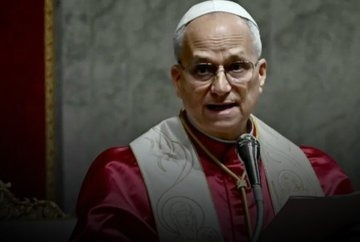
The claim that Pope Leo XIV has refused to engage in a public debate with United States President Donald Trump over remarks concerning Iran has circulated widely online, but available verified information from the Vatican and major international news organizations does not confirm that such an exchange or statement has taken place.
As of current public record, there is no authenticated transcript of comments made by the pontiff using the title Pope Leo XIV, nor is there evidence of an official Vatican press briefing describing a confrontation with President Trump on the subject of Iran or any related geopolitical dispute.
Fact-checking across established international media outlets and official Vatican communication channels shows no record of Pope Leo XIV holding an in-flight press conference on a journey to Algeria or making statements regarding direct political debate with the United States president.
The Vatican typically releases transcripts of papal remarks through its press office, and no such documentation matching the quoted statements has been made available, further raising questions about the authenticity of the circulating narrative.
Public interest in relations between the United States and Iran has remained high due to ongoing geopolitical tensions, with global leaders frequently issuing statements calling for de-escalation, diplomacy, and restraint in the region.
However, despite heightened attention to these issues, there is no credible evidence linking Pope Leo XIV to any recent commentary directed at President Trump, nor is there confirmation of any diplomatic or political exchange between the two figures on this subject.
Analysts note that misinformation involving high-profile religious and political figures often spreads rapidly on social media platforms, particularly when it intersects with sensitive international relations topics such as nuclear diplomacy and security concerns in the Middle East.
Media literacy experts emphasize the importance of verifying statements attributed to global leaders through official channels, especially in an era where digitally manipulated content and fabricated quotes can easily circulate without verification.
The current situation underscores the broader challenge faced by news consumers in distinguishing between authentic statements and fabricated narratives, particularly when stories involve figures of global religious authority and high-profile political leaders whose words carry significant international weight.
As of this report, neither the Vatican Press Office nor the White House has issued any confirmation regarding the alleged remarks, and no verified media outlet has reported a direct exchange between Pope Leo XIV and President Trump on the issue of Iran.
Historically, the papacy has often adopted a neutral diplomatic posture in international conflicts, focusing on humanitarian appeals and calls for peace rather than direct political confrontation with individual heads of state, a tradition maintained through formal Vatican diplomacy and the work of the Holy See in international organizations.
Relations between Washington and Tehran have remained tense for decades, shaped by disagreements over nuclear enrichment, regional security dynamics, sanctions regimes, and periodic military incidents that have drawn global concern and repeated diplomatic interventions by multiple world powers.
In recent years, the rapid spread of unverified political content online has led to frequent confusion regarding statements attributed to global leaders, with fabricated quotes often gaining traction before official clarification can be issued by relevant authorities.
The Vatican Press Office typically relies on structured briefing notes, written transcripts, and accredited journalist reporting to communicate papal statements, ensuring that official remarks are preserved accurately and disseminated through recognized channels to prevent misinterpretation or fabrication.
Media analysts continue to emphasize the importance of cross-checking politically sensitive claims with multiple reputable sources, particularly when statements involve global religious figures or matters of international security where misinformation can escalate public misunderstanding.
Social media platforms have played a significant role in amplifying the unverified claim, with posts and short video clips circulating widely across different regions, often stripped of context and presented as confirmed statements, which has contributed to confusion among audiences seeking reliable information.
Observers note that high-profile interactions involving religious leaders and political figures tend to attract heightened attention, especially when they involve contentious geopolitical issues, making them particularly vulnerable to distortion or misrepresentation in online environments where speed of dissemination often outweighs verification processes.
International news organizations typically require multiple layers of confirmation before attributing direct quotations to heads of state or religious leaders, including corroboration from official spokespeople, recorded transcripts, or on-the-record briefings conducted through established press channels.
Given the absence of such corroboration in this case, media experts recommend treating the statement as unverified until further notice, particularly in light of the potential for politically sensitive misinformation to spread during periods of heightened global tension.
Such developments highlight the broader challenge facing both journalists and audiences in distinguishing between legitimate diplomatic communication and fabricated narratives, especially when content is rapidly shared across platforms without editorial oversight or institutional verification.
Experts further emphasize that public understanding of international affairs depends heavily on responsible reporting practices, transparent sourcing, and critical evaluation of claims, particularly when they involve figures such as the Pope or the President of the United States whose statements carry global diplomatic weight.
Until verified information emerges from official Vatican communications or recognized international media organizations, the claim remains unsubstantiated. Analysts caution that the proliferation of such narratives underscores the importance of verifying political and religious statements before acceptance or dissemination, especially in an environment where digital content can be rapidly altered or misrepresented. As global audiences continue to engage with international news through social media platforms, the responsibility of ensuring accuracy becomes increasingly shared between media producers and consumers alike. In this context, the case serves as a reminder of the need for careful scrutiny of viral claims and the continued relevance of traditional journalistic standards in an evolving information landscape.
Authorities and media monitors continue to track the spread of the claim, urging restraint until verified confirmation is issued through official diplomatic or ecclesiastical channels.
📩 Stone Reporters News | 🌍 stonereportersnews.com
✉️ info@stonereportersnews.com | 📘 Facebook: Stone Reporters News | 🐦 X (Twitter): @StoneReportNew | 📸 Instagram: @stonereportersnews
Add comment
Comments