

Reported by: Ijeoma G | Edited by: Carmen Diego
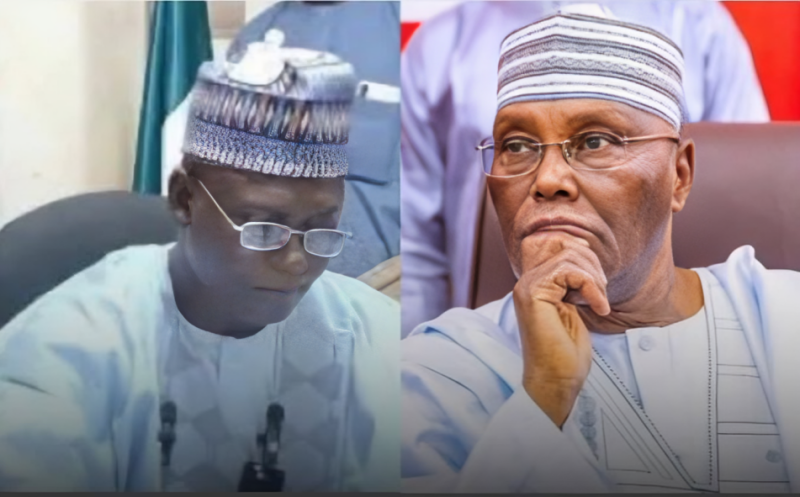
A fresh internal rupture has opened in the African Democratic Congress in Adamawa State after a faction of the party announced the suspension of former Vice President Atiku Abubakar, former Secretary to the Government of the Federation Babachir Lawal, and several other figures over alleged anti-party activities, a move challenged by rival party officials and dismissed by Lawal as illegitimate.
The suspension was announced on Monday, April 13, by Muh’d Raji Sulaiman Zumo, who identified himself as chairman of a faction of the ADC in Adamawa. Addressing journalists, Zumo said no member is above the party’s constitution, and argued that the decision followed consultations within his executive. He accused Atiku, Lawal and others of fostering disunity in the state chapter. Reports from multiple Nigerian outlets said those named included Atiku, Lawal, transition committee chairman Sadiq Ibrahim or Sadiq Dasin, though reports varied on the list and titles.
What might have been presented as a disciplinary action quickly turned into a public test of legitimacy inside a party already engulfed by competing claims to authority. Within hours, Lawal rejected the announcement outright, saying the individuals behind it lacked lawful standing and should not be taken seriously. In comments reported by major Nigerian newspapers, the former SGF described the purported suspension as baseless and said Zumo had no recognised authority to speak for the party in Adamawa. Yohanna Shehu, another figure identified in reports as the Adamawa State chairman of the ADC, also distanced the party from the move and questioned Zumo’s status.
The clash in Adamawa is not an isolated quarrel. It is part of a wider leadership struggle that has gripped the ADC since the party was adopted last year by a coalition of opposition politicians seeking a stronger platform ahead of Nigeria’s 2027 general election. That coalition, closely associated with Atiku and other opposition figures, elevated former Senate President David Mark and former Osun State governor Rauf Aregbesola into leading national roles. But the transition triggered resistance from rival blocs within the party, setting off a legal and organisational battle over who controls the ADC’s structures.
That national dispute has intensified in recent days. Court filings and news reports show that the David Mark-led camp has been battling challenges over its recognition, including disputes involving the Independent National Electoral Commission and rival party officers. The Supreme Court is due to hear an appeal linked to the party’s leadership crisis on Tuesday, April 14, the same day the Mark-led faction is expected to hold a national convention in Abuja. The convention itself became part of the controversy after the party said it had faced venue denials before securing the Rainbow Event Centre in Abuja.
Against that background, the Adamawa suspension announcement appears to be as much about control of local structures as about discipline. Adamawa is Atiku’s home state and remains important in any contest over his political base. It is also one of the states where the ADC’s internal divisions have become visible. A High Court in Yola recently ordered the suspension of ADC congresses in the state pending the hearing of a suit filed by Yohanna Shehu, who argued that he and his executives had been sidelined from the planning process. The court fixed April 15 for further hearing, although reports said controversial congresses still went ahead.
Those congresses have since become another flashpoint. Several reports said Sadiq Dasin emerged from the disputed exercise as a state chairman, while critics argued that the process violated the court order. Senator Aishatu Ahmed Binani, a prominent ADC governorship aspirant in Adamawa, also faulted the congresses and said her bloc stayed away because of the legal issues surrounding them. That means the suspension announced by Zumo rests on party structures whose legitimacy is already being challenged both politically and judicially.
For Atiku, the development is politically awkward even if it does not immediately carry enforceable consequences beyond the faction that pronounced it. The former vice president has been one of the most visible figures in efforts to consolidate an opposition front capable of confronting President Bola Tinubu and the ruling All Progressives Congress in the 2027 election cycle. His association with the ADC coalition has made the party a focal point of political calculations, but it has also drawn internal resistance from those who see the coalition as an attempted takeover of an existing platform.
The timing is therefore significant. The suspension drama broke on the eve of a crucial Supreme Court hearing and just before the party’s national convention, amplifying questions about whether the ADC can project unity at a moment when it is trying to position itself as a credible national alternative. For critics, the spectacle reinforces doubts about the coherence of the opposition. For supporters of the Mark-led camp, the incident may be seen as one more episode in a struggle they argue is being driven by hostile factions and procedural sabotage.
So far, there is no indication from the material published Monday that Atiku himself issued a direct public response to the suspension claim. The clearest rebuttal came from Lawal and from rival Adamawa party officials who argued that the announcement had no constitutional force. That leaves the immediate status of the suspension contested rather than settled. In practical terms, the question of who can validly suspend a member, organise congresses, or speak for the Adamawa chapter now appears inseparable from the court cases and national leadership battles still unfolding.
What is already clear is that the episode has exposed the fragility of the ADC’s attempt to transform itself into the central vehicle of Nigeria’s opposition. A party hoping to market discipline, cohesion and national readiness has instead entered a decisive week consumed by litigation, rival executives, disputed congresses and public insults among senior figures. Whether the courts, the convention or a negotiated settlement can restore order remains uncertain. But for now, the Adamawa suspension of Atiku has become less a straightforward disciplinary story than a vivid symptom of a party struggling to determine who is actually in charge.
📩 Stone Reporters News | 🌍 stonereportersnews.com
✉️ info@stonereportersnews.com | 📘 Facebook: Stone Reporters News | 🐦 X (Twitter): @StoneReportNew | 📸 Instagram: @stonereportersnews
Add comment
Comments