

Reported by: Ijeoma G | Edited by: Oravbiere Osayomore Promise.
The Dangote Group has dismissed a widely circulated social media claim alleging that the Federal Government collects “52 kobo from every N1 on cement,” describing the statement as false and wrongly attributed to its chairman, Aliko Dangote.
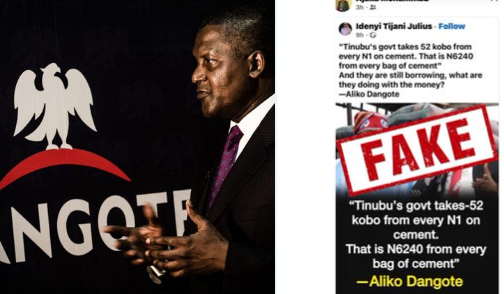
The claim, which gained traction across platforms including Facebook, was reportedly posted by a user identified as Idenyi Tijani Julius and attributed to Dangote. The post suggested that the government extracts significant revenue from cement sales, claiming that the equivalent of N6,240 is taken from every bag, and questioned why authorities would continue borrowing despite such purported income.
The message quickly spread, fueling public debate over cement pricing, taxation, and broader economic management. Given the importance of cement in Nigeria’s construction sector and its impact on housing and infrastructure costs, the claim drew significant attention and reactions from users concerned about affordability and fiscal policy.
In response, the Dangote Group issued a clarification via its official account on X, categorically rejecting the statement. The company shared a screenshot of the viral post clearly marked “FAKE,” distancing both the organisation and its chairman from the content.
By publicly debunking the claim, the company sought to correct what it described as misinformation and to prevent further confusion among the public. It emphasized that the statement did not originate from Dangote and should not be regarded as an accurate reflection of government taxation or company position.
The swift rebuttal reflects growing concern among major corporations about the spread of misinformation on social media, particularly when such claims have the potential to influence public perception, market dynamics, or policy discussions. Analysts note that viral posts, even when inaccurate, can shape narratives around sensitive economic issues such as pricing and taxation.
Cement pricing in Nigeria has long been a subject of public scrutiny, given its central role in construction and infrastructure development. As one of the country’s leading producers, Dangote Cement operates at the heart of this conversation, making it particularly vulnerable to speculation and misinformation.
Industry observers say that while taxes and levies do contribute to the final cost of goods, claims such as the one circulated online often lack context or factual basis. They stress the importance of relying on verified information, especially when discussing complex issues involving government policy and corporate operations.
The incident also highlights the challenges posed by digital platforms, where unverified content can spread rapidly before corrections are issued. In recent years, both government agencies and private organisations have increased efforts to counter false information through timely responses and public awareness campaigns.
For the Dangote Group, the decision to address the claim directly underscores its approach to reputation management and transparency. By promptly clarifying the issue, the company aimed to reassure stakeholders and maintain confidence in its operations.
The broader economic context adds further significance to the situation. Nigeria continues to navigate a period of economic adjustment, with ongoing debates about fiscal policy, taxation, and the cost of living. In such an environment, misinformation related to pricing or government revenue can easily gain traction and amplify public concerns.
Experts warn that inaccurate claims about taxation can distort public understanding and complicate policy discussions. They argue that clear communication from both the public and private sectors is essential to ensure that citizens have access to reliable information.
The Dangote Group’s response serves as a reminder of the need for critical evaluation of online content, particularly when it involves high-profile individuals or sensitive economic topics. As digital platforms remain a primary source of information for many Nigerians, the responsibility to verify claims before sharing them has become increasingly important.
While the viral post has been widely discredited, its rapid spread illustrates the ongoing challenge of combating misinformation in the digital age. For companies like Dangote Group, maintaining public trust requires not only operational performance but also active engagement in correcting false narratives.
As discussions around cement pricing and taxation continue, stakeholders are expected to rely more heavily on official data and credible sources to guide public discourse. The incident underscores the importance of accuracy in economic reporting and the role of institutions in safeguarding factual integrity.
📩 Stone Reporters News | 🌍 stonereportersnews.com
✉️ info@stonereportersnews.com | 📘 Facebook: Stone Reporters News | 🐦 X (Twitter): @StoneReportNew | 📸 Instagram: @stonereportersnews
Add comment
Comments