

Reported by: Ijeoma G | Edited by: Oravbiere Osayomore Promise.
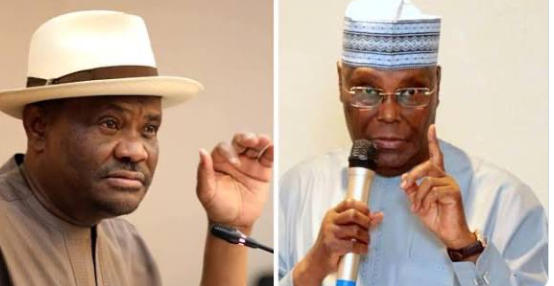
Nigeria’s Minister of the Federal Capital Territory, Nyesom Wike, has launched a fresh verbal attack on former Vice President Atiku Abubakar, describing him as a “serial contestant and loser” while predicting that he would still pursue the presidency again in 2031.
Wike made the remarks during a public inspection of ongoing infrastructure projects in Abuja, where he also responded to recent criticisms directed at the administration of President Bola Ahmed Tinubu by opposition figures, including Atiku.
According to Wike, Atiku’s repeated presidential bids have weakened his credibility as a critic of government performance. He argued that Nigerians would find it difficult to take seriously a politician who has consistently contested for the presidency without success over several election cycles.
He stated that Atiku would likely continue in his political ambitions despite previous losses, adding that even after the 2027 election cycle, the former vice president would still be in the race again in 2031. Wike used the comment to question what he described as contradictions in Atiku’s political messaging, particularly his criticisms of the current administration.
The FCT minister also challenged Atiku’s record in public office, comparing developments in Abuja under successive administrations and arguing that significant infrastructural improvements were being achieved under the current government. He maintained that ongoing projects in the capital were evidence of effective governance and should not be overshadowed by political disagreements.
Wike’s comments come amid ongoing political tension between key figures in Nigeria’s ruling and opposition blocs. Atiku Abubakar, a former vice president and long-time presidential candidate, has remained one of the most prominent opposition voices in the country. He has contested the presidency multiple times since the return to civilian rule in 1999, but has not succeeded in winning the office.
In recent public statements, Atiku has continued to criticize the Tinubu administration, particularly on economic policies and governance direction. He has argued that the government’s reforms have placed significant strain on Nigerians, citing rising living costs and economic hardship as key concerns.
Wike, who previously served as governor of Rivers State before becoming FCT minister, has in recent years aligned himself closely with the current administration. He has frequently responded to opposition criticisms, particularly from figures within the Peoples Democratic Party, from which he has had a strained relationship following internal party disputes.
The latest exchange reflects continuing political realignments and rivalries within Nigeria’s political landscape. Wike’s remarks also highlight the increasing use of personal political histories as a tool in public criticism, particularly ahead of future election cycles.
Beyond the political back-and-forth, Wike emphasized that his priority remains the delivery of infrastructure projects within the Federal Capital Territory. He stated that development work would continue regardless of political debates or election-related distractions, stressing that governance should take precedence over partisan disagreements.
He also reiterated that contractors and ongoing projects would not be affected by political considerations, insisting that administrative responsibilities must remain separate from electoral politics.
The comments have added to ongoing discussions about Nigeria’s evolving political environment, where prominent figures continue to position themselves for future contests even several years ahead of scheduled elections. Analysts note that such early political positioning is increasingly common among major actors in the country’s democratic space.
Atiku’s long-standing presence in presidential politics remains a defining feature of his career, while Wike’s outspoken style and strong alignment with the current administration have made him a prominent voice in defending government actions and responding to criticism.
The latest remarks further underline the deepening rivalry between leading political figures and reflect the heightened rhetoric that continues to shape Nigeria’s political discourse as attention gradually shifts toward future electoral cycles.
📩 Stone Reporters News | 🌍 stonereportersnews.com
✉️ info@stonereportersnews.com | 📘 Facebook: Stone Reporters News | 🐦 X (Twitter): @StoneReportNew | 📸 Instagram: @stonereportersnews
Add comment
Comments