

Reported by: Ijeoma G | Edited by: Oravbiere Osayomore Promise.
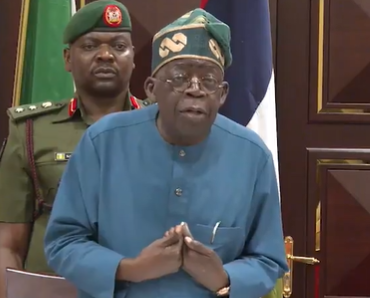
President Bola Ahmed Tinubu has stirred widespread reactions after declaring that his administration represents a continuation of the leadership of his predecessor, Muhammadu Buhari, describing the former president as his “partner” and asserting that “Buhari is me.”
The remarks were made during a recent engagement with political stakeholders, where Tinubu addressed concerns over his administration’s policies and defended the direction of ongoing economic reforms. In his comments, the president argued that his government should not be viewed as a departure from the previous administration, but rather as an extension of a shared vision that has been in motion for years.
According to him, “I took over leadership from myself. Buhari is me; he was my partner,” a statement that has since generated debate across political and public spaces. He added that if Nigerians are yet to see or appreciate the progress made so far under his leadership, “we will give them eyeglasses,” a remark widely interpreted as a metaphor suggesting that the achievements of his administration may not yet be fully visible to the public.
The statement comes at a time when Tinubu’s government is implementing major economic reforms that have reshaped Nigeria’s fiscal and monetary landscape. These include the removal of fuel subsidies, exchange rate adjustments, and broader structural reforms aimed at stabilizing the economy and encouraging investment. While these policies have been defended by the government as necessary and long overdue, they have also contributed to rising costs of living, prompting criticism from sections of the public.
Tinubu’s reference to Buhari as a “partner” reflects a long-standing political alliance between the two leaders. Both figures played key roles in the formation and rise of the ruling All Progressives Congress, which came to power in 2015 after defeating the then-incumbent government. Tinubu was widely seen as instrumental in building the coalition that supported Buhari’s presidential bid, and their partnership continued throughout Buhari’s tenure.
By framing his administration as a continuation of Buhari’s leadership, Tinubu appears to be reinforcing a narrative of political and policy continuity. Analysts say this approach may be aimed at maintaining cohesion within the ruling party while also positioning his government as part of a longer-term reform agenda rather than an isolated administration.
However, the statement has also prompted mixed reactions. Some supporters view it as a reaffirmation of unity and consistency in governance, while critics argue that it raises questions about accountability and the extent to which the current administration is willing to differentiate itself from the past. The comparison has also reignited discussions about the legacy of the previous administration and how it intersects with current policies.
The comment about “giving eyeglasses” has attracted particular attention, with varying interpretations. While some see it as a lighthearted expression of confidence in the administration’s progress, others have criticized it as potentially dismissive of the economic difficulties faced by many Nigerians. The remark has circulated widely in public discourse, reflecting the heightened sensitivity around issues of governance and economic performance.
Tinubu’s administration has consistently maintained that its reforms are designed to address long-standing structural challenges in the economy. Officials have argued that previous systems, including fuel subsidies and multiple exchange rates, were unsustainable and placed a heavy burden on public finances. The government has emphasized that while the transition may be difficult, the long-term benefits will include greater economic stability, improved infrastructure, and increased investor confidence.
The broader context of the president’s remarks lies in the ongoing debate about the pace and impact of these reforms. Many Nigerians continue to experience the immediate effects of policy changes, particularly in the form of higher fuel prices, increased transportation costs, and inflation. These realities have shaped public perceptions of the administration and influenced reactions to statements from government officials.
Political observers note that Tinubu’s assertion of continuity may also reflect the interconnected nature of governance, where policies and decisions often span multiple administrations. By aligning himself closely with Buhari’s legacy, the president may be seeking to emphasize that current reforms are part of a longer trajectory rather than abrupt or isolated measures.
At the same time, the statement underscores the challenges of leadership communication in a diverse and economically strained society. Balancing optimism about future gains with acknowledgment of present difficulties remains a delicate task for the administration, particularly as public expectations continue to evolve.
The alliance between Tinubu and Buhari has been one of the defining features of Nigeria’s recent political history. Their collaboration contributed to a major political shift in 2015 and shaped the direction of governance for nearly a decade. As Tinubu continues to lead the country, his efforts to build on that legacy while establishing his own policy identity remain central to his administration.
The latest remarks have added a new dimension to public discourse, highlighting questions about continuity, accountability, and the future direction of Nigeria’s governance. As reactions continue to emerge, the statement serves as a reminder of the complex relationship between past and present leadership in shaping national policy.
Whether interpreted as a statement of unity or a point of contention, Tinubu’s comments have reinforced the ongoing conversation about leadership, reform, and the expectations of Nigerians in a period of significant economic and political transition.
📩 Stone Reporters News | 🌍 stonereportersnews.com
✉️ info@stonereportersnews.com | 📘 Facebook: Stone Reporters News | 🐦 X (Twitter): @StoneReportNew | 📸 Instagram: @stonereportersnews
Add comment
Comments