

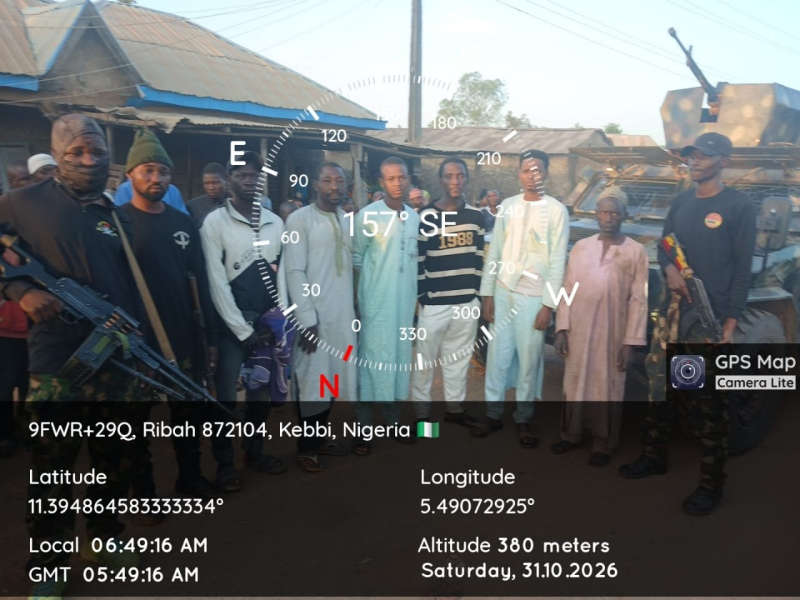
Troops of Sector 2, Operation FANSAN YAMMA, have reportedly rescued 11 kidnapped victims during two separate military operations in Danko-Wasagu Local Government Area of Kebbi State, following armed confrontations that forced suspected bandits to abandon their captives and flee.
The operations took place on October 30 and 31, 2026, along the Ribah road and around Wasagu, according to details of the military intervention. Seven victims were rescued during the first encounter, while four others regained their freedom after troops repelled an attack during a security patrol.
In the first incident, soldiers reportedly received a distress call concerning the movement of suspected bandits along the Ribah road. Troops mobilised towards the location and encountered the armed group, resulting in an exchange of gunfire.
The soldiers reportedly gained the advantage during the confrontation, compelling the attackers to withdraw and abandon seven kidnapped individuals. The troops subsequently secured the victims and made arrangements for their return to safety.
The second operation occurred around Wasagu, where soldiers conducting a patrol came under attack from suspected terrorists. The troops returned fire and repelled the assault, forcing the gunmen to retreat.
During their withdrawal, the attackers reportedly abandoned four people who had previously been abducted from their farms. The soldiers recovered the victims and ensured they were transferred to appropriate local authorities.
According to the operational account, all 11 rescued individuals have either been reunited with their families or handed over to community leaders responsible for facilitating their safe return.
The identities, ages and genders of the victims were not disclosed in the initial information. Their precise periods in captivity and the circumstances surrounding their original abductions also remain unclear.
There was no confirmed information about military casualties, arrests or weapons recovered during the engagements. The number of attackers involved and whether any sustained injuries have likewise not been independently established.
The reported operations represent another intervention by Operation FANSAN YAMMA, the military task force responsible for confronting armed groups involved in kidnapping, livestock theft and attacks on communities across northwestern Nigeria.
Sector 2 has maintained operations in Kebbi and neighbouring areas, where criminal groups frequently exploit difficult terrain, isolated settlements and rural transportation routes to carry out attacks.
Danko-Wasagu has experienced repeated security incidents involving farmers, travellers and livestock owners. Its communities remain vulnerable because agricultural activities often require residents to work considerable distances from established security positions.
The latest rescue highlights the importance of responding quickly to distress calls, particularly when abductors are moving victims between locations.
Timely information can enable security personnel to intercept armed groups before captives are transported into areas where recovery becomes more difficult.
However, successful interventions do not necessarily mean that the networks responsible for kidnapping have been dismantled. Preventing further attacks requires sustained intelligence gathering, investigations and effective security coverage.
The operations follow several earlier rescues reported by the military in Kebbi State.
On October 21, troops of Sector 2 rescued two kidnapped victims during an operation between Bena and Sawade, following information about suspected terrorists moving captives from Dipindu village in Danko-Wasagu.
The victims were identified as Jimoh Su-Arege, 35, and Kalahe Danjuma, 41. Military authorities said they were subsequently handed over to the traditional leadership in Dipindu.
That intervention formed part of wider operations in Kebbi and Zamfara states, where troops also rescued two people from farmland in Maru Local Government Area.
Earlier, on October 18, soldiers working alongside local vigilantes responded to an attack on Rambo village in Danko-Wasagu.
According to the military, suspected terrorists had attempted to abduct residents and steal livestock before security personnel confronted them.
The operation resulted in the rescue of 40-year-old Suleiman Maiyaki Ikara and the recovery of 18 cattle. The rescued resident and recovered animals were handed over to community authorities.
In September, troops also reported rescuing six kidnapped individuals after engaging armed attackers around Mehinua village along the Wasagu-Ayu road.
The attackers reportedly fled during the confrontation, leaving their captives behind. Military authorities said the victims were rescued unharmed.
These earlier incidents provide context for the continuing security operations but remain separate from the reported rescue of 11 people on October 30 and 31.
The recurrence of kidnappings demonstrates the difficulties facing rural communities despite repeated military interventions.
Farmers are particularly exposed because their livelihoods depend on access to fields, grazing areas, markets and roads that may be difficult to secure continuously.
When armed groups attack agricultural settlements, the consequences frequently extend beyond those directly abducted.
Families may abandon farmland, reduce their movements or suspend commercial activities because of fears of further violence.
Such disruptions can affect household income, local food production and the movement of agricultural goods between communities.
The fear of kidnapping also creates psychological pressure on residents who must decide whether to continue working in locations where previous attacks have occurred.
For rescued victims, returning home may be only the beginning of recovery, particularly when captivity has involved threats, violence or prolonged separation from relatives.
Appropriate medical attention, psychological support and assistance with reintegration can be important, depending on individual circumstances.
The latest operational account did not specify whether the 11 victims required medical treatment or other specialised assistance.
Security authorities have repeatedly encouraged residents to report suspicious movements and provide credible information that could assist operations against armed groups.
Such cooperation remains important, but civilians must not be expected to confront heavily armed attackers or expose themselves to unnecessary danger.
The military's responsibility extends beyond rescuing captives to protecting vulnerable settlements and identifying those responsible for repeated abductions.
Effective coordination between soldiers, police, intelligence agencies and community leaders can improve emergency responses and support investigations.
The reported rescue of 11 people is a significant development for the affected families, particularly those who had faced uncertainty over their relatives' safety.
Nevertheless, the broader security challenge remains unresolved while kidnapping continues to threaten communities across southern Kebbi.
Sustained protection, accountable security operations and successful prosecution of offenders will be essential to restoring confidence among farmers and rural residents.
For the rescued victims, the immediate outcome is freedom. For communities around Ribah and Wasagu, the continuing priority is ensuring that residents can travel, farm and conduct their daily activities without fear of abduction.
📩 Stone Reporters News | 🌍 stonereportersnews.com
✉️ info@stonereportersnews.com | 📘 Facebook: Stone Reporters News | 🐦 X (Twitter): @StoneReportNew | 📸 Instagram: @stonereportersnews
Add comment
Comments