

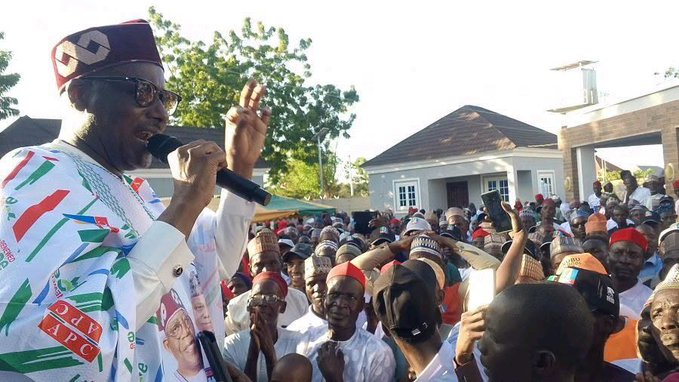
A prominent All Progressives Congress (APC) chieftain, Dr Magaji Da’u Aliyu, has warned that denying President Bola Ahmed Tinubu a second term in 2027 could undermine political trust between northern and southern Nigeria, arguing that an earlier understanding supporting the transfer of presidential power must be respected.
Aliyu made the remarks during an interaction with APC members and Tinubu supporters from Birnin Kudu/Buji Federal Constituency in Jigawa State, according to reports published on Saturday, October 31, 2026. The gathering took place at his residence in Birnin Kudu Local Government Area.
The former two-term member of the House of Representatives, who serves as Deputy Director-General for the North-West of the Tinubu Support Group, maintained that northern political leaders had a responsibility to honour commitments made during the political negotiations preceding Muhammadu Buhari's election in 2015.
“The South-West supported and voted for Buhari for two terms under Tinubu’s political leadership, with an understanding that the presidency would shift to the South-West after Buhari,” Aliyu said.
“That has happened, and we need to fulfil the promise by supporting and voting for Tinubu to complete his constitutionally allowed eight years in office,” he added.
Aliyu argued that abandoning Tinubu after his first term would damage the North's reputation for respecting political agreements and weaken the understanding that has helped manage regional competition for Nigeria's presidency.
His comments reflect a renewed debate over power rotation as political parties and prospective candidates prepare for the 2027 general elections.
The APC chieftain recalled Buhari's unsuccessful presidential campaigns before the formation of the APC, claiming that northern political leaders approached Tinubu in Lagos to secure his support for Buhari's eventual victory.
According to Aliyu, the discussions produced an understanding that the presidency would return to Tinubu's political camp after Buhari completed eight years in office.
“He agreed to support us on the understanding that after Buhari’s eight years in office, power would return to his side, and we accepted the agreement,” he said.
The alleged arrangement has not been established as a legally binding agreement. It represents Aliyu's account of political negotiations and his interpretation of the obligations arising from them.
Buhari won the 2015 presidential election as the APC candidate, defeating incumbent President Goodluck Jonathan. He secured re-election in 2019 and completed his second term in May 2023.
Tinubu, a former Lagos State governor and influential figure in the APC's formation, subsequently won the 2023 presidential election.
Aliyu argued that the sequence of events demonstrated the importance of cooperation between northern and southwestern political interests.
He maintained that allowing Tinubu to seek another term would preserve that cooperation and strengthen national cohesion.
“For every Northerner, fulfilling that agreement is mandatory. We have no reason not to honour the agreement we entered into,” he declared.
However, political agreements between party leaders do not remove the constitutional rights of Nigerians to support alternative candidates or vote according to their preferences.
Nigeria's Constitution permits an eligible president to serve a maximum of two elected four-year terms. It does not guarantee a second term or require the presidency to rotate between geographical regions.
The principle of power rotation has nevertheless remained influential in Nigerian politics, particularly within parties seeking to balance competing regional interests.
Supporters argue that alternating political leadership between North and South can promote inclusion and reduce perceptions of domination.
Critics contend that informal arrangements should not override democratic competition, voters' choices or assessments of government performance.
The debate has intensified as opposition parties consider possible presidential candidates ahead of 2027, including politicians from northern Nigeria.
Some southern political leaders maintain that the South should retain the presidency until 2031, following Buhari's eight years in office.
Others argue that electoral competition should remain open to qualified Nigerians regardless of their region.
Former Niger State Governor Babangida Aliyu previously expressed support for allowing Tinubu to complete a second term, warning that disrupting the informal rotation arrangement could create political tensions.
The Arewa Unity Forum, however, rejected that position in 2025, arguing that no political understanding should prevent northern politicians from contesting presidential elections.
These contrasting positions demonstrate that northern Nigeria does not have a single, universally accepted stance on Tinubu's re-election.
Magaji Da’u Aliyu nevertheless expressed confidence that northern APC supporters would mobilise extensively for the President.
He pledged that members of the Tinubu Support Group would commit their resources to securing victory in 2027.
“On our part, we will support Tinubu’s re-election bid with our lives and wealth to ensure that we fulfil the promise we made,” he said.
He urged party members to remain peaceful, law-abiding and committed to grassroots political engagement.
The former lawmaker also defended Tinubu's economic policies, arguing that northern communities were benefiting from reforms introduced by the administration, particularly measures relating to food security.
His assessment comes amid continuing national debate over inflation, household purchasing power, agricultural production and the consequences of economic reforms.
The administration has defended its policies as necessary for economic stability, while opposition politicians have criticised the hardship experienced by households.
Aliyu also addressed insecurity, a major concern across northern Nigeria, where communities continue to experience kidnappings, armed attacks and displacement.
He urged Nigerians to avoid excessive blame and emphasised the importance of seeking divine assistance in restoring peace.
“Let us stop the blame game. Only God has the power to provide security. We should seek His forgiveness, and He will grant us peace and stability,” he said.
His remarks represent a political and religious appeal rather than an assessment of the government's constitutional responsibility to protect lives and property.
The controversy surrounding power rotation highlights the challenge of balancing regional political expectations with democratic accountability.
For Tinubu's supporters, the 2027 election presents an opportunity to sustain a political partnership they consider central to the APC's national success.
For opponents, the election offers voters an opportunity to judge the administration's record and consider alternative leadership.
Aliyu's warning places particular emphasis on the long-term consequences of political promises, but the outcome will ultimately depend on Nigerians exercising their electoral rights.
As preparations intensify, the competing arguments over zoning, regional loyalty and government performance are expected to remain prominent in the presidential contest.
The final decision on whether Tinubu receives another mandate rests with voters, rather than any informal agreement between political leaders.
📩 Stone Reporters News | 🌍 stonereportersnews.com
✉️ info@stonereportersnews.com | 📘 Facebook: Stone Reporters News | 🐦 X (Twitter): @StoneReportNew | 📸 Instagram: @stonereportersnews
Add comment
Comments