

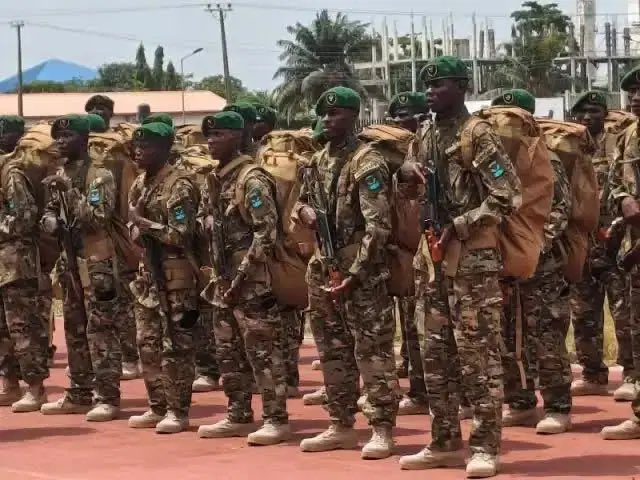
The Nigerian Navy has announced that its Marines, working alongside the Nigerian Army's 403 Amphibious Brigade, killed an estimated 34 Boko Haram and Islamic State West Africa Province (ISWAP) fighters during separate operations in the Lake Chad region, as security forces intensify their campaign against insurgent groups.
The operations took place on October 28 and 30, 2026, under Operation Hadin Kai, the military campaign against insurgency in northeastern Nigeria. Navy Captain Abiodun Folorunsho, Director of Naval Information, disclosed the results in a statement issued on Saturday, October 31, explaining that intelligence gathering and coordinated attacks had enabled troops to target suspected terrorist positions.
Folorunsho said the first engagement occurred on October 28, when Nigerian Navy Marines launched an offensive against armed elements operating around Lake Chad. Initial battlefield reports indicated that eight fighters had been killed, but a subsequent assessment increased the estimated number to 28.
The revised figure is significant because an earlier statement from Operation Hadin Kai had reported eight deaths during the same maritime engagement. The Navy's latest announcement therefore represents an updated assessment rather than confirmation of an entirely separate operation involving another 28 fatalities.
In the second engagement, conducted on October 30, Marines stationed at Naval Base Lake Chad attacked an identified Boko Haram position at Dumba. The Navy said intelligence, surveillance and reconnaissance activities had enabled personnel to locate and monitor suspected fighters before carrying out a precision strike.
Preliminary assessments indicated that approximately six insurgents were killed and several others injured during the Dumba operation. Combining the revised October 28 estimate with the October 30 figure produced the Navy's reported total of 34 fatalities.
Folorunsho cautioned that the figures remained provisional because operational assessments were continuing. Independent confirmation of the casualties was not available, and the Navy did not release a complete list of those killed or disclose the methods used to establish their identities.
The statement also provided no confirmed figures for civilian casualties or injuries among participating security personnel. It did not specify whether weapons, ammunition, boats or other equipment were recovered during the two engagements.
The Nigerian Navy described the operations as evidence of growing cooperation between its newly established Marine units and Army formations deployed against insurgents in the Lake Chad Basin.
According to Folorunsho, the Marines have strengthened offensive capabilities under Operation Hadin Kai by supporting attacks on insurgent positions and restricting the movement of armed groups through waterways.
The Navy said its deployment was intended to disrupt hostile activities, weaken insurgent capabilities and prevent fighters from using difficult terrain to evade security operations.
The military's emphasis on maritime operations reflects the geographical challenges of the Lake Chad region, where waterways, islands, marshes and remote settlements complicate conventional security operations.
Armed groups have exploited these conditions to move between locations, establish temporary positions and threaten communities dependent on fishing, farming and trade.
The Lake Chad Basin extends across Nigeria, Niger, Chad and Cameroon, making insecurity in the region a cross-border challenge requiring cooperation among neighbouring countries.
Boko Haram emerged in northeastern Nigeria before its insurgency expanded into neighbouring territories. ISWAP subsequently developed as a separate organisation associated with the Islamic State movement.
Although the groups have shared ideological origins, they are distinct organisations whose fighters have also engaged in violent competition.
Both have been responsible for attacks that have killed civilians and security personnel, disrupted economic activities and displaced communities across the region.
Their continued presence has made the restoration of security around Lake Chad an important objective for Nigerian forces and regional partners.
The latest Navy announcement follows other operations reported by the military during the same week.
On October 29, Operation Hadin Kai said troops had killed an estimated 44 suspected terrorists during coordinated engagements involving ground, maritime and air components.
That earlier announcement covered operations beginning on October 26, including engagements in Kukawa Local Government Area of Borno State and the October 28 maritime action.
Military spokesperson Captain Mohammed Goni said ground troops had killed an estimated 28 fighters in Kukawa, while six others were reportedly injured.
He separately reported eight suspected insurgents killed and 10 injured during the October 28 maritime operation near Lake Chad.
Another air operation reportedly targeted suspected insurgents preparing improvised explosive devices, killing eight fighters and destroying vehicles, motorcycles and explosive materials.
The Navy's subsequent revision of the October 28 maritime casualty estimate means the previously reported totals should not simply be added together. Doing so could count fatalities from the same engagement twice.
Earlier, on October 26, the military reported killing 16 suspected ISWAP fighters during coordinated air and artillery attacks on three positions in the Tunbunma area of southern Lake Chad.
Those operations followed surveillance information indicating the presence of suspected insurgents at the targeted locations.
The succession of announcements illustrates the sustained military pressure being applied to armed groups, although battlefield casualty estimates alone cannot establish their remaining strength or operational capacity.
Military operations around Lake Chad have also involved efforts to protect bases, disrupt attacks and secure equipment needed for movement through difficult terrain.
In June 2025, the Nigerian Navy reported repelling an insurgent attack on Naval Base Lake Chad with support from other components of Operation Hadin Kai.
The attackers had reportedly sought to destroy equipment, including swamp-clearing machinery used to improve access through waterways.
That incident demonstrated the strategic importance of military infrastructure in an environment where control of transport routes can influence the ability of security forces to respond.
For residents of affected communities, however, the effectiveness of military operations is measured not only by insurgent casualties but also by improvements in everyday safety.
Fishing, agriculture, commercial transportation and access to markets remain essential livelihoods throughout the Lake Chad region.
Communities require dependable protection against attacks, abductions and restrictions on movement if displaced families are to rebuild their lives.
Sustained security also depends on intelligence cooperation, protection of civilians and measures addressing the economic and humanitarian consequences of prolonged conflict.
The Nigerian Navy said it would continue supporting joint operations through intelligence-led engagements and sustained offensive action.
Its latest announcement indicates progress in targeting suspected insurgent positions, but the provisional casualty figures remain subject to further verification.
The broader challenge for security authorities is converting battlefield gains into lasting protection for communities that have endured years of insurgent violence.
📩 Stone Reporters News | 🌍 stonereportersnews.com
✉️ info@stonereportersnews.com | 📘 Facebook: Stone Reporters News | 🐦 X (Twitter): @StoneReportNew | 📸 Instagram: @stonereportersnews
Add comment
Comments