

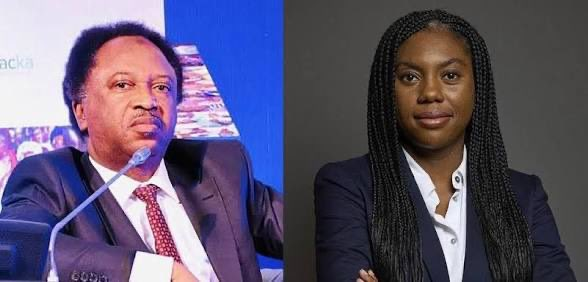
Former Nigerian senator Shehu Sani has criticised British Conservative Party leader Kemi Badenoch over her relationship with her Nigerian heritage, arguing that distancing herself from her ancestral homeland cannot guarantee acceptance in British society or prevent others from drawing attention to her origins.
Sani, who represented Kaduna Central in Nigeria's Senate, made the remarks in a social media statement reported on October 9, 2026. His comments have acquired renewed relevance following a controversy in Britain involving remarks by a former adviser to Reform UK leader Nigel Farage, who described Badenoch as a “Nigerian scammer”.
The former lawmaker accused Badenoch of repeatedly portraying Nigeria negatively while seeking recognition primarily through her British identity. He suggested that her experience illustrated the limitations of distancing oneself from an ancestral country in the hope of securing social acceptance elsewhere.
“Kemi is fighting hard to be identified as British and the Whites keeps reminding her of her roots and where she belongs,” Sani wrote on X.
He argued that public figures should recognise the potential consequences of consistently presenting their countries of origin in unfavourable terms, particularly when discussing national identity before international audiences.
“This is a message to all; you can’t continuously tell the World that your ancestral homeland is full of evil and think that that will make you acceptable to the World,” he stated.
Sani added that individuals could become associated with the negative descriptions they repeatedly use about their ancestral communities.
His comments reflected a longstanding disagreement between Badenoch and some Nigerian political figures over her public assessments of the country where she spent much of her childhood.
However, Sani's interpretation remains a political opinion rather than evidence that Badenoch's Nigerian ancestry undermines her British identity or citizenship.
Badenoch was born in London in 1980 to Nigerian parents and spent much of her childhood in Lagos before returning to Britain at 16.
She subsequently studied engineering and law, worked in financial services and entered British politics, eventually becoming the first Black woman to lead a major British political party in November 2024.
Her political career has included ministerial appointments under successive Conservative governments and election to the House of Commons.
Despite her Nigerian family background, Badenoch has repeatedly emphasised that she identifies primarily as British.
In an interview published in August 2025, she explained that her connection to Nigeria was rooted in ancestry rather than her present sense of national identity.
She also disclosed that she had not renewed her Nigerian passport for approximately two decades and had required a visa when travelling to Nigeria following her father's death.
Those statements attracted criticism from Nigerians who believed she was distancing herself unnecessarily from her heritage.
Others defended her right to define her identity according to her citizenship, personal experiences and family circumstances.
Badenoch has previously criticised corruption, insecurity and economic difficulties in Nigeria, often referring to her childhood experiences when explaining her political beliefs.
She has argued that those experiences helped shape her appreciation of British institutions and opportunities.
Her critics, including Sani, maintain that repeated negative descriptions of Nigeria risk reinforcing stereotypes about the country.
Supporters counter that criticism of governance or social conditions should not automatically be interpreted as rejection of an entire nation or its people.
The disagreement has become more prominent following renewed controversy over Badenoch's Nigerian background in British political debate.
On October 29, the Conservative leader condemned remarks made by Raheem Kassam, a former adviser to Farage, who had referred to her as a “Nigerian scammer” in social media posts.
Kassam also warned people against sharing their credit card numbers and banking information with her.
Badenoch described the comments as racist, arguing that political opponents were attempting to use her ancestry against her.
Speaking on ITV's Good Morning Britain, she rejected the suggestion that racial attacks would damage her political standing.
She maintained that Britain was not fundamentally a racist country and that efforts to exploit her background would fail.
Her response placed renewed attention on the distinction between legitimate criticism of a politician's conduct and language that invokes ethnic or national stereotypes.
Farage subsequently described Kassam's remarks as excessive but said he did not believe they were intentionally racist.
Reform politician Robert Jenrick also declined to condemn the comments explicitly, arguing that Kassam did not occupy an official position within the party.
Their responses attracted criticism from Labour representatives, who maintained that challenging racism should not depend on political affiliation.
The controversy highlights the complexity of Badenoch's position as a British politician whose Nigerian heritage remains a recurring subject of public discussion.
Her identity has become a source of competing political interpretations in both countries.
In Britain, she has emphasised integration, national belonging and the importance of shared civic values.
In Nigeria, some political commentators have questioned whether her criticism of the country is compatible with maintaining a meaningful connection to her ancestry.
These arguments raise broader questions about whether individuals with multinational family backgrounds should be expected to demonstrate loyalty to countries associated with their parents or childhood.
Citizenship, ancestry and cultural identity are related but distinct concepts, and individuals may understand their relationship with each differently.
A person's decision to identify as British does not necessarily amount to hostility towards Nigeria, just as criticism of Nigerian institutions does not automatically mean rejection of Nigerian people.
Equally, criticism of Badenoch's political positions does not justify discriminatory attacks based on her ethnicity or family origins.
Sani has previously challenged Badenoch over similar statements.
In August 2025, after she publicly explained that she no longer identified as Nigerian, he responded with a sarcastic suggestion that she should return her Nigerian name.
His remarks reflected frustration among critics who believed Badenoch was seeking to separate her public identity from her family background.
The latest dispute illustrates how questions of belonging can become politically contentious when prominent figures discuss migration, integration and national loyalty.
Badenoch's experience is also significant because she leads a major British political party while maintaining family connections to a country that features prominently in debates about migration and diaspora identity.
For Nigerians living abroad, the controversy touches on differing experiences of integration and the freedom to determine their own sense of belonging.
Some maintain strong cultural and national connections with Nigeria, while others identify primarily with the countries where they live and have established families.
Neither position, by itself, establishes the legitimacy of a person's political views or their entitlement to equal treatment.
Sani's criticism ultimately rests on his belief that rejecting or disparaging one's ancestral homeland cannot guarantee acceptance elsewhere.
Badenoch, meanwhile, has maintained that her British identity is not dependent on approval from Nigerian commentators and that racial stereotyping has no legitimate place in political debate.
The renewed controversy demonstrates how national identity, political disagreement and public perceptions of ancestry continue to intersect across borders.
As the debate develops, the central distinction remains between challenging public statements on their merits and using a person's heritage to question their belonging or credibility.
📩 Stone Reporters News | 🌍 stonereportersnews.com
✉️ info@stonereportersnews.com | 📘 Facebook: Stone Reporters News | 🐦 X (Twitter): @StoneReportNew | 📸 Instagram: @stonereportersnews
Add comment
Comments