

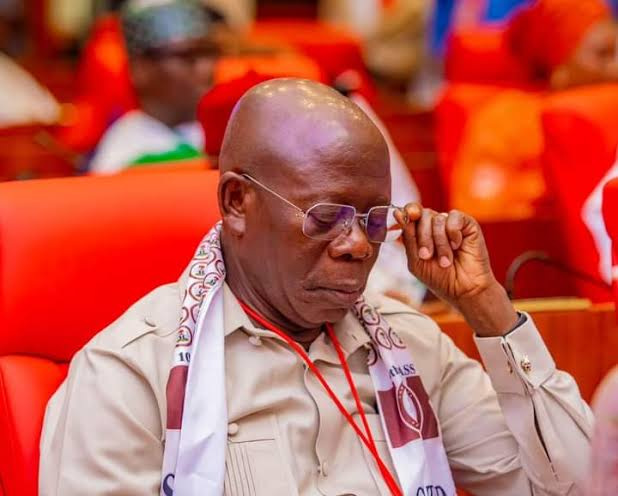
Former Edo State Governor and Senator representing Edo North, Adams Oshiomhole, has engaged in a heated exchange with Arise Television presenter Rufai Oseni during a live interview, accusing the journalist of repeatedly interrupting his responses to questions concerning President Bola Tinubu's administration and prominent political figures.
The confrontation occurred on Friday, October 30, 2026, during Arise Television's Morning Show. The discussion centred on the political activities of Federal Capital Territory Minister Nyesom Wike, Imo State Governor Hope Uzodimma and Tinubu's journey to Saudi Arabia, against the background of preparations for the 2027 presidential election.
Oshiomhole, a former national chairman of the ruling All Progressives Congress, became visibly displeased with Oseni's questioning style, insisting that the presenter should allow him to complete his answers before introducing further challenges.
“Rufai, I am very ready for you,” Oshiomhole declared as the disagreement intensified.
The senator accused the broadcaster of asking several questions simultaneously and attempting to interrupt his explanations before he could address them.
He argued that the interview should follow accepted standards of professional broadcasting, with sufficient opportunity for guests to respond to questions and presenters to seek clarification.
“I won't allow you to continue with this tradition of speak to yourself and answer yourself,” Oshiomhole said.
He maintained that Oseni had raised three separate issues and should permit him to address each without interruption.
“You asked three questions and I will reply them. And you have no right to interrupt when I am replying,” the senator added.
Oshiomhole also appealed for mutual respect, arguing that the presenter had a responsibility to listen to his responses regardless of differences in political opinion.
“You must have the patience to listen to my answer. And you must treat me as a guest with respect,” he said.
The exchange reflected growing tensions surrounding the public defence of Tinubu's administration as the ruling party seeks another presidential mandate.
Although the confrontation occurred during discussion of political developments involving the President and his allies, available reporting does not establish that the disagreement arose exclusively from Tinubu's campaign speech.
The interview also examined questions about Wike's political activities and Uzodimma's position within the ruling party.
Oshiomhole rejected suggestions that Wike enjoyed inappropriate preferential treatment, defending the government's relationship with the minister.
Wike, a member of the Peoples Democratic Party, serves in Tinubu's administration despite belonging to a political organisation traditionally regarded as a major opposition party.
His appointment has generated debate about cross-party cooperation, political loyalty and the relationship between the APC and influential opposition figures.
Oshiomhole has previously defended the arrangement, arguing that Tinubu's decision to appoint Wike demonstrates a willingness to draw on political experience beyond party boundaries.
The senator has also maintained that Wike's support for Tinubu does not require him to become an APC member.
The latest confrontation followed several days of exchanges involving Arise Television presenters and representatives of the ruling party over Tinubu's campaign activities.
On October 24, Tinubu launched his re-election campaign at a rally in Kaduna, where he defended his administration's economic policies and sought renewed support ahead of the January 2027 presidential election.
During the rally, the President criticised political opponents over Nigeria's economic difficulties, arguing that previous administrations had contributed to longstanding problems involving poverty and hunger.
His remarks attracted criticism from opposition figures and commentators who questioned whether the administration had adequately addressed the hardship confronting households.
Oseni subsequently criticised Tinubu's presentation, arguing that the President's campaign team should have prepared a clearer explanation of his administration's achievements and future priorities.
The broadcaster questioned the structure of the President's speech and suggested that the occasion provided an opportunity to address concerns about economic conditions.
His criticism became the subject of another contentious Arise Television interview involving APC National Publicity Secretary Felix Morka.
Appearing on the programme on October 27, Morka rejected suggestions that Tinubu had failed to communicate effectively during the Kaduna rally.
The APC spokesperson maintained that the event was designed primarily to mobilise supporters and formally launch the President's campaign rather than serve as a detailed policy presentation.
“All the president needed to do in Kaduna was to show up,” Morka said.
He argued that Tinubu's presence and appeal for electoral support were sufficient to fulfil the purpose of the gathering.
Morka described the rally as successful and rejected attempts to judge it according to expectations he considered inconsistent with its political objectives.
Oseni challenged that explanation, pressing the APC spokesperson on the economic difficulties Nigerians continue to experience.
The exchange illustrated disagreements over whether campaign appearances should prioritise political mobilisation or detailed explanations of government performance.
Those questions have become increasingly important as Nigeria approaches another presidential election amid continuing concerns about living costs, security and public finances.
Tinubu's administration has defended its economic reforms, including the removal of petrol subsidies and changes to the foreign exchange system, as necessary measures to address structural weaknesses.
The government argues that these policies have improved fiscal stability and investor confidence, creating conditions for longer-term economic development.
However, the reforms have also contributed to significant financial pressure on households, particularly through higher transportation and living costs.
Opposition politicians have questioned whether improvements in economic indicators are producing sufficient benefits for ordinary citizens.
Oshiomhole has remained a prominent defender of the administration, although he has acknowledged that government policies should be subjected to public scrutiny.
On October 29, the senator defended Tinubu's proposed external borrowing programme, arguing that additional financing was needed to develop infrastructure and strengthen economic productivity.
He maintained that borrowing for productive investment should be distinguished from borrowing to finance recurrent government expenditure.
The senator also argued that opposition criticism was legitimate within a democracy, while insisting that scrutiny should not prevent necessary development projects.
His positions have placed him among the ruling party's prominent voices defending Tinubu's economic and political agenda.
The confrontation with Oseni nevertheless raises broader questions about the relationship between politicians and journalists during election campaigns.
Broadcast interviews provide opportunities for public officials to explain policies, defend decisions and respond to concerns raised by citizens.
Presenters are expected to ask relevant questions and challenge statements requiring clarification, while interviewees are entitled to reasonable opportunities to complete their responses.
Disagreements over questioning techniques can become particularly contentious when interviews involve controversial political decisions or competing interpretations of government performance.
The latest exchange also demonstrates the growing influence of televised political discussions in shaping public debate ahead of the elections.
For Oshiomhole, the immediate disagreement concerned his insistence on answering questions without interruption.
For Oseni, the interview formed part of continuing scrutiny of political developments involving Tinubu and senior figures associated with his administration.
The incident comes as the APC intensifies its campaign activities and opposition parties seek to challenge the President's record.
As Nigeria moves towards the 2027 elections, exchanges between political leaders and journalists are likely to remain an important part of public accountability and electoral debate.
The confrontation ultimately highlighted the tensions that can arise when forceful political advocacy meets persistent questioning in a live television setting.
📩 Stone Reporters News | 🌍 stonereportersnews.com
✉️ info@stonereportersnews.com | 📘 Facebook: Stone Reporters News | 🐦 X (Twitter): @StoneReportNew | 📸 Instagram: @stonereportersnews
Add comment
Comments