

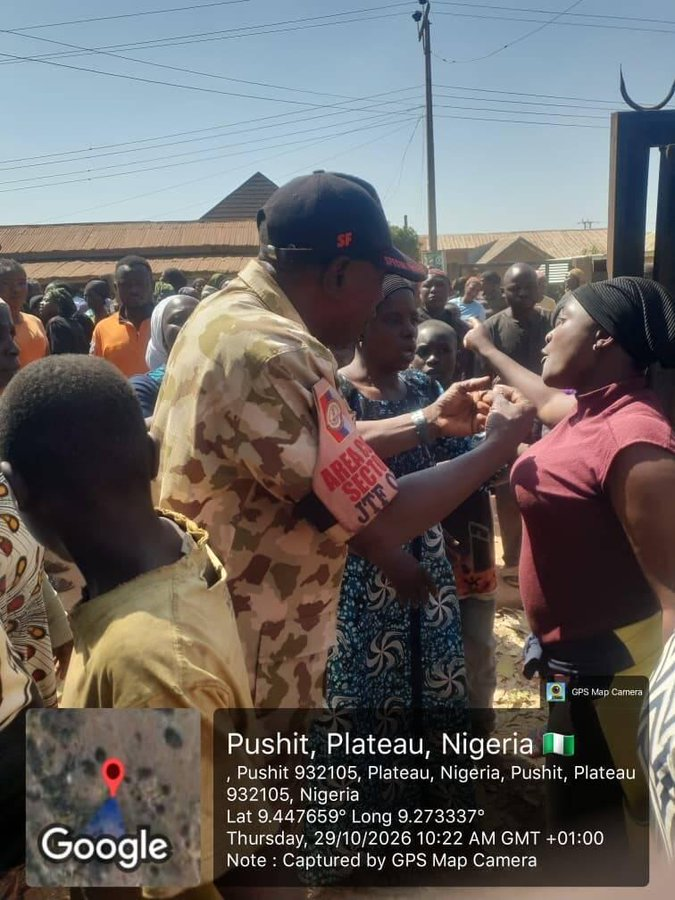
Troops of the Nigerian military have reopened the Jos–Pankshin highway in Plateau State following a violent protest over the arrest of a suspected militia member, with at least nine civilians and one police operative reportedly injured during the confrontation.
The incident occurred on Thursday, October 29, 2026, along the Jos–Mararaban Pushit–Pankshin highway in Mangu Local Government Area. The protest followed the arrest of a man identified as Karfe, whom security sources accused of involvement in the killing of a Fulani herder.
According to security reports published by counterinsurgency analyst Zagazola Makama, the demonstration began at approximately 10:05 a.m. when women and youths, reportedly dressed in black, barricaded the highway and demanded Karfe's release.
The protesters reportedly described Karfe as their vigilante leader, while security sources identified him as a suspected member of an armed militia associated with the Mwaghavul community.
These competing descriptions reflect the disagreement surrounding his arrest. The allegations against Karfe have not been established by a court, and he remains entitled to the presumption of innocence.
The blockade disrupted vehicular movement along the highway, an important transport corridor connecting Jos with communities in Mangu, Pankshin and surrounding areas.
Troops of Sector 8, Operation Enduring Peace, were reportedly deployed to the scene following the disruption.
Security sources said the soldiers initially attempted to resolve the situation through dialogue, appealing to the protesters to remove the barricades and allow motorists to continue their journeys.
However, the engagement reportedly failed to produce an agreement, prompting the deployment of additional military personnel.
The Commander of the 236 Tank Battalion subsequently led the Sector 8 Quick Reaction Force to the location to restore movement and prevent further disruption.
According to the security account, soldiers began removing the barricades before some protesters allegedly attacked them with stones and other objects.
One police operative attached to the security response reportedly sustained a head injury during the confrontation.
The troops subsequently employed crowd-dispersal measures to restore order and reopen the road.
Nine civilians were reported injured during the dispersal, although the precise circumstances in which each person sustained injuries have not been independently established.
Two of the injured civilians were identified as Victor Monday, 47, and Sadiq Ibrahim, 30.
Monday was reportedly taken to Mangu General Hospital, while Ibrahim received treatment at Allah Na Kowa Hospital.
The injured police operative was also evacuated for medical attention.
The identities and medical conditions of the remaining injured civilians were not fully disclosed in the initial report.
There was no confirmed report of fatalities arising directly from the highway confrontation.
The disturbance followed the arrest of Karfe on October 27 by troops conducting an operation in Mangu Local Government Area.
Security sources alleged that the suspect was connected to the killing of a Fulani herder in an attack along a road within the area.
An earlier security report identified the location as the Lamor–Gohotkung road, while the subsequent account of the protest referred to the Jipun–Jennaret road.
The discrepancy in the reported location requires clarification from the relevant security authorities.
According to the initial report, Karfe was arrested at approximately 6:30 p.m. by troops of Sector 8 following a search for suspects linked to the killing.
Security sources also alleged that he had previously been sought in connection with similar incidents.
However, the available reports did not provide court records or independently verified evidence establishing his involvement in those allegations.
His arrest therefore remains part of an ongoing investigation rather than proof of criminal responsibility.
The circumstances surrounding the reported killing have also not been fully established, including the identity of the victim and whether additional suspects have been apprehended.
Following the highway confrontation, the Commander of the 236 Tank Battalion reportedly convened an emergency stakeholders' meeting at the palace of the paramount ruler in Mararaban Pushit.
The meeting was intended to reduce tensions, restore confidence and prevent further disturbances.
Participants reportedly included district heads within Pushit District, representatives of local women's organisations, civil society representatives and security officials.
Also represented were the Department of State Services, Operation Rainbow, the local police command and the leadership of Mangu Local Government Area.
During the meeting, the battalion commander reportedly emphasised the importance of resolving disputes peacefully and avoiding actions that could threaten public safety.
He assured community representatives that troops would continue to protect law-abiding residents and maintain impartiality while carrying out their responsibilities.
The commander also reportedly visited injured persons receiving medical treatment following the confrontation.
Security personnel remained deployed in the general area to prevent renewed disturbances and maintain access along the highway.
The incident has drawn attention to the difficult relationship between community-based security organisations and formal law enforcement institutions in parts of Plateau State.
Vigilante groups have emerged in several communities where residents face threats involving armed attacks, cattle theft, kidnapping and other criminal activities.
Some communities regard local security volunteers as an important source of protection, particularly in areas where police and military personnel may be unable to respond immediately to emergencies.
However, the activities of such groups can become controversial when members are accused of taking the law into their own hands or participating in violence against rival communities.
The existence of a community security role does not exempt any individual from investigation where credible allegations of criminal conduct arise.
Equally, an arrest should not be treated as proof of guilt, and suspects must be afforded the legal protections guaranteed under Nigerian law.
Plateau State has experienced recurring tensions involving farming communities, pastoral groups and other residents, with disputes sometimes escalating into deadly confrontations.
The causes of violence in the state are complex and can involve land access, livestock grazing, criminal activity, historical grievances and competition over local resources.
Religious and ethnic identities may also influence how incidents are interpreted, increasing the importance of careful investigation and responsible public communication.
Assigning collective responsibility to an entire ethnic or religious community for the alleged actions of particular individuals risks deepening mistrust.
The reported confrontation in Mangu illustrates how a criminal investigation can generate wider public disorder when sections of a community dispute the legitimacy of an arrest.
It also raises questions about the management of protests and the responsibility of security personnel to use lawful and proportionate measures when restoring public order.
The right to peaceful assembly is protected under Nigeria's Constitution, although violence against individuals and unlawful obstruction of public safety may attract legal consequences.
Where injuries occur during crowd-control operations, an impartial examination of the circumstances is important for establishing accountability.
As of the initial reports, no detailed independent investigation into the injuries sustained during Thursday's confrontation had been publicly established.
The immediate priority for authorities remains preventing further violence, ensuring medical care for the injured and conducting a credible investigation into the allegations surrounding Karfe's arrest.
Community leaders also face the responsibility of discouraging retaliatory actions and supporting peaceful engagement between residents and security agencies.
The reopening of the Jos–Pankshin highway has restored an important transport connection, but the underlying tensions require continued attention.
For residents of Mangu and neighbouring communities, lasting stability will depend on impartial law enforcement, accountability for violence and sustained cooperation among community leaders, security institutions and local authorities.
The incident underscores the importance of addressing criminal allegations through lawful investigations rather than allowing disputes over arrests to escalate into further confrontation.
📩 Stone Reporters News | 🌍 stonereportersnews.com
✉️ info@stonereportersnews.com | 📘 Facebook: Stone Reporters News | 🐦 X (Twitter): @StoneReportNew | 📸 Instagram: @stonereportersnews
Add comment
Comments