

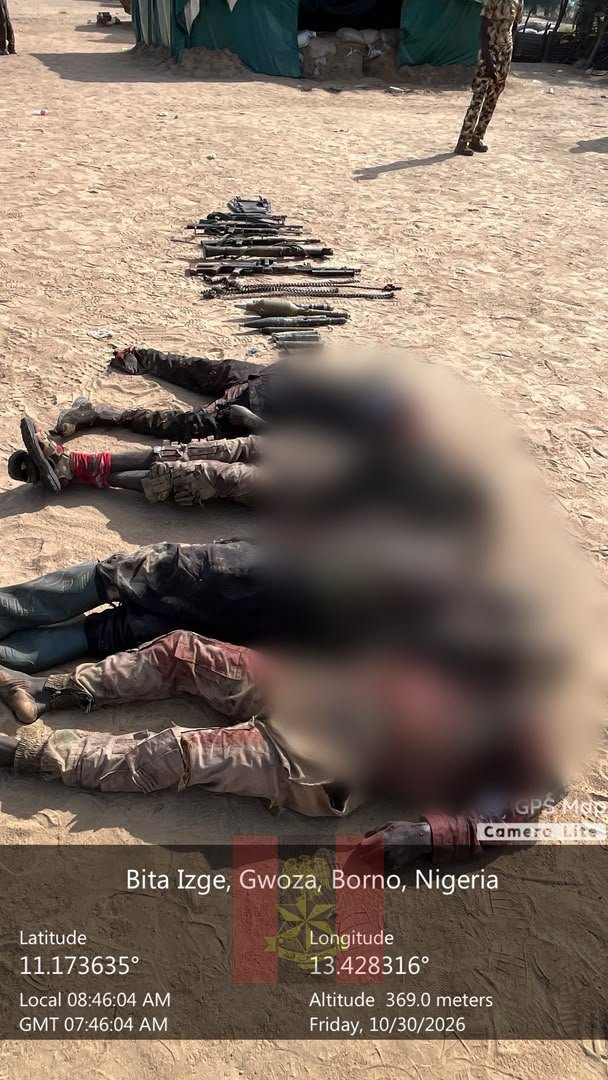
The Nigerian military says troops of Operation HADIN KAI have killed 48 suspected Islamic State West Africa Province (ISWAP) fighters during separate attacks on military positions in Borno and Yobe states, recovering 52 weapons and thousands of rounds of ammunition after intense fighting that also claimed the life of a soldier.
The engagements occurred between Thursday, October 29, and Friday, October 30, 2026, in Bitta, Gwoza Local Government Area of Borno State, and at the North East Theatre Training School in Buni Yadi, Gujba Local Government Area of Yobe State. Two other soldiers sustained minor injuries and are receiving medical treatment.
Captain Mohammed Goni, Acting Media Information Officer of the Joint Task Force, North East, disclosed the developments in a statement issued on Friday. He said the attacks were repelled through coordinated operations involving ground troops, air support and intelligence capabilities.
According to Goni, the first confrontation occurred in Bitta on Thursday night when suspected insurgents attempted to overrun a military position. Soldiers responded with support from military aircraft, disrupting the assault and forcing the attackers to withdraw.
The military said the operation inflicted substantial casualties on the attacking fighters, although it did not provide a separate death toll for the Bitta encounter.
In a related development, ISWAP fighters attacked the North East Theatre Training School in Buni Yadi later that night, triggering a prolonged confrontation that continued into the early hours of Friday.
The military said the counter-offensive lasted approximately five hours and was coordinated by the Theatre Command, with ground forces and aircraft working alongside intelligence, surveillance, target acquisition and reconnaissance systems.
These capabilities were deployed to monitor the attackers and support the military response. According to the statement, the operation overwhelmed the insurgents and resulted in the deaths of 48 fighters.
The figure represents the military's reported battlefield assessment and has not been independently verified. The statement did not provide a detailed breakdown of casualties between the two locations.
Following the fighting, soldiers recovered 42 AK-47 rifles, five PKT machine guns, four general-purpose machine guns and one 60-millimetre mortar.
The recovered equipment also included 105 AK-47 magazines and two video cameras, according to the military.
Ammunition recovered comprised 30 rounds of 12.7-millimetre armour-piercing incendiary ammunition, 2,738 rounds of 7.62-millimetre special ammunition, 223 rounds of 7.62-millimetre NATO ammunition and 2,054 rounds of PKT ammunition.
The four categories amount to 5,045 rounds, based on the figures released by the military.
The recovery of weapons and ammunition is significant because insurgent groups depend on such supplies to sustain attacks against security installations and civilian communities.
However, the seizure does not independently establish the overall strength of ISWAP or the extent to which its wider operational capabilities have been reduced.
Goni described the engagements as a major setback for the insurgents, maintaining that the coordinated military response demonstrated the effectiveness of ongoing counterterrorism operations.
The military also confirmed the death of one soldier during the engagements. His identity was not disclosed in the initial statement.
Two other personnel sustained injuries described as minor and were responding to treatment. The military said troop morale remained high despite the casualties.
The latest confrontations underline the continuing security challenges in northeastern Nigeria, where ISWAP and Boko Haram factions have maintained the capacity to attack military positions despite years of counterinsurgency operations.
Operation HADIN KAI is the Nigerian military's principal joint operation against insurgent groups in the North-East, involving personnel from different services and coordination with other security institutions.
Its responsibilities include protecting communities, defending military installations, disrupting insurgent movements and supporting efforts to restore security in areas affected by prolonged conflict.
Borno State has experienced extensive insurgent violence since Boko Haram's uprising developed into a sustained armed conflict in 2009.
Over time, the insurgency expanded beyond Borno into neighbouring states and across parts of the Lake Chad Basin, affecting communities in Nigeria, Cameroon, Chad and Niger.
ISWAP emerged from divisions within the wider Boko Haram movement and has developed its own operational structures, particularly in areas surrounding Lake Chad and parts of northeastern Nigeria.
Although the organisations have experienced internal rivalries and confrontations, both have continued to pose threats to civilians and security personnel.
Military formations remain important targets because attacks on them can provide insurgents with opportunities to seize weapons, undermine security operations and demonstrate continued fighting capacity.
Bitta, in Gwoza Local Government Area, lies within a region that has experienced repeated insurgent activity and military operations.
Gwoza became internationally prominent in 2014 when Boko Haram captured territory and declared a self-styled caliphate before Nigerian forces subsequently regained control.
Buni Yadi, in Yobe State, has also experienced devastating attacks during the insurgency, including the killing of students at a federal government college in February 2014.
These historical incidents demonstrate the prolonged impact of extremist violence on education, public safety and community life.
The latest attack on a military training institution therefore carries particular significance, although the military did not report damage to the facility or disruption to its training activities.
The military's statement did not disclose whether additional suspects escaped, whether pursuit operations were continuing or whether civilians were affected by the engagements.
No independently confirmed civilian casualty figures were available in the initial reports.
While the reported killing of 48 fighters represents a substantial battlefield claim, determining its wider significance will require further information about the insurgents' movements and subsequent security conditions.
For communities across Borno and Yobe, the immediate concern remains protection against renewed attacks, displacement and disruption to livelihoods.
Sustained security will depend not only on successful military engagements but also on reliable intelligence, protection of vulnerable settlements and effective cooperation between security agencies and local communities.
The military has maintained that operations will continue across the North-East to restrict insurgent movements and prevent further attacks.
Friday's announcement highlights both the reported effectiveness of coordinated air and ground operations and the continuing human cost of Nigeria's counterinsurgency campaign.
With one soldier killed and two others wounded, the latest engagements demonstrate that the threat remains serious despite the losses the military says it inflicted on ISWAP.
📩 Stone Reporters News | 🌍 stonereportersnews.com
✉️ info@stonereportersnews.com | 📘 Facebook: Stone Reporters News | 🐦 X (Twitter): @StoneReportNew | 📸 Instagram: @stonereportersnews
Add comment
Comments