

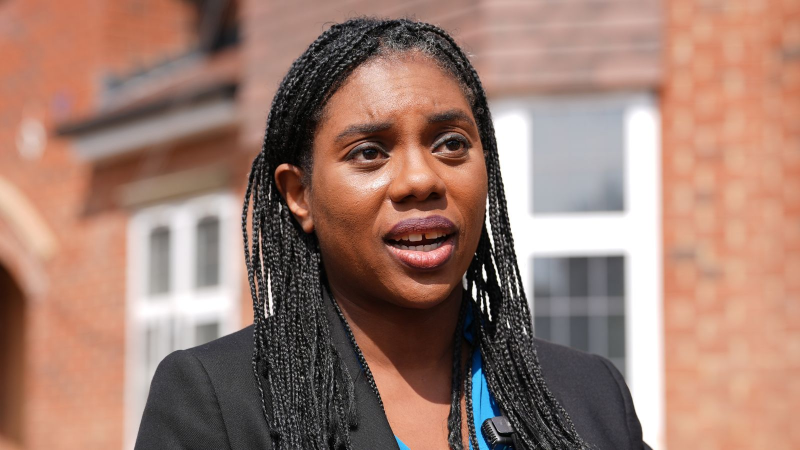
British Conservative Party leader Kemi Badenoch has condemned comments describing her as a “Nigerian scammer”, accusing political opponents associated with Reform UK of using her racial background to undermine her credibility and gain political advantage.
Badenoch responded on Thursday, October 29, 2026, during an interview on ITV's Good Morning Britain, following social media attacks by Raheem Kassam, a former adviser to Nigel Farage and prominent Reform supporter. The controversy has also drawn scrutiny of Farage and former Conservative politician Robert Jenrick over their reluctance to condemn the remarks as racist.
Kassam had published posts questioning Badenoch's political credibility, referring repeatedly to her Nigerian background and warning social media users against sharing their financial information with her.
In one widely criticised message, he asked how people could continue believing the Conservative leader before describing her as a Nigerian scammer and advising against providing credit card or bank account details.
The remarks prompted accusations that Kassam was invoking a racial stereotype associating Nigerians with financial fraud, rather than restricting his criticism to Badenoch's political record.
Responding publicly, Badenoch suggested that Reform figures believed highlighting her race could strengthen their political position.
She rejected that approach, declaring that Britain was not fundamentally a racist country and that attempts to use her background against her would fail.
“Britain is not a racist country and because it’s not a racist country, their racist attacks and using my race as an attack form is not going to work,” she said.
Badenoch also accused her political opponents of concentrating on personal attacks instead of presenting policies intended to improve people's lives.
She argued that Reform politicians were spending disproportionate attention criticising her despite the fact that she was not the prime minister.
The Conservative leader used the controversy to appeal directly to former Conservative voters who had moved towards Reform UK, encouraging them to reconsider their political allegiance.
Her response reflected growing tensions between the Conservatives and Reform, which compete for support among voters concerned about immigration, economic management and the direction of British politics.
Kassam, who previously worked with Farage during his association with the UK Independence Party, has remained a vocal political commentator and supporter of Reform.
However, Reform representatives have maintained that he does not hold an official position within the party.
The distinction has become central to the controversy, with Reform politicians arguing that they cannot be held responsible for every statement made by individuals who support their organisation.
Critics counter that prominent political leaders should be willing to condemn discriminatory language, particularly when it comes from individuals with longstanding connections to their political movement.
Farage faced repeated questioning about Kassam's remarks during an appearance on BBC Breakfast earlier in the week.
Presenter Sally Nugent asked whether he considered the description racist, challenging him to explain his position as leader of a party that says it opposes discrimination.
Farage initially sought to distinguish between the words Nigerian and scammer, suggesting that the reference to Badenoch's background was separate from the allegation concerning her honesty.
He also pointed to Kassam's Indian heritage, although Nugent questioned whether a person's ethnic background prevented them from making racist remarks.
The Reform leader eventually acknowledged that the language had gone too far but rejected the suggestion that it was deliberately racist.
“Do I think the comment was over the top? Yes I do,” Farage said, adding that he did not believe it was intentionally racist.
His response attracted criticism because he declined to condemn the phrase unequivocally, instead presenting it as part of a wider disagreement over Badenoch's political statements.
Farage also argued that he could not reasonably be expected to take responsibility for every social media comment made by supporters or associates.
Kassam subsequently acknowledged that Farage had privately criticised his wording.
According to reporting by The Times, Kassam accepted that the remark had been poorly expressed and suggested alternative language would have been more appropriate.
He nevertheless maintained that his underlying criticism concerned Badenoch's credibility and political conduct rather than her ethnicity.
The controversy intensified when Jenrick, who defected from the Conservatives to Reform, was repeatedly asked whether he considered Kassam's remarks racist.
During an interview with LBC, Jenrick declined to give a direct condemnation, describing Kassam as a journalist who did not occupy a formal role within Reform.
He argued that he was not responsible for policing the public statements of individuals outside the party's official structure.
Jenrick also referred to a separate controversy concerning Badenoch's claim that she had received an offer connected to studying at Stanford University.
Badenoch has maintained that she received an offer when she was 16 but no longer possesses the relevant documentation.
Questions surrounding that claim have been reported separately and do not establish the truth of Kassam's broader accusation that she is a scammer.
Speaking to ITV following Badenoch's interview, Jenrick again declined to characterise Kassam's language as racist.
He suggested that the comments might have been unpleasant or rude but maintained that determining the acceptability of an outside commentator's social media posts was not his responsibility.
Badenoch dismissed Jenrick's intervention, emphasising that he was no longer a Conservative parliamentarian and was therefore a matter for Farage's party.
The Labour Party also entered the dispute, criticising Jenrick's refusal to condemn the language.
A Labour spokesperson argued that challenging racism should not depend on party affiliation and described the issue as one of basic decency.
The exchange has reopened wider questions about race, national identity and political rhetoric in Britain.
Badenoch was born in London to Nigerian parents and spent significant parts of her childhood in Nigeria before returning to Britain.
She became Conservative leader in November 2024, making history as the first Black woman to lead a major British political party.
Her political positions have frequently generated debate, including her views on immigration, national identity, integration and the role of race in public life.
Badenoch has previously challenged arguments portraying Britain as institutionally racist, maintaining that the country's institutions provide opportunities across ethnic backgrounds.
Her condemnation of Kassam's remarks therefore carries particular significance because she has consistently rejected broad generalisations about British society while distinguishing them from individual incidents of racial prejudice.
The controversy also comes amid wider scrutiny of Reform UK following allegations concerning offensive comments by individuals associated with the party.
Those separate allegations have intensified questions about how political organisations respond when supporters or representatives use language considered discriminatory.
However, Kassam's status as a supporter rather than a formal party official remains relevant when assessing organisational responsibility.
For Badenoch, the immediate issue is the use of her Nigerian heritage as part of a personal political attack.
For Farage and Reform, the dispute concerns the boundaries between robust political criticism, offensive stereotyping and responsibility for the conduct of political associates.
The disagreement has also demonstrated how quickly social media comments can become major national political controversies when senior politicians are pressed to defend or reject them.
While Kassam maintains that his criticism concerns Badenoch's credibility, the Conservative leader insists that invoking her racial background represents an unacceptable political tactic.
Her response has placed renewed attention on the standards expected of public figures and the responsibility of political leaders to address allegations of racism.
As the Conservatives and Reform continue competing for electoral support, the controversy illustrates how questions of identity, political accountability and public conduct remain central to Britain's increasingly contentious political debate.
📩 Stone Reporters News | 🌍 stonereportersnews.com
✉️ info@stonereportersnews.com | 📘 Facebook: Stone Reporters News | 🐦 X (Twitter): @StoneReportNew | 📸 Instagram: @stonereportersnews
Add comment
Comments