

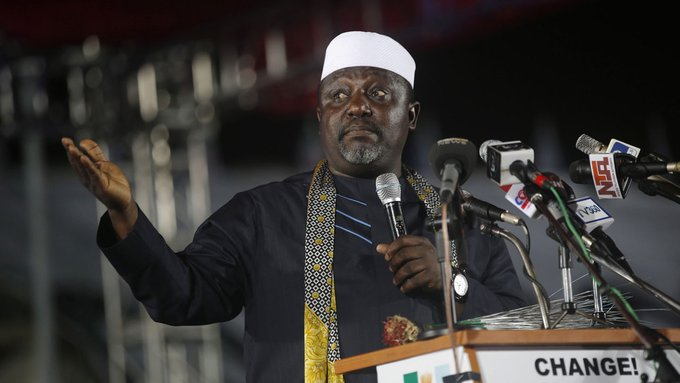
Former Imo State Governor Rochas Okorocha has claimed that 90 per cent of Nigerian politicians currently occupying public office would lose their positions if the country practised genuine democracy, alleging that many political leaders emerge through imposition and manipulation rather than the free choice of voters.
Okorocha made the assertion during an interview with Arise News on Thursday, October 29, 2026, while reacting to a Federal High Court judgment in Abuja that recognised him as the winner of the All Progressives Congress (APC) primary election for the Imo West Senatorial District ahead of the 2027 general elections.
“If democracy is practiced the way it should be practiced, 90% of people holding office in Nigeria cannot hold office,” the former governor declared.
He argued that Nigeria's political system had increasingly allowed individuals to occupy influential positions without securing genuine electoral support, describing candidate imposition as a major obstacle to representative government.
“Most of them are not truly the choice of people. These are people who are imposed, opportunists, who find their way,” Okorocha said.
His comments came amid renewed controversy surrounding the APC senatorial primary in Imo West, where he challenged the nomination of incumbent Governor Hope Uzodimma.
The Federal High Court ruled in Okorocha's favour, directing the Independent National Electoral Commission (INEC) to recognise him as the party's candidate for the senatorial election scheduled for January 16, 2027.
The dispute arose from conflicting results attributed to the APC primary conducted on May 18, 2026, with both politicians maintaining that they had legitimately secured the party's nomination.
Documents presented during the controversy reportedly credited Uzodimma with 230,464 votes against 1,098 votes for Okorocha. Another set of records indicated that Okorocha secured 150,780 votes, creating a dispute over the authenticity and validity of the competing results.
Okorocha maintained that the documents supporting his victory were obtained directly from INEC and reflected the genuine outcome of the primary election.
According to him, he obtained certified documents from the electoral commission on July 22, 2026, before another document dated August 22 emerged in support of Uzodimma's nomination.
The former governor questioned the circumstances surrounding the conflicting records, arguing that the discrepancies demonstrated weaknesses in the management of party nominations.
He also raised concerns about the role of political influence in determining which candidates are presented to voters during general elections.
However, his broader assertion that 90 per cent of Nigerian officeholders lack genuine electoral legitimacy remains a political opinion rather than a statistically established finding.
No nationwide electoral assessment or independently verified study was presented during the interview to substantiate the percentage.
Okorocha nevertheless maintained that the judgment represented an important development for Nigeria's democratic institutions.
He said his satisfaction extended beyond securing the senatorial ticket, explaining that the court's intervention had addressed questions surrounding the disputed nomination.
“My joy is not on the basis that I was declared a winner, but for the fact that so many misinformations paraded in the news media,” he said.
He further defended the documents relied upon in his legal challenge, insisting that the evidence supporting his position was clear.
“The facts are too glaring,” Okorocha declared.
The former governor described the litigation as an opportunity to establish that political officeholders could be challenged successfully through the courts, regardless of their influence within a governing party.
He argued that democratic competition should be determined by established rules and the choices of eligible voters rather than the preferences of influential political figures.
His remarks have brought renewed attention to longstanding debates over internal party democracy in Nigeria, particularly the procedures used by political parties to select candidates for public office.
Under Nigeria's electoral framework, political parties are required to conduct nomination exercises in accordance with applicable laws and their constitutions.
INEC has responsibilities relating to monitoring party primaries and receiving candidate information, while disputes concerning the lawful nomination of candidates may be brought before the courts.
Controversies over primary elections have repeatedly generated litigation, with aspirants challenging alleged irregularities involving voting procedures, delegate participation, candidate substitution and the publication of results.
Such disputes can create uncertainty for political parties and voters, particularly when competing candidates claim the same nomination close to an election.
The Imo West controversy also reflects the continuing political rivalry between Okorocha and Uzodimma, both prominent figures in the state's political history.
Okorocha governed Imo State between 2011 and 2019 before representing Imo West in the Senate from 2019 to 2023.
Uzodimma became governor in January 2020 following a Supreme Court judgment concerning the disputed 2019 governorship election.
Their political disagreements have continued to influence party activities and electoral contests in the state.
Following the latest Federal High Court judgment, Uzodimma indicated that he would appeal the decision, meaning the legal dispute may continue before a superior court.
The possibility of an appeal is significant because the judgment establishes Okorocha's position at the Federal High Court level but does not prevent further judicial examination.
Any subsequent appellate decision could affect the recognition of the APC candidate before the senatorial election.
Beyond the personal contest, Okorocha insisted that Nigeria needed a political environment in which candidates could seek public support without depending on imposition by party leaders.
He maintained that the interests of voters should take precedence over arrangements designed to favour politically connected individuals.
The former governor also emphasised that the dispute was fundamentally about democratic rights rather than simply his ambition to return to the National Assembly.
“It’s about the people,” he said.
His position highlights the wider distinction between conducting elections and ensuring that the processes leading to those elections provide meaningful opportunities for political participation.
Although party primaries are internal nomination exercises, their credibility can influence the choices ultimately available to voters.
Where nomination processes are disputed, political parties may face questions about transparency, fairness and their commitment to democratic principles.
Nevertheless, allegations of candidate imposition must be assessed individually, and the existence of disputes does not establish that every challenged nomination was unlawful.
For the APC, the immediate issue remains the legal status of its Imo West senatorial candidate and the outcome of any appeal pursued by Uzodimma.
For Nigeria's wider political system, Okorocha's remarks have revived questions about whether party structures sufficiently reflect the preferences of members and whether electoral institutions can consistently enforce nomination rules.
As preparations for the 2027 elections continue, the controversy underscores the importance of credible primaries, transparent documentation and the resolution of electoral disputes through lawful procedures.
While Okorocha's 90 per cent claim remains unsubstantiated by independent statistical evidence, his criticism reflects an ongoing national debate about political representation, internal party democracy and the extent to which elected leaders genuinely emerge through the choices of the electorate.
📩 Stone Reporters News | 🌍 stonereportersnews.com
✉️ info@stonereportersnews.com | 📘 Facebook: Stone Reporters News | 🐦 X (Twitter): @StoneReportNew | 📸 Instagram: @stonereportersnews
Add comment
Comments