

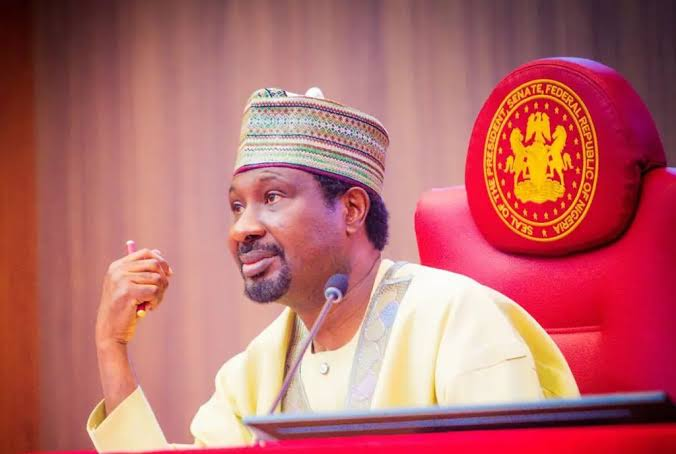
Nigeria's Deputy President of the Senate, Senator Barau Jibrin, has welcomed the approval of 20 academic programmes at the Federal University of Science and Technology, Kabo, Kano State, describing the development as an important step towards expanding access to science, technology and medical education.
Barau made the remarks during a courtesy visit by the university's Governing Council to the National Assembly in Abuja on Thursday, October 29, 2026. The delegation was led by its Pro-Chancellor and Governing Council Chairperson, Chief Grace Titilayo Laoye-Tomori, a former deputy governor of Osun State.
Details of the meeting were disclosed in a statement issued on Friday by Ismail Mudashir, Special Adviser on Media and Publicity to the Deputy President of the Senate. The statement said the institution had secured regulatory approval for 20 programmes ahead of its inaugural academic session.
Barau congratulated the Governing Council, management and staff on the progress achieved since the institution's conversion from a federal polytechnic into a university. He urged the administrators to maintain high academic standards while building an institution capable of preparing graduates for employment, research and national development.
“I am delighted with the remarkable progress recorded by the Federal University of Science and Technology, Kabo, within such a short period,” he said.
The senator pledged continued support for the institution, emphasising that investment in education was essential to Nigeria's long-term economic and social progress.
“Our greatest asset as a nation is our human resources, particularly the youth,” Barau declared, stressing the importance of providing young Nigerians with quality education and relevant skills.
He also expressed appreciation to President Bola Tinubu for approving legislation that facilitated the institution's elevation to university status.
During the visit, Laoye-Tomori briefed the senator on preparations for academic activities and the progress made in obtaining approval for the programmes.
She described the development as a significant achievement for a relatively new institution and expressed confidence that the university was positioned to commence teaching.
The council chairperson acknowledged Barau's longstanding involvement in the institution's establishment, tracing the initiative to his legislative efforts beginning in 2016.
According to her, the senator initially sponsored legislation seeking to establish a federal polytechnic in Kabo before supporting its subsequent conversion into a specialised university.
She said the expansion reflected a broader vision of increasing educational opportunities, particularly for young people in northern Nigeria.
Laoye-Tomori also thanked Barau on behalf of the Governing Council, management, staff and students for his contributions to the institution's development.
The Federal University of Science and Technology, Kabo, emerged from the Federal Polytechnic, Kabo, which was established in 2022.
President Tinubu approved the institution's conversion in May 2025, expanding the federal university system in Kano State.
The transition was intended to strengthen access to higher education in disciplines considered important to Nigeria's economic transformation, including computing, engineering, health sciences and applied technology.
The university's published academic information identifies programmes in computer science, software engineering, cybersecurity, electrical engineering and computer engineering.
Its health-related offerings include medicine and surgery, nursing science, medical laboratory science, pharmacy and other disciplines.
The institution also lists programmes in architecture, quantity surveying, accounting and business administration, reflecting an academic structure extending beyond conventional engineering and scientific subjects.
The university's website indicates that admissions are being processed for the 2026–2027 academic session through the Joint Admissions and Matriculation Board.
However, an important distinction exists between initial regulatory approval, resource verification and full programme accreditation.
The National Universities Commission oversees university education in Nigeria, including the approval and quality assurance of academic programmes.
New programmes generally undergo resource verification before admitting students, while subsequent accreditation exercises assess their performance against established standards.
The university's own published guidance acknowledges that programmes admitting their first cohorts may operate under resource verification, with full accreditation visits scheduled at later stages.
Consequently, although the university's leadership described the 20 programmes as accredited, the available information does not independently establish that every programme has completed the full accreditation cycle.
Prospective students are therefore advised to confirm the precise approval status of individual programmes, particularly those subject to additional professional regulation.
For medical and other health-related courses, compliance with the requirements of relevant professional councils is especially important because graduates may need professional registration before practising.
The university's establishment forms part of broader efforts to increase tertiary education opportunities in Kano and surrounding states.
Nigeria's expanding youth population has placed considerable pressure on existing universities, with demand for admission frequently exceeding available places in popular disciplines.
Specialised institutions can help address some of these challenges by increasing capacity in technical and professional fields.
However, creating additional universities also raises questions about sustainable funding, recruitment of qualified lecturers, laboratory facilities, student accommodation and research infrastructure.
The ability of new institutions to deliver quality education depends not simply on the number of approved programmes but also on the resources available to support them.
For science and engineering students, practical laboratories, workshops and access to modern equipment are essential components of effective training.
Medical and health sciences students additionally require suitable clinical facilities, supervised placements and compliance with professional training standards.
These requirements make Barau's emphasis on academic excellence particularly relevant as the university prepares to expand its operations.
Beyond infrastructure, effective governance and transparent administration will be important in establishing the institution's reputation.
Universities must maintain credible admissions procedures, academic integrity, qualified teaching staff and assessment systems that meet national standards.
Collaboration with industries, hospitals and research organisations can also strengthen practical learning and improve employment opportunities for graduates.
Barau has been involved in other legislative initiatives concerning tertiary education in Kano State.
Earlier in October, the Senate passed a bill he sponsored to provide a statutory framework for the Yusuf Maitama Sule Federal University of Education, Kano.
That initiative followed the federal government's approval of the conversion and renaming of the former Federal College of Education, Kano.
The developments illustrate continuing federal efforts to expand specialised tertiary education, although each institution has distinct responsibilities and regulatory requirements.
For Kabo and neighbouring communities, the university's development could generate demand for accommodation, transportation, retail services and other local economic activities.
Such benefits will depend on the institution's operational growth, student enrolment and ability to maintain a stable academic calendar.
The Governing Council now faces the task of translating the reported programme approvals into effective teaching, research and student services.
Barau's message placed responsibility on the institution's leadership to sustain its progress rather than regard the approvals as an endpoint.
The coming academic sessions will provide a clearer indication of how successfully the university meets its commitments to students and national educational standards.
For prospective students, the immediate priorities include reliable admissions information, programme-specific regulatory confirmation and assurance that the institution possesses the facilities necessary for quality training.
The reported approval of 20 programmes marks an important stage in the university's development, but its longer-term contribution will be measured by the quality of its graduates, research and service to society.
📩 Stone Reporters News | 🌍 stonereportersnews.com
✉️ info@stonereportersnews.com | 📘 Facebook: Stone Reporters News | 🐦 X (Twitter): @StoneReportNew | 📸 Instagram: @stonereportersnews
Add comment
Comments