

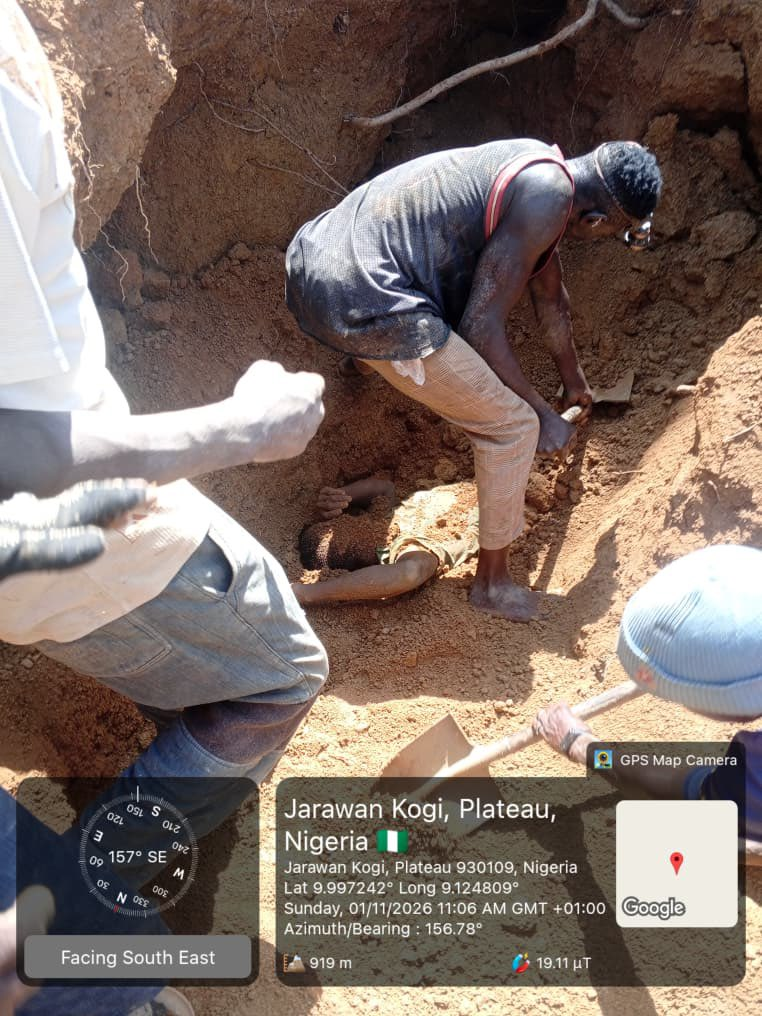
A 35-year-old miner, Ibrahim Jabir, has reportedly died following the collapse of a suspected illegal mining pit in Asaradan village, Jos East Local Government Area of Plateau State, renewing concerns about hazardous excavation practices and the safety of people working at unregulated mining sites.
The incident occurred at approximately 11:10 a.m. on Sunday, November 1, 2026, according to security sources who disclosed that troops of Sector 1, Sub-Sector 12, under Operation Enduring Peace responded to information about the collapse.
Upon arriving at the location, the troops reportedly discovered that community members had already recovered Jabir's body from the collapsed excavation. The security personnel subsequently documented the incident and initiated further communication with relevant authorities.
The sources said Keystone Division in Angware was contacted for necessary follow-up action. However, they did not provide details about the nature of that intervention or whether a formal investigation had commenced.
The circumstances surrounding the collapse remained unclear on Monday. There was no independently confirmed explanation of what caused the pit to cave in, how long Jabir had been working there or whether other miners were present when the accident occurred.
Authorities had also not publicly established who operated the mining site, whether it possessed the necessary licences or whether any safety inspections had previously been conducted.
Although the location was described in initial security reporting as an illegal mining site, the precise regulatory status of the operation had not been independently documented.
Jabir's death adds to a series of fatal mining incidents reported across Plateau State, where mineral extraction provides livelihoods but can expose workers to serious occupational hazards.
In September, four miners were reported dead after an excavation pit collapsed in the Baban Rafi area of Bokkos Local Government Area. Community representatives said the victims were extracting tin when the structure gave way.
The victims included two men and two women, according to local accounts. Their bodies were subsequently recovered by relatives, while questions remained about the circumstances surrounding the collapse.
At the time, Plateau State Police Command spokesperson Alfred Alabo said the command had not received an official report of the incident, highlighting difficulties authorities sometimes face in documenting mining accidents.
The latest death in Jos East raises similar questions about reporting procedures, emergency preparedness and oversight of excavation activities taking place outside established industrial operations.
Earlier this year, another major mining tragedy occurred in the Kampani Zurak area of Wase Local Government Area, where 37 people died after entering abandoned underground workings containing dangerous gases.
Twenty-five others were hospitalised following the February incident, which prompted a federal investigation into the circumstances of the deaths and the continued use of disused mining tunnels.
Investigators subsequently identified carbon monoxide and hydrogen sulphide accumulation, linked to inadequate ventilation, as central factors in that disaster.
The investigation also highlighted the dangers associated with abandoned mining infrastructure that remains accessible to people searching for valuable mineral deposits.
Those findings concern a separate incident and do not establish the cause of Sunday's collapse in Asaradan, which requires its own examination.
Nevertheless, the incidents illustrate different hazards associated with mineral extraction, including unstable excavations, underground gases, inadequate ventilation and insufficient emergency arrangements.
On October 31, Minister of Solid Minerals Development Dele Alake called for the establishment of an army battalion in Zurak to strengthen security and address illegal mining activities.
He made the proposal while receiving a report from the committee investigating the February mining disaster in Wase.
Alake argued that stronger enforcement, improved surveillance and additional resources for Mining Marshals were necessary to protect mining locations and prevent unauthorised operations.
He disclosed that enforcement personnel had recovered more than 100 mining sites from illegal operators, while acknowledging the difficulty of maintaining a permanent security presence at recovered locations.
The committee recommended stronger protection around abandoned workings, improved public awareness, skills development and a nationwide assessment of dangerous legacy mining sites.
These recommendations demonstrate the broader regulatory challenges confronting Nigeria's mining sector, particularly in remote communities where enforcement resources may be limited.
In May, troops of Operation Enduring Peace also conducted an operation against suspected illegal mining at Laminga village in Jos East.
Security reports indicated that suspected operators fled the location, leaving behind equipment recovered by military personnel.
That operation was separate from the Asaradan incident, and there is no established evidence connecting the two sites or their operators.
However, it demonstrates that authorities have previously identified suspected unauthorised mining activities within the same local government area.
The recurring incidents raise questions about whether enforcement efforts are sufficiently coordinated with occupational safety inspections and community education.
Mining pits can become unstable when excavations are inadequately supported, particularly where workers lack suitable equipment or technical guidance.
Determining whether those conditions contributed to Jabir's death would require examination of the collapsed structure and evidence from people familiar with the operation.
Such an investigation should establish the depth and condition of the excavation, the circumstances immediately preceding the collapse and the availability of emergency assistance.
It should also clarify whether the deceased was working independently, employed by another person or participating in a wider mining operation.
These distinctions matter when determining responsibility for workplace safety and identifying any breaches of applicable regulations.
For communities dependent on mineral extraction, preventing further deaths requires measures that recognise both economic realities and the dangers of unsafe practices.
Enforcement against unauthorised operations remains important, but public education, access to safer livelihoods and practical guidance can also reduce exposure to hazardous sites.
The immediate priority in Asaradan is establishing how the collapse occurred and whether additional risks remain at the location.
Authorities have not announced arrests, sanctions or confirmed regulatory action arising from the incident.
For Jabir's family and community, the tragedy represents the loss of a young man whose death has brought renewed attention to the dangers confronting miners.
His death underscores the need for effective safety oversight, timely emergency responses and investigations capable of preventing similar tragedies across Plateau State.
📩 Stone Reporters News | 🌍 stonereportersnews.com
✉️ info@stonereportersnews.com | 📘 Facebook: Stone Reporters News | 🐦 X (Twitter): @StoneReportNew | 📸 Instagram: @stonereportersnews
Add comment
Comments