

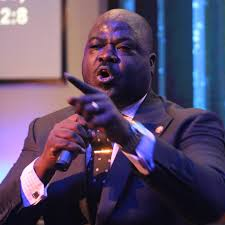
Pastor Olumide Emmanuel Defends Church-Funded Schools Amid Public Backlash Over Accessibility and Accountability
Nigerian cleric Olumide Emmanuel has ignited renewed public debate after strongly defending the use of church funds to establish educational institutions, arguing that such projects must operate as financially independent entities rather than charitable extensions of religious organizations.
In a widely circulated address, the pastor responded to critics questioning why churches invest in schools that many congregants cannot afford. His remarks, delivered in a confrontational tone, framed the issue as a misunderstanding of financial structure and institutional sustainability rather than a moral failure.
Emmanuel maintained that once funds are allocated from church resources into a school project, the institution transitions into a business entity requiring operational viability. According to him, such schools must generate revenue to cover salaries, infrastructure maintenance, and long-term growth, warning that failure to do so would lead to collapse.
He emphasized that educational institutions, regardless of their origin, carry recurring financial obligations. Teachers, administrators, and support staff must be paid consistently, and facilities must be maintained. In his view, expecting a church to indefinitely subsidize these costs without structured income reflects a lack of understanding of economic realities.
The pastor also drew comparisons with large religious campuses in Nigeria, referencing developments associated with Redeemed Christian Church of God and Living Faith Church Worldwide. He cited their ability to provide infrastructure such as electricity within their domains as evidence of effective institutional management, contrasting this with persistent failures in public governance.
In particular, he pointed to Redemption Camp and Canaanland—major religious settlements linked to the two churches—as examples of environments where consistent power supply and organized systems have been achieved independently of the state. Emmanuel argued that similar efficiency, if replicated at the national level, could address longstanding challenges such as unreliable electricity and limited access to quality education.
However, his comments have intensified scrutiny over the broader issue of affordability and inclusion within church-owned institutions. Critics argue that while such schools may be financially sustainable, they often remain inaccessible to lower-income members whose contributions helped fund their establishment.
Stone Reporters note that this tension reflects a wider pattern across Nigeria’s private education sector, where faith-based institutions play a significant role but frequently operate at cost levels beyond the reach of average citizens. The debate raises fundamental questions about whether religious organizations should prioritize social welfare or institutional expansion when deploying collective funds.
Emmanuel dismissed these criticisms, attributing them partly to what he described as personal grievances against religious institutions. He suggested that past negative experiences with churches may be influencing public perception, leading to generalized opposition without full understanding of operational dynamics.
His remarks also included sharp criticism of social media commentators, whom he accused of lacking practical experience in running organizations. He argued that managing a school involves complex financial planning, and that public discourse often overlooks these realities in favor of emotional or reactionary arguments.
The controversy comes at a time when Nigeria continues to grapple with systemic challenges in both education and infrastructure. Public universities have faced repeated disruptions, while private institutions—many of them church-owned—have expanded to fill gaps in capacity and quality.
At the same time, electricity supply remains a persistent issue nationwide, with businesses and institutions frequently relying on independent power solutions. This context has allowed large religious organizations with significant resources to develop semi-autonomous systems within their campuses, reinforcing comparisons such as those made by Emmanuel.
Despite his defense, the pastor’s language has drawn criticism in its own right, with some observers raising concerns about the tone used in addressing dissenting voices. The use of derogatory expressions has been viewed by critics as undermining constructive dialogue on an already sensitive issue.
Supporters, however, argue that his core message highlights an important distinction between charitable giving and capital investment. They contend that without financial discipline and sustainability, even well-intentioned projects would fail, ultimately serving no one.
The debate continues to evolve across Nigerian media and public discourse, reflecting deeper divisions over the role of religion in socio-economic development. Questions remain about transparency, accountability, and the balance between faith-driven initiatives and public responsibility.
For many observers, the issue extends beyond a single statement, touching on broader concerns about governance, inequality, and the expectations placed on both religious and political institutions in addressing national challenges.
📩 Stone Reporters News | 🌍 stonereportersnews.com
✉️ info@stonereportersnews.com | 📘 Facebook: Stone Reporters News | 🐦 X (Twitter): @StoneReportNew | 📸 Instagram: @stonereportersnews
Add comment
Comments