

Reported by: Ijeoma G | Edited by: Oravbiere Osayomore Promise.
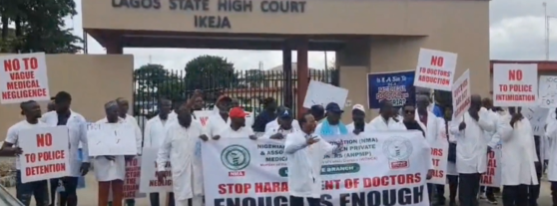
Medical practitioners in Lagos staged a peaceful protest on Saturday, raising concerns over what they described as persistent harassment by law enforcement officers and the growing trend of public condemnation of doctors on social media without due process.
The demonstration, organised by the Association of Nigerian Private Medical Practitioners in collaboration with the Nigerian Medical Association, brought together healthcare professionals from both private and public institutions. Participants gathered at the frontage of the Lagos State University Teaching Hospital in Ikeja before proceeding in an orderly march to express their grievances.
Carrying placards bearing messages such as “Doctors are not criminals” and “Say no to intimidation,” the protesters called for an end to what they described as a pattern of unwarranted arrests, intimidation, and interference with medical duties. The rally began at about 10 a.m. and drew attention from passersby and hospital visitors, as well as broader public discourse on the challenges facing healthcare professionals in Nigeria.
Speaking during the protest, the Chairman of the Lagos State branch of the Nigerian Medical Association, Dr Saheed Babajide Kehinde, said the treatment of doctors by some security operatives was unacceptable and detrimental to the healthcare system. He stressed that medical professionals should not be subjected to criminalisation while performing their duties.
Kehinde said there had been multiple instances in which doctors were allegedly taken away from their workplaces by police officers and detained for extended periods. According to him, such actions not only disrupt medical services but also pose serious risks to patients who depend on timely care.
He emphasised that the role of doctors is fundamentally centred on saving lives, adding that any form of intimidation or obstruction undermines that responsibility. He called on authorities to ensure that medical practitioners are allowed to carry out their duties without fear of harassment or interference.
Also addressing the gathering, the Chairman of the Lagos State chapter of the Association of Nigerian Private Medical Practitioners, Dr Jonathan Esegine, echoed similar concerns. He noted that beyond physical harassment, doctors are increasingly subjected to what he described as “trial by social media,” where allegations—often unverified—are widely circulated, damaging reputations and eroding public trust.
Esegine warned that the cumulative effect of these challenges could further strain Nigeria’s already burdened healthcare system. He said continued intimidation and lack of protection for doctors might discourage professionals from remaining in the country or continuing in active practice, potentially worsening the shortage of medical personnel.
Participants at the protest also highlighted broader systemic issues, including workplace pressures, legal uncertainties, and the absence of clear protocols governing interactions between healthcare providers and law enforcement agencies. Some protesters called for the establishment of formal guidelines to protect medical practitioners from arbitrary arrest or detention, particularly while they are on duty.
Observers note that tensions between healthcare workers and law enforcement are not new, but recent incidents have intensified calls for reform. Medical professionals argue that while accountability in the health sector is important, it must be pursued through appropriate legal and professional channels rather than through public shaming or coercive tactics.
The issue of social media influence has also become a focal point of concern. With the rapid spread of information online, doctors say they are increasingly vulnerable to reputational damage from unverified claims, which can quickly gain traction and provoke public outrage before investigations are concluded.
Health policy analysts suggest that addressing these concerns will require a coordinated approach involving government authorities, professional bodies, and civil society. They argue that protecting healthcare workers is essential not only for the well-being of practitioners but also for ensuring consistent and reliable medical services for the public.
Despite the grievances expressed during the protest, the demonstration remained peaceful, with organisers emphasising dialogue and constructive engagement. Protest leaders called on the government and relevant agencies to open channels of communication with medical associations to address the issues raised.
For many of the participants, the protest represented both a call for immediate action and a broader appeal for respect and recognition of the medical profession. As discussions around the incident continue, attention is likely to focus on how authorities respond to the concerns raised and whether concrete measures will be implemented to improve conditions for healthcare workers.
The outcome of these efforts may have significant implications for the future of healthcare delivery in Nigeria, particularly in a context where the retention and morale of medical professionals remain critical challenges.
📩 Stone Reporters News | 🌍 stonereportersnews.com
✉️ info@stonereportersnews.com | 📘 Facebook: Stone Reporters News | 🐦 X (Twitter): @StoneReportNew | 📸 Instagram: @stonereportersnews
Add comment
Comments