

Reported by: Ijeoma G | Edited by: Oravbiere Osayomore Promise.
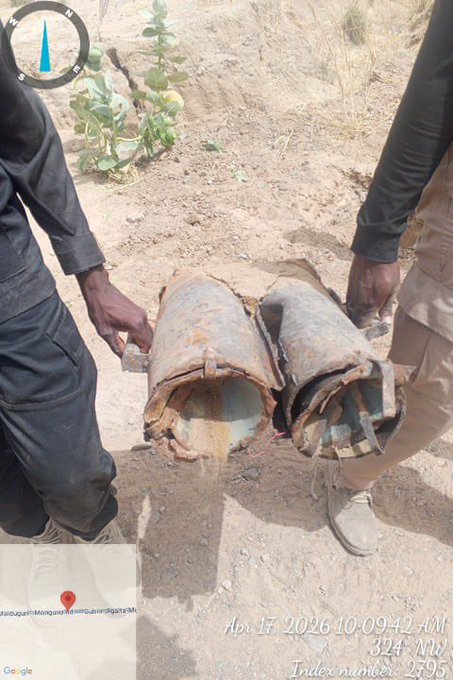
Nigerian troops under Operation Hadin Kai have successfully discovered and neutralised an improvised explosive device planted by suspected insurgents at the exit gate of Mairari town along the Gajiram axis in Borno State, in an incident that underscores the continuing threat of roadside explosives in the North-East region despite sustained military pressure. The device was detected during a routine clearance patrol conducted in the early hours of the morning by an Explosive Ordnance Disposal team assigned to secure key mobility routes within the theatre of operations.
It was gathered from operational sources that the EOD specialists identified the suspicious object while scanning the roadside environment for potential threats, following intelligence suggesting increased insurgent attempts to plant explosive devices along civilian and military movement corridors in the area. Upon confirmation of the device’s characteristics, the troops immediately cordoned off the vicinity to prevent access and ensure civilian safety, temporarily halting movement along the affected axis.
Specialised explosive ordnance personnel proceeded to carry out a controlled detonation after conducting risk assessment procedures and confirming that the device posed a significant danger if left unattended. The controlled blast was executed at a safe distance in accordance with established operational protocols, with security forces maintaining a perimeter throughout the exercise to prevent any unintended exposure to civilians or property.
Following the detonation, troops conducted a thorough sweep of the surrounding environment to ensure that no secondary devices or additional threats were present in the area, a standard precaution in counter-IED operations across insurgency-affected regions. Authorities later confirmed that the entire zone had been cleared and declared safe for both civilian and military movement.
The Mairari axis along the Gajiram corridor remains one of several vulnerable routes within Borno State frequently targeted by insurgent groups operating in the Lake Chad Basin, particularly Islamic State West Africa Province and Boko Haram factions, which have continued to rely on improvised explosive devices, ambush tactics, and sabotage of supply routes as part of their asymmetric warfare strategy against Nigerian security forces.
Military authorities say the renewed focus on route clearance, surveillance patrols, and intelligence-led operations has contributed to a reduction in successful attacks along key supply lines, although sporadic attempts such as the Mairari incident highlight the persistent adaptability of insurgent groups in the region. Operation Hadin Kai continues to integrate ground forces with aerial reconnaissance to disrupt enemy movement and logistics networks.
Residents in affected communities have been urged to remain vigilant and promptly report suspicious objects or movements to security agencies, as part of ongoing efforts to enhance early threat detection and prevent civilian casualties. Security officials have reiterated that public cooperation remains critical in sustaining recent gains achieved in counter-insurgency operations across the North-East.
Operation Hadin Kai, the Nigerian military’s flagship counter-insurgency operation in the North-East, has for years been engaged in coordinated ground, air, and intelligence missions aimed at degrading the capabilities of Boko Haram and Islamic State West Africa Province. The theatre, which covers Borno and surrounding states, remains central to Nigeria’s long-running security response to insurgency in the Lake Chad Basin, where porous borders and difficult terrain have enabled militant movements.
The interception of the Mairari IED is operationally significant because the Gajiram corridor serves as a critical logistics and civilian movement route connecting several local government areas within northern Borno. Security analysts note that successful placement of explosives along such routes is often intended to disrupt supply chains, create fear among civilians, and test the responsiveness of military clearance units operating in the region.
Over time, insurgent groups in the region have increasingly shifted toward the use of improvised explosive devices due to their low production cost and high psychological impact. These devices are often deployed along roadways, near military checkpoints, or in abandoned settlements, making them difficult to detect without specialised equipment and trained personnel. This has necessitated a continuous upgrade in counter-IED capabilities by Nigerian forces.
Local security collaboration has also played a significant role in recent operational successes, particularly through the Civilian Joint Task Force, which supports military operations by providing intelligence, identifying suspicious movements, and assisting in route monitoring across vulnerable communities. Their presence has improved early warning systems and strengthened trust between civilians and security agencies in conflict-affected areas.
Security authorities emphasize that while incidents such as the Mairari IED discovery highlight ongoing risks, they also demonstrate improved detection and response capacity within the theatre. Officials stress that sustained investment in intelligence gathering, community engagement, and rapid response capabilities will remain essential to consolidating gains and preventing insurgent resurgence across the North-East.
Beyond the immediate security dimension, the presence of improvised explosive devices along civilian routes continues to affect daily life in affected communities, disrupting trade, limiting agricultural movement, and increasing anxiety among residents who rely on these corridors for transportation and economic activity. Humanitarian observers note that repeated security alerts often lead to temporary road closures, which can further strain already vulnerable populations in rural areas dependent on consistent access to markets and services.
Strategically, the continued detection and neutralisation of explosive devices underscores both the resilience of insurgent networks and the evolving effectiveness of counter-insurgency operations in Nigeria’s North-East. Security experts argue that sustained coordination between military units, intelligence agencies, and local communities will be crucial in maintaining pressure on insurgent groups and preventing them from re-establishing operational footholds in cleared territories.
Military officials maintain that vigilance along key corridors such as Gajiram–Mairari will remain a priority as part of broader stabilization efforts aimed at securing long-term peace in the region. They reaffirm commitment to continuous patrols, rapid clearance operations, and intelligence-driven interventions designed to neutralise threats before they can materialise into attacks against civilians or security personnel.
📩 Stone Reporters News | 🌍 stonereportersnews.com
✉️ info@stonereportersnews.com | 📘 Facebook: Stone Reporters News | 🐦 X (Twitter): @StoneReportNew | 📸 Instagram: @stonereportersnews
Add comment
Comments