

Reported by: Oahimire Omone Precious | Edited by: Oravbiere Osayomore Promise.
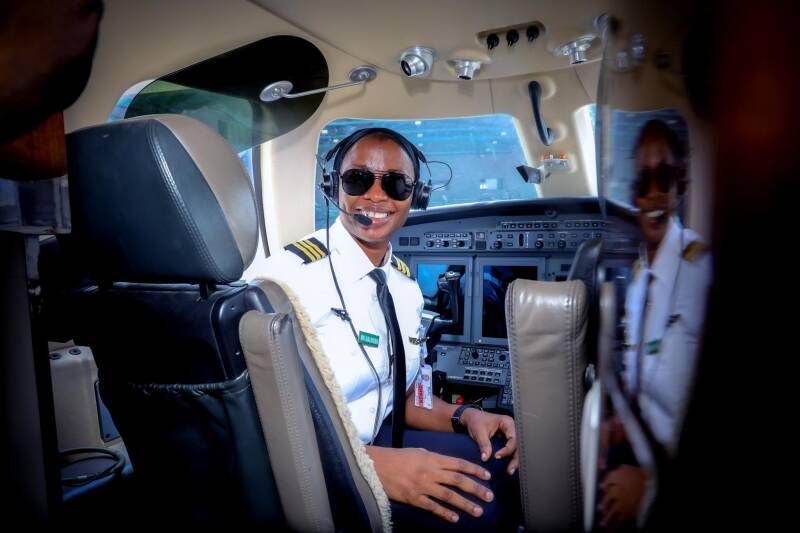
The Nigeria Customs Service (NCS) has drawn national attention after celebrating Superintendent of Customs Nafisat Balogun, who has secured a commercial multi-engine pilot license in the United States, marking a rare achievement within the paramilitary agency and placing her among a select group of Nigerian women in advanced aviation roles.
The announcement, confirmed through official Customs communications, describes Balogun as the first known serving female officer within the NCS to attain such a certification. Her accomplishment is being framed not only as a personal triumph but also as a reflection of evolving institutional priorities within the service, particularly around capacity building, technical specialization, and gender inclusion.
A commercial multi-engine license represents one of the more demanding qualifications in civil aviation. It allows the holder to operate aircraft with more than one engine under commercial conditions, a step beyond basic private or single-engine certifications. The process typically involves intensive theoretical coursework, simulator training, and the accumulation of significant flight hours under strict regulatory supervision. Candidates must demonstrate mastery in navigation, meteorology, aircraft systems, and emergency procedures, as well as pass multiple practical and written examinations.
Training in the United States, where Balogun completed her certification, is widely regarded as rigorous, governed by the Federal Aviation Administration’s stringent standards. Aviation schools in the country attract international trainees due to their structured programs, advanced infrastructure, and global recognition of licenses issued under U.S. regulations.
While specific details about Balogun’s training institution and timeline have not been fully disclosed, officials within the Customs Service indicated that her journey required years of preparation and careful balancing of professional duties with demanding aviation coursework. Colleagues describe her as disciplined and focused, noting that her interest in aviation developed alongside her career in Customs, rather than as a separate pursuit.
Her achievement arrives at a time when Nigerian authorities are increasingly emphasizing local capacity development in aviation. The country has long faced challenges related to pilot shortages and reliance on expatriate expertise, particularly in commercial and specialized aviation operations. Expanding the pool of trained Nigerian pilots has been identified as a strategic priority, with both public and private stakeholders investing in training programs and international partnerships.
Within this broader context, Balogun’s success carries symbolic and practical weight. Although the Nigeria Customs Service is not an aviation regulatory body, it operates within a security ecosystem where aerial surveillance and rapid response capabilities are becoming more relevant. Border monitoring, anti-smuggling operations, and inter-agency coordination often intersect with aviation logistics, especially in a country with vast and sometimes difficult-to-police terrain.
The NCS has undergone a series of reforms in recent years aimed at modernizing its operations and workforce. These reforms have included digitization of customs processes, enhanced enforcement strategies, and expanded training opportunities for officers both locally and abroad. The recognition of Balogun’s achievement fits into this narrative of transformation, suggesting an institutional willingness to support unconventional career paths that may ultimately strengthen operational capacity.
In its official commendation, the Customs Service emphasized values such as perseverance, professionalism, and continuous learning, describing Balogun’s milestone as an example of what officers can achieve when given opportunities for development. The agency also highlighted the importance of representation, noting that her success could inspire more women within and outside the service to pursue careers in aviation and other technical fields.
Gender representation remains a significant issue in Nigeria’s aviation sector. Despite gradual progress, women continue to be underrepresented in cockpit roles and other technical positions. Barriers such as high training costs, limited access to mentorship, and societal expectations have historically constrained participation. However, there has been a steady increase in the number of Nigerian women entering aviation, supported by advocacy initiatives, scholarships, and changing perceptions.
Balogun’s achievement adds to this momentum. Aviation stakeholders and observers see such milestones as critical in challenging stereotypes and encouraging institutional policies that promote inclusivity. The visibility of female professionals in high-skill roles is often cited as a key factor in driving long-term change, particularly in industries traditionally dominated by men.
Beyond gender considerations, her accomplishment also underscores the diversification of skill sets within public service institutions. Increasingly, agencies like the Nigeria Customs Service are recognizing the value of multidisciplinary expertise. Officers are encouraged to develop competencies that go beyond their immediate job descriptions, reflecting the complex and interconnected nature of modern governance and security challenges.
Reactions from within the service and the broader public sphere have been largely positive, with many praising the dedication required to achieve such a credential. Some observers have also pointed to the potential benefits of integrating aviation-trained personnel into government agencies, especially in areas related to surveillance, logistics, and emergency response.
Although there has been no official indication that Balogun will immediately transition into an aviation-specific role within the Customs Service, her qualification is expected to open up new possibilities, both for her career and for the agency’s operational framework. It also reinforces the idea that public service careers can evolve in unexpected and innovative directions.
Her recognition comes amid a wider push by Nigerian institutions to highlight excellence and professionalism within their ranks. By celebrating achievements like Balogun’s, agencies aim to build morale, encourage ambition, and project a positive image to the public. Such narratives are particularly important in a context where public confidence in institutions can be influenced by perceptions of competence and integrity.
For aspiring aviators, especially young women, Balogun’s story serves as a tangible example of what is achievable with determination and access to opportunity. It illustrates the potential for individuals to break through institutional and societal barriers, even in fields that demand significant investment of time, resources, and resilience.
As Nigeria continues to navigate the challenges of development in a rapidly changing global environment, the intersection of public service, technical expertise, and individual ambition is likely to become increasingly important. Stories like this highlight the human dimension of institutional progress, reminding observers that behind policy shifts and reform agendas are individuals pushing boundaries and redefining possibilities.
In celebrating Superintendent Nafisat Balogun, the Nigeria Customs Service is not only acknowledging a remarkable personal achievement but also signaling a broader commitment to growth, inclusivity, and innovation. Her journey reflects a changing landscape in which talent is nurtured across disciplines, and where the pursuit of excellence is encouraged regardless of traditional limitations.
📩 Stone Reporters News | 🌍 stonereportersnews.com
✉️ info@stonereportersnews.com | 📘 Facebook: Stone Reporters News | 🐦 X (Twitter): @StoneReportNew | 📸 Instagram: @stonereportersnews
Add comment
Comments