

Reported by: Ijeoma G | Edited by: Oravbiere Osayomore Promise.
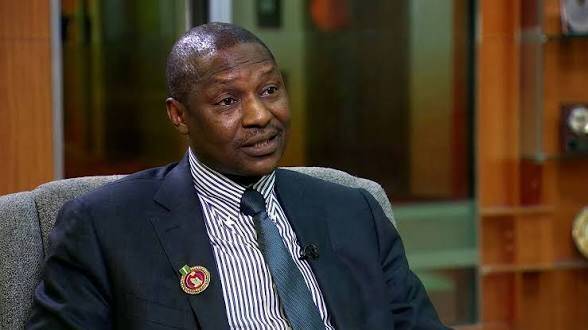
A Federal High Court sitting in Maitama, Abuja, on Monday admitted nine documentary exhibits in an ongoing criminal trial involving former Attorney-General of the Federation and Minister of Justice, Abubakar Malami, SAN, alongside his wife, Hajia Bashir Asabe, and his son, Abubakar Abdulaziz Malami. The decision followed the presentation of the documents by the Economic and Financial Crimes Commission, EFCC, as part of its evidence in the case alleging financial offences connected to the handling of funds running into billions of naira. The court proceedings, presided over by Justice Joyce Abdulmalik, centered on requests by the prosecution to place banking and corporate records before the court for evaluation during trial.
The EFCC is prosecuting the defendants on an amended 16-count charge which includes allegations of conspiracy, procurement of assets, concealment of proceeds of alleged unlawful activities, and money laundering. The commission alleges that the total value of funds involved amounts to N8,713,923,759.49. The charges are brought under provisions of the Money Laundering (Prevention and Prohibition) Act, 2022. The defendants have not been convicted and are presumed innocent until proven guilty, while the prosecution continues to present documentary and testimonial evidence intended to establish its case before the court.
The prosecution called its fourth witness, Mashelia Arhyel Bata, a compliance officer with Zenith Bank Plc, Maitama branch. The witness told the court that his official responsibilities include receiving and responding to correspondence from law enforcement agencies, including the EFCC, particularly where financial records are requested during investigations. He explained that he became involved in the matter after the commission requested documentation relating to several accounts allegedly linked to the defendants and associated corporate entities.
According to Bata, Zenith Bank complied with the EFCC’s requests by providing both soft and hard copies of account opening documents, statements, and transaction records. He stated that the records covered accounts associated with individuals and companies named in the charge, including Rayhaan Hotels Limited, Rayhaan Bustan Agro Allied Limited, Nashab Limited, Golden Age Global Ventures, and Rahamaniyya Properties Limited. He confirmed that he was able to identify nine distinct sets of documents submitted to the court as part of the bank’s response to the EFCC inquiry.
Upon application by prosecution counsel J. S. Okutepa, SAN, the court admitted the documents as Exhibits D1 to D9, despite an initial objection raised by defence counsel J. B. Daudu, SAN, who questioned aspects of the dates on the documents. Justice Abdulmalik ruled that the documents were admissible at this stage of the proceedings. The exhibits, dated between July 19, 2024 and March 12, 2026, were admitted as part of the prosecution’s evidence to be examined further during cross-examination and subsequent hearings.
During further testimony led by prosecution counsel Ekele Iheanacho, SAN, the witness provided details of financial transactions reflected in the documents. He identified Exhibit D1 as containing account opening forms and statements for accounts linked to Abubakar Malami and A. A. Malami & Co, including both naira and dollar accounts. He stated that the account statements covered a period spanning from January 1, 2012 to December 31, 2023, during which various inflows and outflows were recorded. He noted that the accounts remained active over multiple years, with transactions occurring between 2015 and 2023.
The witness further informed the court that one of the accounts recorded total credits amounting to N383,637,211.55 between 2016 and 2023, while another set of records showed credits of N560,506,465.12 between 2012 and 2015. He also stated that debits recorded during similar periods amounted to N384,322,120.85 and N571,891,174.08 respectively. He added that among the transactions captured were inflows such as N194,791,608 received on November 11, 2020 from New Horizons Limited, N622,500,000 received on June 24, 2022 from Rayhaan Bustan Agro Allied Limited, and two separate inflows of N250 million each from Rayhaan Hotels Limited in July 2022.
The witness also told the court that an additional N500 million was recorded as an inflow in December 2022 from Rayhaan Bustan Agro Allied Limited, alongside other transactions that he said extended into several billions of naira when aggregated across the period under review. Following the presentation of the documents and oral testimony, defence counsel J. B. Daudu, SAN, requested an adjournment to enable the defence team to review the exhibits thoroughly and prepare for cross-examination of the witness at a later date. The court granted the application.
Justice Joyce Abdulmalik subsequently adjourned the matter to May 13, 2026, for continuation of trial. The case continues to draw attention due to the prominence of the defendants and the scale of the allegations presented by the EFCC, while the court maintains its role in assessing the admissibility and weight of evidence as the proceedings advance.
In cases involving alleged financial crimes, documentary evidence such as bank statements, account opening forms, and corporate transaction records often plays a central role in establishing patterns of fund movement. Prosecutors typically rely on such materials to demonstrate the flow of funds between individuals and corporate entities, especially where allegations of concealment or layering are raised under anti-money laundering laws. However, courts are required to evaluate such evidence within the framework of due process, ensuring that admissibility is balanced with the rights of the defendants to challenge the authenticity, relevance, and interpretation of the records. The EFCC, as Nigeria’s principal anti-corruption agency, continues to present such materials in line with its statutory mandate, while the court remains the arbiter of their probative value.
The adjournment granted by the court reflects standard procedural safeguards in complex financial trials, where voluminous records are introduced over extended periods. Defence teams are typically afforded time to scrutinize documentary exhibits before cross-examining prosecution witnesses in detail. The next hearing is expected to focus on further examination of the bank official and potential clarification of transaction entries already tendered. As the proceedings continue, both parties are anticipated to refine their arguments around the interpretation of the financial records, while the court ensures that the trial proceeds in an orderly and fair manner consistent with established criminal procedure before the Federal High Court
📩 Stone Reporters News | 🌍 stonereportersnews.com
✉️ info@stonereportersnews.com | 📘 Facebook: Stone Reporters News | 🐦 X (Twitter): @StoneReportNew | 📸 Instagram: @stonereportersnews
Add comment
Comments