

Reported by: Oahimire Omone Precious | Edited by: Oravbiere Osayomore Promise.
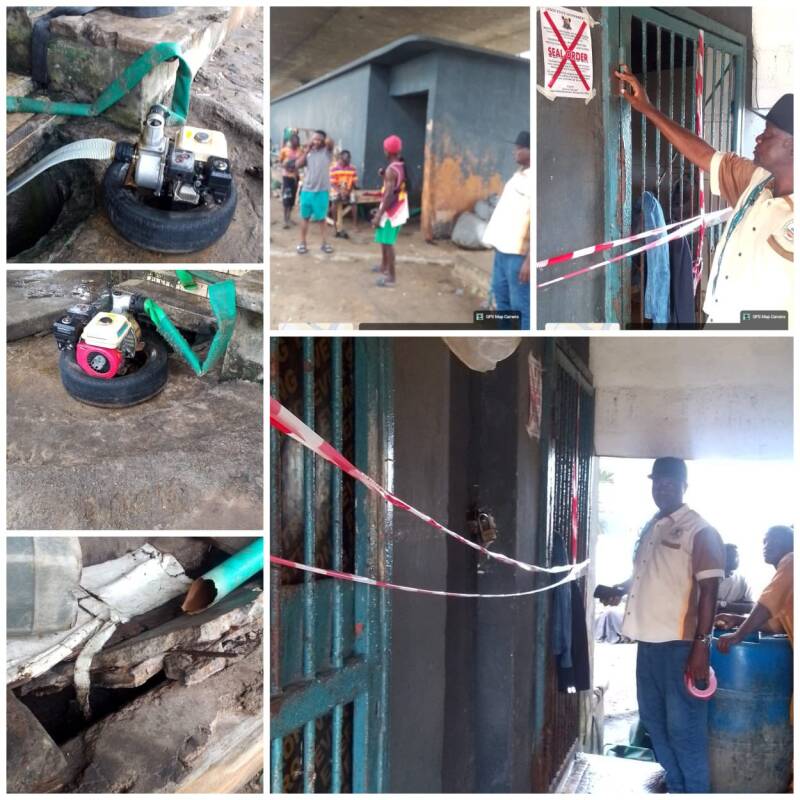
The Lagos State Wastewater Management Office has sealed two public toilets for discharging untreated faecal matter into canals and using pumping machines to force raw sewage into public drains, an enforcement action that underscores the state government’s renewed zero tolerance for environmental pollution. The facilities, located at No. 68 Jinadu Street in Surulere and under the Marina Bridge on Lagos Island, were shut down on Tuesday following a surge in public complaints about offensive odours and visible sewage flows within the communities. The Commissioner for Environment and Water Resources, Tokunbo Wahab, announced the closures in a statement on X, warning that violators of wastewater management regulations would face sanctions and possible prosecution. “The first toilet, located at No. 68, Jinadu Street, Surulere, was sealed for discharging untreated faecal matter into the canal, thereby polluting the environment,” Wahab said. He noted that the second toilet, situated at Marina under Bridge, Lagos Island, was sealed for the deliberate discharge of raw sewage and untreated wastewater into public drains using a pumping machine, an act he described as constituting a public nuisance, environmental pollution and endangering human health. The state government enjoined residents to adopt proper wastewater management and hygiene practices to support public health and promote environmental sustainability, adding that any act of environmental nuisance will attract appropriate sanctions and possible prosecution.
The closure of the two facilities represents the latest salvo in an intensifying crackdown by the Lagos State Wastewater Management Office against illegal wastewater discharge across the metropolis. Over the past year, the agency has sealed numerous properties in Surulere, Amuwo Odofin, Victoria Island, Lekki, Ebute Metta, and other areas for similar violations. In February 2026, the LSWMO shut down a public toilet at Ijora Olopa, near the Nipost area, for the deliberate discharge of raw sewage into its surroundings using a pumping machine. Earlier that month, a public toilet on Savage Street in Ebute Metta was sealed after officials discovered raw sewage being pumped directly into a public drain, creating offensive odour and visible sewage flow within the community. In March 2026, the agency sealed a shopping complex and a public toilet facility on Offin Road after operators allegedly channelled their septic tank contents directly into a drainage system, resulting in sewage overflow. The pattern is unmistakable: across Lagos, operators of public toilet facilities have been caught circumventing proper waste management protocols, often choosing to pump untreated waste into the nearest drain rather than paying for approved disposal services.
The enforcement drive has not been limited to public toilets. In January 2026, the LSWMO sealed Ebute-Ero Market Block N for illegally channelling sewage pipes into public drains and constructing a septic tank on a walkway. In April 2026, a building operated by Access Bank Plc in the Oniru area of Lagos Island was sealed over allegations that untreated wastewater was being discharged into the public drainage system. The LSWMO has also intensified its scrutiny of residential properties, with the agency warning that any building found without a proper toilet facility will be sealed as a proactive measure to prevent the spread of cholera and other water-borne diseases. The Lagos State Government has provided over 4,710 public toilets across the state, including 1,710 government-installed units and 3,000 provided by petrol stations and other private entities. Yet despite this availability, illegal discharge persists, suggesting that enforcement alone may not be sufficient to change behaviour.
The public health implications of untreated sewage discharge are severe. Raw sewage contains pathogens that cause cholera, typhoid, dysentery, and hepatitis A. When pumped directly into drains and canals, these pathogens can contaminate groundwater, surface water, and even the air in densely populated areas. In Lagos, a coastal megacity with poor drainage infrastructure and high population density, the risks are amplified. The state has recorded outbreaks of water-borne diseases in the past, and health officials have warned that improper waste management practices are contributing factors. The LSWMO’s intensified enforcement is therefore not merely about aesthetics or regulatory compliance; it is a direct public health intervention aimed at preventing disease outbreaks before they occur.
Reactions to the latest closures on social media have been largely supportive. On Wahab’s X post, a user identified as Umeh, who tweets as @UmehWrites, described the action as a “good move” and called for sustained inspections and publication of approved toilet locations to make hygienic facilities easily accessible. Another user, @AlliOlabisi5, urged the government to “seal everything up and prosecute the offenders to the fullest extent of the law.” Others commended the commissioner for assuring a cleaner Lagos through consistent action. The supportive tone reflects a growing public intolerance for environmental violations, particularly in areas where residents have endured years of sewage overflow and offensive odours without effective redress.
The LSWMO has indicated that the enforcement drive will continue and may expand. In a statement following the closures, the agency reiterated its commitment to safeguarding public health and maintaining environmental standards across the state. The commissioner stressed that the state government has zero tolerance for the indiscriminate discharge of untreated wastewater into the environment. He urged residents to regularly evacuate their septic tanks and soakaway pits and to report any observed violations to the LSWMO through its official contact channels. The agency also warned that property owners and facility operators found to be in violation of wastewater management regulations could face prosecution, which may result in fines or imprisonment under the Environmental Management and Protection Law 2017.
For the operators of the two sealed facilities, the path forward is uncertain. The toilets will remain closed until the LSWMO determines that corrective measures have been implemented and approved. Whether the operators will be prosecuted has not been announced. What is clear, however, is that the state government has drawn a line. In a city where rapid urbanisation has outpaced infrastructure development, where many residents still lack access to proper sanitation, the enforcement of wastewater regulations is not merely a bureaucratic exercise. It is a struggle for the very health and habitability of Africa’s largest metropolis. The closure of two public toilets on Jinadu Street and under the Marina Bridge may seem like a small action. But it is part of a larger message: in Lagos, the days of pumping raw sewage into public drains are coming to an end.
📩 Stone Reporters News | 🌍 stonereportersnews.com
✉️ info@stonereportersnews.com | 📘 Facebook: Stone Reporters News | 🐦 X (Twitter): @StoneReportNew | 📸 Instagram: @stonereportersnews
Add comment
Comments