

Reported by: Ijeoma G | Edited by: Oravbiere Osayomore Promise.
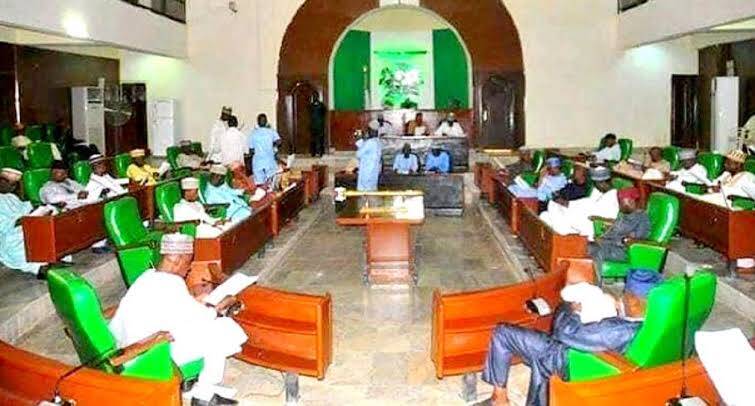
The Jigawa State House of Assembly has directed the state government to recover missing public funds and sanction officials over financial irregularities uncovered in audited accounts from 2019 to 2024, in what observers have described as the most sweeping accountability exercise in the state in over a decade. The decision followed the presentation and unanimous adoption of a report by the House Committee on Public Accounts during plenary in Dutse on Wednesday, April 22, 2026. Chairman of the committee, Sani Isyaku Abubakar, who is also the deputy speaker, presented the document after a public hearing and a detailed review of audited accounts covering the state government and all 27 local government councils.
The report found systemic weaknesses in financial management across both state and local government levels, including expenditures above approved budgets, weak procurement processes, poor revenue collection, documentation gaps, irregular and unauthorised payments, project execution issues, and loss of records. At the local government level, the committee identified “fictitious and unauthorised payments” as well as “overpayments, unaccounted cheques, and unverifiable expenditures.” In such cases, the committee recommended recovery of funds and disciplinary action against responsible officers. Commissioners, permanent secretaries, accounting officers, directors of administration and finance, and other relevant officials were invited by the committee to respond to unresolved audit queries. Local government chairmen, directors of administration and general services, treasurers, and other key officers also appeared before the panel.
The committee reviewed reports from both the Auditor-General for the State and the Auditor-General for Local Government Councils, examining financial statements, payment vouchers, contract records, and procurement documents. Isyaku said the committee adopted a balanced approach by allowing the MDAs and local government councils to respond to audit observations while maintaining strict adherence to the principles of transparency, accountability, and fiscal discipline. The committee traced the irregularities to poor training of accounting officers, weak enforcement of financial rules, and reliance on manual systems vulnerable to manipulation. “These weaknesses undermine fiscal discipline, public trust, and effective service delivery,” Isyaku said. To address the issues, the committee recommended regular training for accounting officers and auditors, alongside stronger funding and independence for the Auditor-General’s office. Speaker of the House, Haruna Dangyatim, commended the committee for what he described as a thorough review and said the report would be forwarded to the executive for action.
Lawmakers unanimously adopted the report following a voice vote at plenary. The probe covered the period of the administration of former Governor Mohammed Badaru Abubakar, who served from 2015 to 2023, and the current administration of Governor Umar Namadi, who assumed office in May 2023. The committee’s review of financial records from 2019 to 2024 therefore spans both administrations. While the assembly’s resolution does not name specific individuals, the report implicitly targets officials who served during the period under review, including commissioners, permanent secretaries, and local government chairmen.
The timing of the probe has raised eyebrows across the state’s political landscape, coming just days after the government set up a reconciliation committee aimed at resolving lingering tensions between allies of former Governor Badaru and supporters of the incumbent, Governor Namadi. Observers believe the investigation may be more than just a financial accountability exercise.
The recent defection of several Badaru loyalists, particularly former council chairmen, to the African Democratic Congress (ADC) has unsettled the ruling All Progressives Congress (APC), fueling speculation that the probe could be politically motivated. Political analysts warn that if the investigation is pursued to its logical conclusion, it could send shockwaves through Jigawa’s power structure, as a significant number of current lawmakers and government officials reportedly served under Badaru’s administration.
With alliances shifting and tensions rising, the unfolding probe may not only determine financial accountability but also reshape the state’s political future. The assembly’s resolution, however, focuses squarely on the financial irregularities identified in the audit reports. The committee recommended that all unverifiable expenditures, overpayments, and unaccounted funds be recovered, with responsible officers sanctioned in line with civil service rules and financial regulations. The report also recommended that the office of the Auditor-General be strengthened with adequate funding, staff, and operational independence in accordance with the state audit law. Regular training and professional certification for accounting officers, internal auditors, and treasury staff should be institutionalised by the government. The committee also suggested that fireproof storage facilities be made available for record keeping, and that staff who demonstrate professionalism and excellent accounting practices be rewarded to encourage probity and accountability.
The assembly’s decision has been welcomed by civil society groups and anti-corruption advocates, who have long called for greater accountability in public financial management in Jigawa State. The Centre for Fiscal Transparency and Integrity Watch praised the assembly for what it described as a “landmark resolution” and called on the executive to implement the recommendations without delay. The group also urged the assembly to follow up on the implementation of the report to ensure that recovery and sanctions are carried out. The resolution comes amid ongoing anti-corruption efforts in Jigawa State. In March 2026, the Economic and Financial Crimes Commission (EFCC) handed over N387 million recovered from fraudulent actors to the Jigawa State government. In 2024, the state government suspended a commissioner over alleged mismanagement of funds for a Ramadan feeding programme, and also suspended four local government chairpersons over allegations of misappropriation of funds. The assembly’s resolution, however, represents the most comprehensive attempt to address systemic financial irregularities in the state’s history.
The report, described by some public commentators as the first of its kind by the assembly for over a decade, has been hailed as a model for legislative oversight. The House has been called upon to maintain the tempo to enforce and enhance discipline in public financial management in the state. As the report is transmitted to the executive for action, all eyes will be on Governor Namadi to see whether he will implement the recommendations fully or whether the probe will be watered down. For the people of Jigawa State, the resolution offers hope that public funds will be managed with greater transparency and accountability in the future. The assembly has spoken. Now the executive must act.
📩 Stone Reporters News | 🌍 stonereportersnews.com
✉️ info@stonereportersnews.com | 📘 Facebook: Stone Reporters News | 🐦 X (Twitter): @StoneReportNew | 📸 Instagram: @stonereportersnews
Add comment
Comments