

Reported by: Ijeoma G | Edited by: Oravbiere Osayomore Promise.
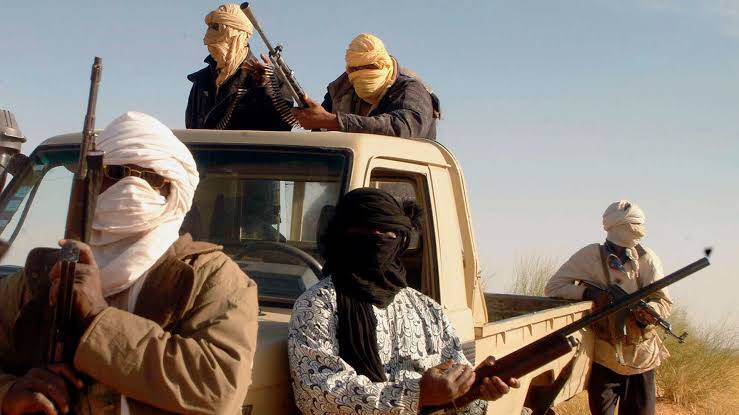
Al-Qaeda-linked militants and Tuareg separatists launched a rare and highly coordinated wave of attacks across military-ruled Mali on Saturday, striking multiple cities including the capital Bamako, in what analysts described as the largest assault on the junta in years. Explosions and sustained gunfire were first reported shortly before 6 a.m. local time near the main military base at Kati, a garrison town on the outskirts of Bamako that houses the residences of junta leader General Assimi Goïta and Defence Minister Sadio Camara. Within hours, fighting had spread to several other locations, including Bamako’s international airport, the central towns of Sevare and Mopti, and the northern cities of Gao and Kidal, which had been a symbol of the government’s military victory after it was recaptured in 2023.
Jama’at Nusrat al‑Islam wal‑Muslimin (JNIM) – the country’s main al‑Qaeda‑affiliated militant group – claimed responsibility for the operation, which it said was carried out in coordination with the Tuareg‑led Azawad Liberation Front (FLA).
According to a statement published by the SITE Intelligence Group, JNIM said its fighters attacked the homes of the junta leader and the defence minister, Bamako’s Modibo‑Keïta International Airport, and military sites in Kati. The group also claimed to have “captured” the northern city of Kidal and taken control of Mopti and most military positions in Gao and Sevare. The FLA, which seeks a breakaway ethnic Tuareg state, confirmed that the attacks were part of a “well‑planned” joint operation. “We had been working on this operation for a long time, in a well‑planned manner, and in fact, in alliance with JNIM,” FLA spokesman Mohamed Elmaouloud Ramadane told the BBC.
The Malian army reacted slowly at first. In a brief statement, it described unidentified “terrorist” groups as the perpetrators but gave no details. It later claimed that the situation was under control and that “several hundred” assailants had been killed, though no evidence was provided, and the BBC noted that fighting appeared to continue long after the announcement. By late morning, reports indicated that the defence minister’s residence in Kati had been badly damaged, a military helicopter had been shot down near Gao, and about ten suspected attackers’ bodies had been counted. The US embassy urged its citizens to shelter in place, and the UK Foreign Office advised against all travel to Mali, warning that the airport had been temporarily closed.
The military government, led by General Goïta, has been under intense pressure since it seized power in coups in 2020 and 2021, promising to restore security but failing to halt a jihadist insurgency that has plagued the Sahel state for over a decade.
Saturday’s attacks were widely seen as the boldest and most sophisticated challenge to the junta in years, targeting not only remote northern positions but the capital itself. “This looks like the biggest coordinated jihadist attack on Mali for years,” said Ulf Laessing, head of the Sahel programme at the Konrad Adenauer Foundation. The African Union strongly condemned the violence, while Russia’s foreign ministry claimed that about 250 fighters had attacked Bamako’s airport and surrounding areas but had been repelled.
By Saturday evening, an uneasy calm had settled over parts of the capital, though residents reported that heavy fighting continued in several neighbourhoods. The authorities imposed a nightly curfew from 9 p.m. to 6 a.m. for three days, and checkpoints were set up on roads leading to the airport. For millions of Malians who had watched their government lose control of vast tracts of the north and centre over years of bloodshed, the day was a stark reminder that none of the country’s major cities are safe anymore.
📩 Stone Reporters News | 🌍 stonereportersnews.com
✉️ info@stonereportersnews.com | 📘 Facebook: Stone Reporters News | 🐦 X (Twitter): @StoneReportNew | 📸 Instagram: @stonereportersnews
Add comment
Comments