

Reported by: Ijeoma G | Edited by: Oravbiere Osayomore Promise.
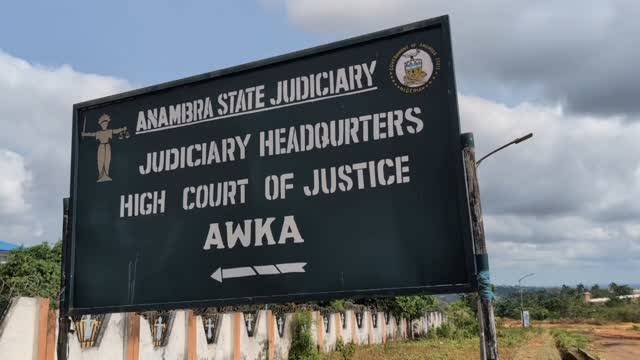
An Anambra State High Court sitting in Awka has sentenced a 28‑year‑old man, Ifeanyi Anizoba Jnr, to death by hanging for the murder of his father, Ifeanyi Anizoba, in a case that has sent shockwaves through the community and reignited debate about the sanctity of life and the limits of familial violence. The judgment, delivered on Monday, April 27, 2026, by Justice Chukwudi Okaa, marked the end of a trial that began more than six years after the tragic incident on Christmas Eve, 2019. The prosecution, led by Chief State Counsel Chiamaka Chukwuka, presented evidence that the defendant pushed his father during a heated altercation at their home in Nodu Village, Awka, causing the older man to hit his head against a wall and lose consciousness. Rather than seeking medical help, the court heard, the defendant locked his incapacitated father inside a room and left him unattended for two full days. It was only when neighbours detected a foul odour emanating from the room that the alarm was raised, and family members forced the door open to discover the decomposing body.
The case exposed a long‑simmering tension between father and son. According to court documents, the deceased had previously reported the defendant to the police for threatening his life and engaging in conduct likely to cause a breach of the peace. That case was prosecuted for about a year before the father withdrew the charge, and it was struck out. On the day of the fatal incident, the court heard that the father had become angry because the defendant had used his soap to bathe and failed to return it. He reported the matter to the police, who attempted to arrest the defendant, but he evaded them. Later that evening, the defendant returned home, confronted his father, and asked why he had called the police on him. The father slapped the defendant, and the defendant responded by pushing him hard, causing the fatal head injury. After the fall, the defendant locked the door, leaving his father in that state, and went to his room to sleep. He did not check on his father or seek medical help for two days, until the body began to smell.
The prosecution called three witnesses: a relative of the deceased, the investigating police officer, and the medical doctor who conducted the autopsy. Their testimonies, along with the defendant’s own statement to the police – in which he acknowledged pushing his father and locking the door – formed the backbone of the case. The defendant, who initially had no legal counsel, was later assigned a lawyer from the Office of the Public Defender. He called two witnesses and denied responsibility for his father’s death, but his defence was rejected by the court. Justice Okaa held that the totality of the evidence proved beyond a reasonable doubt that the defendant’s actions led directly to the death of the deceased. “The totality of the evidence before the court established that the defendant’s actions led to the death of the deceased, and he is hereby sentenced to death by hanging,” the judge declared.
The sentencing of a child for the murder of a parent is a rare and solemn event in Anambra State, where the family is considered the bedrock of society. Legal experts note that under the Criminal Code applicable in Anambra, murder carries a mandatory death sentence, and the court has no discretion to impose a lesser penalty once guilt has been established. However, the case has drawn mixed reactions. Some residents of Nodu Village expressed satisfaction that justice had been served, recalling the trauma of discovering the decomposing body of a respected elder. Others voiced sorrow that a family dispute had escalated into irreversible tragedy. “It is sad that a son could do such a thing to his own father. But the law must take its course,” a community elder told local reporters.
The defendant’s defence team has indicated that an appeal will be filed. Under Nigerian law, a death sentence is automatically subject to review by the Court of Appeal and ultimately the Supreme Court. The process could take several years. In the meantime, the convicted man remains in custody at a correctional facility in Awka. The case has also prompted renewed calls for the abolition of the death penalty in Nigeria, which is one of only a handful of African countries that still carry out executions. Human rights organisations argue that the death penalty is irreversible and disproportionately affects the poor and mentally ill. However, supporters of capital punishment contend that certain crimes, such as parricide, demand the ultimate sanction.
For the family of the late Ifeanyi Anizoba, the judgment brings a measure of closure, but the wounds left by the Christmas Eve tragedy may never fully heal. A neighbour who witnessed the aftermath of the incident described the family’s grief as “unbearable.” “They lost a father, and now they have lost a son. There are no winners here,” she said. As the legal process moves to the appellate courts, the question of whether Ifeanyi Anizoba Jnr will ultimately face the gallows remains unresolved. What is clear is that a single act of violence, committed in anger on a festive night, has shattered a family and left a community grappling with the consequences of a son’s betrayal.
📩 Stone Reporters News | 🌍 stonereportersnews.com
✉️ info@stonereportersnews.com | 📘 Facebook: Stone Reporters News | 🐦 X (Twitter): @StoneReportNew | 📸 Instagram: @stonereportersnews
Add comment
Comments