

Reported by: Oahimire Omone Precious | Edited by: Oravbiere Osayomore Promise.
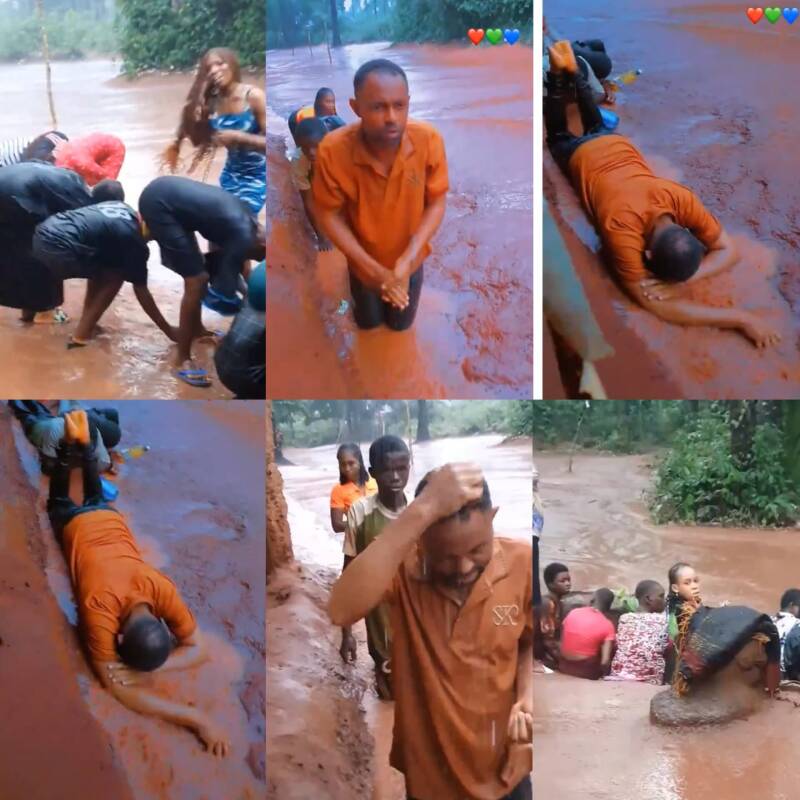
A disturbing video circulating widely on social media has ignited a firestorm of outrage and concern after capturing a group of worshippers engaging in an intense religious exercise under extremely harsh weather conditions. The footage, which appears to have been recorded during a heavy downpour, shows dozens of men and women, some barefoot and visibly drenched, standing in pools of muddy water that resembled erosion gullies or flooded roads, as they prayed fervently and engaged in acts of devotion. The video, whose exact location and date have not been independently verified, has drawn millions of views and thousands of comments, with many questioning the sanity, safety, and theological basis of such practices.
The clip, which has been shared across Facebook, WhatsApp and X (formerly Twitter), opens with a chaotic scene: rain pouring down relentlessly, worshippers kneeling or lying prostrate on soaked ground, and some appearing to struggle to keep their balance in what looks like fast‑moving runoff water. In the background, voices can be heard crying out for divine intervention, while a leader, apparently a pastor or prophet, commands the heavens to “open.” At several points, individuals are seen plunging their hands into the muddy water, splashing it on their faces, and even immersing themselves partially. One woman is helped to her feet after slipping in the mud, raising immediate concerns about injuries or exposure.
The video has elicited sharply divided reactions. Some commenters defended the actions as a demonstration of raw, undiluted faith. “When you desperately need a miracle, you don’t care about the weather,” one user wrote. “God honoured their sacrifice.” Another added, “This is what it means to worship in spirit and in truth. No comfort, no air‑conditioned church.” However, the overwhelming majority of reactions have been critical, with many accusing religious leaders of exploiting vulnerable followers and endangering their lives. The rhetorical question that topped many comments was captured in a now‑viral post: “Must they swim inside erosion for God to answer their prayers?” Others asked, “If the water carries them away, will the pastor raise them from the dead?”
The incident has also drawn sharp condemnation from human rights activists and medical professionals. Dr. Yetunde Bamidele, a public health physician in Lagos, warned that prolonged exposure to rain and stagnant water could lead to hypothermia, respiratory infections, and water‑borne diseases. “Prayer is essential, but so is common sense. This is not faith; it is reckless endangerment,” she said. Similarly, the Nigerian Meteorological Agency (NiMet) had earlier issued warnings of flash floods and advised citizens to avoid low‑lying areas during heavy rains, a message that was clearly ignored by the participants.
The video also highlights a troubling trend in parts of Nigeria where extreme Pentecostal practices – including mountain prayer sessions at odd hours, fasting to the point of collapse, and even walking on fire or drinking‑poison‑to‑prove‑faith – have become commonplace. In 2024, a similar video showed worshippers lying on a busy highway during a thunderstorm, claiming that God would protect them from vehicles. No accident occurred, but the incident led to a police inquiry and a pastor’s arrest. In 2025, three members of a prayer group drowned in a river in Delta State during a “spiritual bath” session.
Religious leaders across denominations have weighed in on the controversy. Bishop Stephen Adebayo of the Anglican Communion described the practice as “misguided and unbiblical.” He said, “The God who answers prayer does not require anyone to endanger their life or the lives of others. This is not faith; it is fanaticism.” On the other hand, a popular Pentecostal pastor who asked not to be named argued that “extreme situations require extreme prayers,” but he stopped short of endorsing the dangerous elements of the video.
Meanwhile, the police in the state where the video was allegedly recorded – thought to be either Ogun, Oyo or Lagos State – have not yet issued a statement. A police source told our reporter that the command was trying to ascertain the location and date of the event to determine if any laws were broken, particularly reckless endangerment or obstruction of public highways. Civil liberties organisations have called on the National Orientation Agency (NOA) to launch a public enlightenment campaign to educate citizens on the difference between sincere faith and hazardous extremism.
The video has also sparked conversations on social media governance, with many users demanding that platforms take down content that promotes dangerous activities. However, others argued that removal would amount to censorship. The platform where the video first appeared has not removed it, but has attached a content warning label.
As the debate rages, the identities of the worshippers and their leader remain unknown. No church or ministry has come forward to claim responsibility. What is clear, however, is that the video has opened a painful conversation about the lengths to which desperate people will go for a miracle – and the responsibility of religious leaders to protect, not exploit, the faith of their followers.
In the words of one viral comment that captured the mood of many: “Faith should not require a doctor’s visit afterward. Let them build a church with a roof. God is not afraid of architecture.” Until sanity prevails, the image of worshippers “swimming in erosion” will remain a chilling symbol of religion gone awry.
📩 Stone Reporters News | 🌍 stonereportersnews.com
✉️ info@stonereportersnews.com | 📘 Facebook: Stone Reporters News | 🐦 X (Twitter): @StoneReportNew | 📸 Instagram: @stonereportersnews
Add comment
Comments