

Reported by: Ijeoma G | Edited by: Oravbiere Osayomore Promise.
The Federal Government has incurred a total expenditure of N604,825,797.09 on the rehabilitation of repentant terrorists under the Operation Safe Corridor initiative, according to new expenditure data sourced from Govspend, a civic accountability platform. The funds, which cover the construction of dormitories, consultancy services, and statutory tax payments, have reignited a fierce debate over the government’s non‑kinetic counterterrorism approach, with critics arguing that prioritising the reintegration of former insurgents over justice for victims amounts to a “betrayal of justice”.
The expenditure details reveal a series of payments made between 2022 and 2024 for rehabilitation infrastructure. A consultancy contract worth N47,436,922.88 was awarded to ENCLEF PROJECT & CONSULTANTS LTD on December 27, 2022, for overseeing and preparing a bill of quantities for the rehabilitation of facilities at the Kirikiri Medium Security Custodial Centre. In the North‑East, EL‑HABY CONCEPT LTD received N41,728,606.10 on December 20, 2024, for additional construction work on a dormitory for repentant terrorists in Mallam Sidi, Gombe State.
The largest recipient, FOSAB GLOBAL ENERGY SERVICE LTD, managed multiple contracts for dormitory construction under Operation Safe Corridor. On March 27, 2023, the company received N303,799,847.88 as an additional 40 percent payment for construction work at the deradicalisation and registration camp. On the same day, the government paid N23,984,198.52 as 7.5 percent VAT and N15,989,465.68 as a 5 percent withholding tax to the Federal Inland Revenue Service. A further payment of N151,899,923.93 was made to FOSAB on May 3, 2024, alongside VAT of N11,992,099.26 and withholding tax of N7,994,732.84.
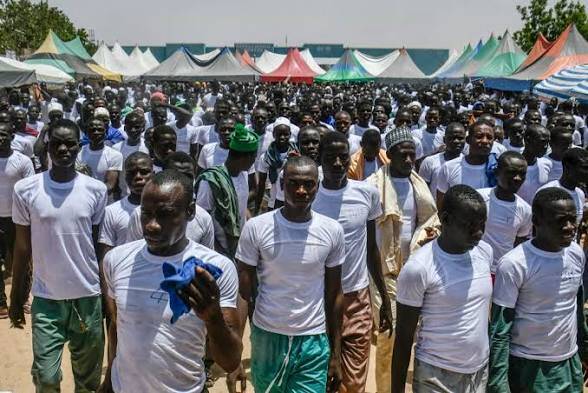
The rehabilitation programme has so far processed 744 former insurgents and victims of violent extremism, including eight foreign nationals from Burkina Faso, Cameroon, Chad, and Niger Republic. Borno State accounts for the highest number of beneficiaries at 597, followed by Yobe with 58, Kano with 15, Bauchi with 12, and Adamawa with 10. Of the total, 733 are Muslims and 11 are Christians. During a graduation ceremony in Gombe State, the Chief of Defence Staff, General Olufemi Oluyede, defended the programme as a long‑term strategy to reduce violence and curb the spread of extremist ideologies. “Operation Safe Corridor is a strategic intervention designed to reduce violence and curb the spread of extremist beliefs,” he said, adding that rehabilitation is not an act of leniency but a necessary security measure.
The programme’s coordinator, Brigadier‑General Yusuf Ali, stated that participants undergo a structured transformation process, including vocational training, psychosocial support, and religious reorientation. He argued that many individuals were forced into insurgency. Gombe State Governor Inuwa Yahaya encouraged beneficiaries to view reintegration as a “new beginning”, describing the programme as part of Nigeria’s comprehensive security response.
However, the financial and policy decisions have drawn sharp political criticism. Bolaji Abdullahi, spokesperson for the African Democratic Congress (ADC), posted on X: “Terrorism is not a family dispute. Responding to such a threat with language that diminishes its significance, and policies that seem to prioritise rehabilitation over accountability, is not compassion; it is weakness.” He added that what Nigerians are witnessing is “confusion masquerading as policy”.
Dr. Omenazu Jackson, Chancellor of the International Society for Social Justice and Human Rights (ISSJHR), condemned the reintegration policy as “a serious betrayal of justice” and “a dangerous precedent”. He argued that rehabilitation without justice amounts to impunity, and that the government should suspend the programme until clear justice mechanisms are established, terrorism perpetrators are prosecuted, and a comprehensive compensation framework is developed for victims. “A nation that fails to deliver justice for victims risks normalising injustice,” he said.
The controversy comes amid earlier reports from the National Counter Terrorism Centre that over 5,000 repentant Boko Haram fighters have been reintegrated into society, with officials claiming that none have returned to insurgency within six months of their release. Yet, concerns over accountability, monitoring systems, and the long‑term financial implications of Nigeria’s peace‑through‑reintegration strategy remain. As rehabilitation programmes expand and funding increases, the debate over whether the state is prioritising the reintegration of its enemies over the healing of its victims is far from settled.
📩 Stone Reporters News | 🌍 stonereportersnews.com
✉️ info@stonereportersnews.com | 📘 Facebook: Stone Reporters News | 🐦 X (Twitter): @StoneReportNew | 📸 Instagram: @stonereportersnews
Add comment
Comments