

Reported by: Ijeoma G | Edited by: Oravbiere Osayomore Promise.
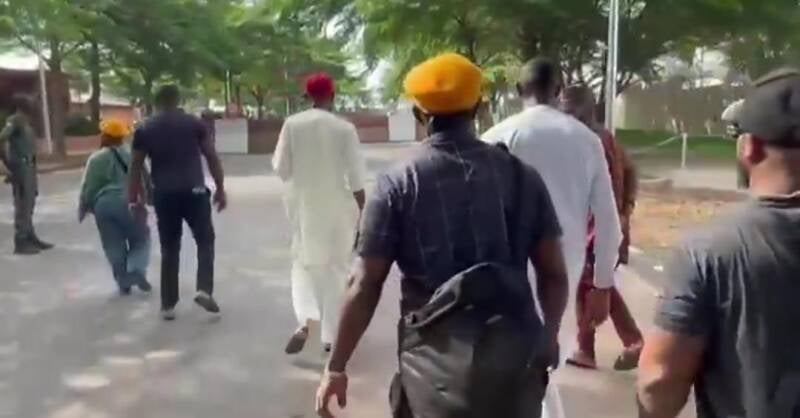
More than a hundred protesters, including members of the African Action Congress (AAC), gathered outside the South African High Commission in Abuja on Thursday, 30 April 2026, to denounce the continued xenophobic attacks, harassment, and extrajudicial killings of Nigerians and other African immigrants in South Africa. They carried placards and chanted slogans, recalling how Nigerians had sheltered anti‑apartheid fighters during the darkest days of white minority rule. One protester told the crowd, “When Nelson Mandela was running for his life, he ran to Nigeria for safety.” The demonstrators accused South Africans of betraying their historic debt to the continent and threatened a far larger and more intense protest if the killings persisted.
The immediate trigger for the demonstration was the recent deaths of at least two Nigerian citizens in separate incidents linked to anti‑foreigner violence. The Nigerian Consulate General in Johannesburg confirmed that Amaramiro Emmanuel, 42, and Ekpenyong Andrew, 37, lost their lives during a fresh wave of xenophobic attacks that began in mid‑April. According to the consulate, Emmanuel died from injuries he allegedly sustained during a brutal assault by personnel of the South African National Defence Force (SANDF) on 20 April in Port Elizabeth. Andrew was arrested on 19 April in the Booysens area of Pretoria following an altercation with Tshwane Metro Police; his body was later found at the Pretoria Central Mortuary under circumstances that his family and community leaders have described as highly suspicious. The Nigerian Union South Africa (NUSA) has said that Andrew’s death was the result of a beating by law enforcement officers, while Emmanuel’s case is being treated as a lethal assault by uniformed military personnel.
Consul‑General Ninikanwa Okey‑Uche has formally demanded a thorough, transparent and impartial investigation by the South African authorities, and she has called on the Independent Police Investigative Directorate (IPID) to expedite its inquiries. In a statement, she warned against the growing tendency to stereotype and profile Nigerians as criminals, stressing that such narratives pose serious risks to innocent citizens living in South Africa. “No one should take laws into their own hands under any circumstances,” she said, adding that the consulate is engaging with Pretoria and closely monitoring the situation. Okey‑Uche also urged Nigerians in South Africa to remain calm and law‑abiding while investigations proceed.
The protest in Abuja came just days after President Cyril Ramaphosa, speaking at the 2026 Freedom Day national commemoration in Bloemfontein, acknowledged that corruption in the immigration system needed to be rooted out. He also condemned the recent xenophobic attacks and warned that his government would not allow vigilantes to take the law into their own hands. “We are clamping down on illegal migration and on businesses that flout the law by hiring undocumented persons at the expense of our citizens,” Ramaphosa said. Yet, despite his words, grassroots movements and vigilante groups are pushing ahead with a nationwide shutdown planned for 4 May under the slogan “Send the foreigners home”. The organisers have called for a total disruption of the economy and the removal of all foreign nationals, regardless of their legal status.
A week before the Abuja protest, Ghana’s Foreign Minister, Samuel Okudzeto Ablakwa, had summoned South Africa’s Acting High Commissioner in Accra over the same wave of anti‑foreigner violence. Ablakwa reminded Pretoria that Ghana had issued passports to stateless South African freedom fighters during the apartheid era and demanded that the safety of Ghanaian nationals be guaranteed. The diplomatic pressure from both Nigeria and Ghana reflects a wider sense of betrayal among West African nations that once served as the rear base for the liberation movements of southern Africa.
The AAC, whose members were prominent at the Abuja protest, has long campaigned against economic exploitation and human rights abuses. At the demonstration, one protester attacked the presence of South African businesses in Nigeria. “South Africa has MTN that is extorting our people trillions on a daily basis. South Africa has DStv, extorting our people, yet we never attacked them,” he said. The same speaker noted that the majority owner of MTN is not even a South African citizen, but the brand remains tied to the country, and Nigerians had nevertheless never retaliated against those companies. The crowd warned that the 30 April action was only a “warning shot” and that a more massive confrontation would follow if the killings do not stop.
When the South African High Commissioner eventually appeared at the gate, she declined to address the crowd directly. She asked the protesters to submit a written petition instead. “I don’t know whether you people are armed,” she said. One of the protest leaders who volunteered to meet her inside the premises replied, “Unlike South Africans killing our people, we are not armed.” The petition was handed over, but the High Commissioner offered no verbal assurance. The refusal to engage face‑to‑face further inflamed the protesters, who vowed to return in larger numbers if the attacks on African immigrants continue.
The violence in South Africa has already spread beyond the initial incidents. In the townships of Gauteng and KwaZulu‑Natal, vigilante groups have torched foreign‑owned shops, blocked access to schools and hospitals, and even attacked the home of a Nigerian traditional leader in the Eastern Cape. The planned 4 May shutdown is expected to test the capacity of the South African state to protect both its citizens and foreign residents. Ramaphosa has repeatedly said that “no one has the right to take the law into their own hands”, but many observers fear that the violence could spiral out of control before his words are translated into action.
For Nigerians, both at home and in the diaspora, the protests at the High Commission in Abuja have become a rallying point. The memory of Nelson Mandela seeking refuge in Nigeria during the struggle against apartheid is still fresh. The sense of betrayal that South Africans are now turning on the very people who once sheltered their leaders was on full display in Abuja. The protesters made it clear that they will not remain silent. The only question is whether Pretoria will hear their message before a far more destructive confrontation erupts.
📩 Stone Reporters News | 🌍 stonereportersnews.com
✉️ info@stonereportersnews.com | 📘 Facebook: Stone Reporters News | 🐦 X (Twitter): @StoneReportNew | 📸 Instagram: @stonereportersnews
Add comment
Comments